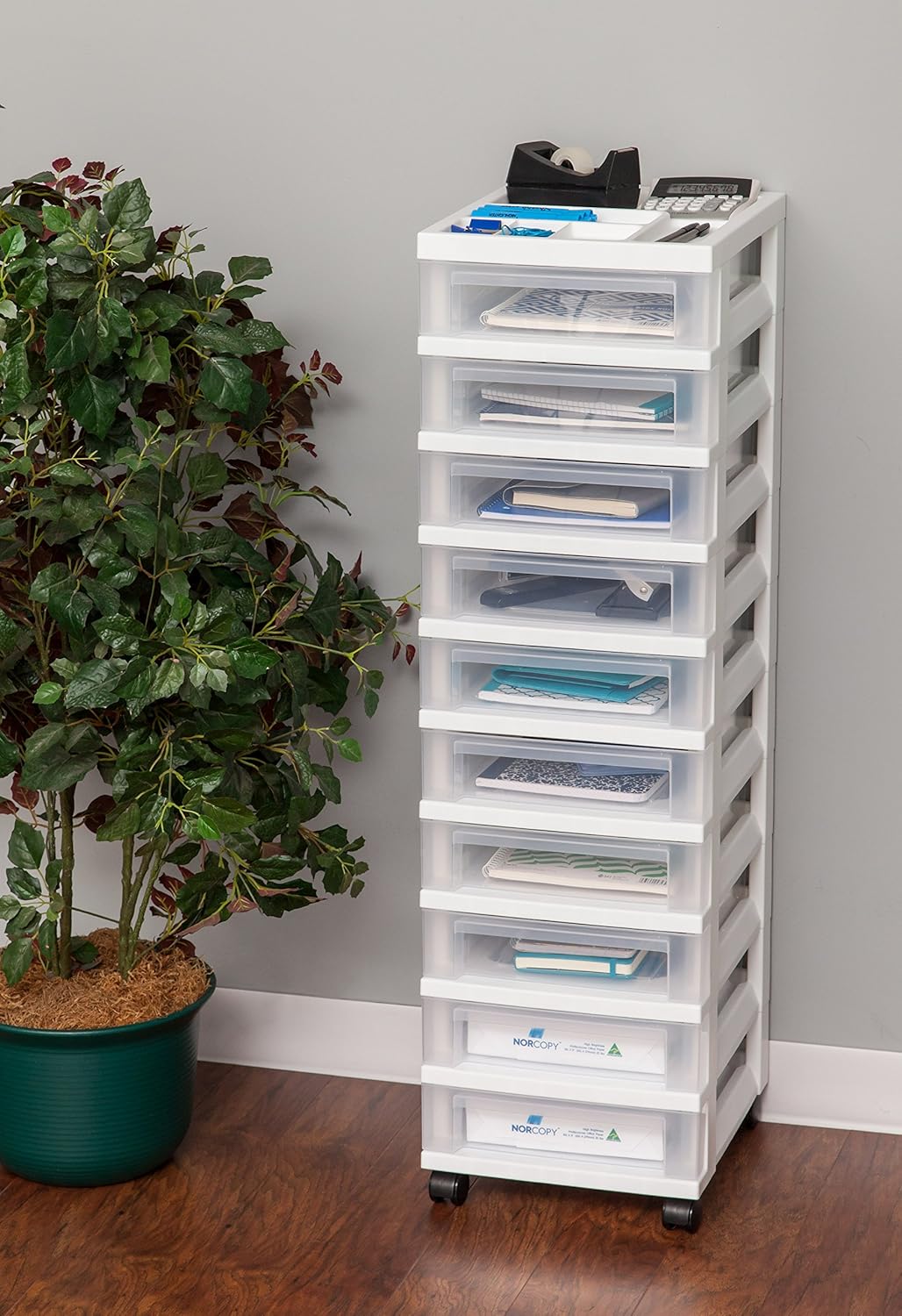
If you’ve ever watched a classroom art cart slowly disintegrate across a school year — drawers that sag by November, casters (the rolling wheels at the base) that lock up by March, laminate surfaces peeling off by June — you already know the problem this article addresses. An art supply cart is a mobile storage unit, usually on four swivel wheels, that lets a teacher wheel supplies to different stations in the room or between classrooms. In a K–12 art room, it’s one of the hardest-working pieces of furniture in the building: loaded with heavy paint bottles, clay tools, and marker sets, rolled across uneven floors, grabbed by students, and rarely handled gently. The difference between a cart that survives the school year and one that doesn’t comes down almost entirely to three things: how the drawers are built, what the cart’s frame is made of, and whether the casters are rated for classroom loads. This guide walks you through each of those decision points, names the brands and configurations worth your budget, and ends with a clear decision framework so you can stop second-guessing the spec sheet.
| EDITOR'S PICKMEEDEN Art Supply Storage Cart | Mid-tierIRIS USA Plastic Drawer Storage… | Budget pickIRIS USA Plastic Drawer Storage… | |
|---|---|---|---|
| Storage type | 3 drawers | 7 drawers | 10 drawers |
| Wheels | 4 wheels | ✓ | ✓ |
| Material | Solid beech wood | Plastic | Plastic |
| Tier count | 5 tier | 7 drawers | 10 drawers |
| Color | Cherry walnut | Black/pearl black | White/clear |
| Price | $336.57 | $76.99 | $67.99 |
| See on Amazon → | See on Amazon → | See on Amazon → |
Why Drawer Construction Is the Real Failure Point
Most buyers focus on the wrong spec. They look at the cart’s overall weight capacity and assume that if the number is big enough, the cart will hold up. But in practice, the drawer system is where carts fail first — and the failure mode is almost always the same: the drawer slides (the metal or plastic rails that let a drawer open and close smoothly) either bend under repeated load or strip out of their mounting points in the sidewall.
There are three common drawer slide types you’ll encounter in the $40–$180 range that dominates school budgets:
Epoxy-coated wire slides are the most common on budget carts. They look clean, they’re lightweight, and they work fine for light paper storage. Under a load of art supplies — especially clay, paint bottles, or large scissors — they deflect (bow downward) and begin to drag within a few months. Per aggregated reviews of wire-frame and folding carts in the Origami Rack product line, owners consistently report that the wire drawer bottoms flex noticeably once loaded beyond roughly 8–10 lbs per drawer, which is easy to exceed with a full set of acrylic paints.
Steel ball-bearing slides are the benchmark for classroom durability. These are the same mechanism used in filing cabinets and kitchen drawers. They operate on a set of recirculating ball bearings that keep the drawer moving smoothly under load and maintain their alignment over thousands of open-and-close cycles. Flash Furniture’s classroom storage line uses full-extension ball-bearing slides on several of its mid-range models, and owners report significantly better longevity than wire-basket alternatives. Full-extension means the drawer pulls all the way out so students can see everything inside — important for supply access without digging.
Plastic roller slides sit in between. They’re more stable than wire, cheaper than steel ball-bearing, and they show up on many mid-priced carts in the $80–$130 range. The honest assessment: they’re adequate for lighter art supplies (markers, colored pencils, glue sticks) but tend to crack under the lateral stress of students pulling drawers at angles, which happens constantly in a busy classroom.
The Weight-Per-Drawer Calculation You Should Do Before Buying
Here’s a quick sanity check before you commit to any cart:
By the numbers:
- A set of 24 acrylic paint bottles (2 oz each): ~6 lbs
- A full set of 30 pairs of student scissors: ~7.5 lbs
- 10 rolls of masking tape + a glue gun + supplies: ~5 lbs
- Clay tools + 6 blocks of air-dry clay: ~12 lbs
If your heaviest drawer load is going to run 10–12 lbs, you need slides rated for at least 75 lbs per pair (manufacturer-rated, not your estimate) to maintain a comfortable safety margin and preserve longevity. Budget carts with plastic or wire slides are typically rated at 25–40 lbs per drawer. Steel ball-bearing slides on mid-range carts start at 75 lbs and go up from there.
School Specialty’s classroom supply storage buyer reference recommends always checking whether a cart’s stated weight capacity refers to the full cart or per drawer — those are very different numbers and the spec sheets don’t always make it obvious.
Frame and Surface Materials: What “Durable” Actually Means at This Price Tier
In the $40–$180 range, you’re choosing between four primary frame materials: wire/steel mesh, MDF (medium-density fiberboard — a pressed wood composite), melamine-laminated particleboard, and powder-coated steel. Each has a different failure mode.
Wire and steel mesh (Origami Rack, some Offex models): Lightweight and easy to reassemble, but the open-frame design means small supplies fall through, and the connection points — usually plastic snap fittings or thin metal clips — are the first thing to crack when the cart is bumped or overloaded. Per Offex product specification sheets, their wire-frame utility carts are rated for classroom use but are best suited to lighter supply categories. The honest trade-off: easy to store flat over summer, but not your best option for heavy mixed-media supply loads.
MDF and melamine-laminated particleboard (dominant in the $80–$160 range): This is the material in most Flash Furniture and many Offex drawer carts. MDF machines cleanly and takes paint or laminate well, but it has two known weaknesses: it swells and delaminates if it gets consistently wet (not usually a classroom issue, but relevant if the cart lives near a sink), and the edges chip. The laminate surface on particleboard carts can peel at the corners within a year of heavy use, especially if students rest sharp tools on the edges. Look for PVC or ABS edge banding (the protective strip applied to exposed board edges) — carts with it last noticeably longer than those without.
Powder-coated steel (found in higher-end units closer to the $150–$180 ceiling): This is the most durable option available at this price tier. The steel frame won’t delaminate or swell, and powder coating (a dry paint finish baked onto metal) resists chips and scratches far better than standard spray paint. The trade-off is weight — a steel-frame cart is meaningfully heavier than a wood composite unit, which matters if one teacher is moving it between rooms repeatedly.
ANSI/BIFMA X5.5, the furniture durability standard published by the Business and Institutional Furniture Manufacturer’s Association, covers commercial furniture load and cycle testing. While these standards are most directly applied to office and institutional furniture, savvy buyers use BIFMA compliance as a proxy signal for build quality — if a manufacturer references BIFMA testing in their spec sheet, it’s a meaningful indicator that the unit has been evaluated against repeatable load benchmarks.
Casters: The Specification Most Buyers Skip
This is where budget carts consistently fail, and it’s the most preventable problem in classroom cart purchasing. A caster is the wheeled swivel fitting at each leg of the cart. There are two variables that matter most: caster diameter and the quality of the swivel housing.
Diameter: Larger casters (3–4 inches) roll more easily over uneven floors — thresholds, rubber matting, the small lip between tile and carpet — than smaller ones (1.5–2 inches). Budget carts frequently ship with 1.5–2 inch casters to cut cost. In practice, per aggregated owner reviews of Flash Furniture classroom carts, the most common complaint is that small casters catch on floor transitions and make the cart hard to steer when loaded. If you’re rolling a cart across multiple room types, 3-inch minimum is the practical standard.
Swivel housing quality: The swivel housing is the ball-bearing mechanism that lets the caster wheel in any direction. Cheap swivel housings use thin stamped-metal races that deform under side-load stress — exactly what happens when a student grabs the cart and pulls it sideways. Once the housing deforms, the caster no longer swivels cleanly and the cart becomes hard to steer. Higher-quality casters use forged or thicker-gauge stamped housings and carry multi-year warranties. When comparing carts, check whether the manufacturer lists a caster warranty separately from the overall product warranty — a 5-year caster warranty versus a 1-year caster warranty on otherwise similar carts is a legitimate tiebreaker.
Offex product specification sheets for their classroom utility series list swivel casters with a 1-year warranty as standard. Flash Furniture’s mid-range drawer cart casters are listed at 2-year coverage on commercial models. If you’re purchasing on a DonorsChoose grant — which per DonorsChoose.org eligibility guidelines covers classroom supplies and furniture — you’re often working with a one-time budget, which makes longevity specs more financially consequential than they might seem at the $120 price point.
Decision Framework: If X, Then Y
After walking through the failure modes, here’s a clear decision rule based on your actual classroom situation:
If your supply load per drawer will exceed 8 lbs and the cart moves daily: Specify steel ball-bearing, full-extension slides rated at 75 lbs minimum. This rules out most wire-frame and plastic-roller carts in the sub-$100 range. Budget for $130–$180 and look at Flash Furniture’s commercial classroom drawer series or powder-coated steel units.
If the cart stays in one room and holds lighter supplies (markers, pencils, paper): Wire-frame or MDF carts in the $50–$100 range are defensible. Origami Rack folding carts earn their price in this scenario — owners report the snap-together construction is genuinely easy to disassemble and store flat over summer breaks.
If you’re crossing floor types (tile to carpet, threshold transitions) repeatedly: Prioritize 3-inch casters above all else. A cart with mediocre slides and great casters will outlast a cart with great slides and small casters in a multi-room routing scenario.
If this is a grant-funded purchase (DonorsChoose, Title I supplemental funds, or similar): Run the total-cost-of-ownership comparison before accepting the lowest bid. A $120 cart that needs caster replacement at month 8 and drawer-slide repair at month 14 has a real-world cost well above the $160 cart that runs clean for three years. The math almost always favors the mid-range unit with steel slides and a longer caster warranty when you account for the time cost of sourcing replacements on a school budget.
If aesthetics matter for a visible makerspace or studio classroom: Melamine-laminated MDF in a clean white or birch finish (the standard Flash Furniture palette) reads as intentional and organized. Powder-coated steel in black or gray reads as utilitarian but durable. Neither is wrong — but the laminate finish shows scuffs more visibly over time, so lean toward steel if the cart will be in a high-traffic public-facing space.
The short version: drawer slides and casters determine longevity. Everything else — color, handle style, the number of drawers — is secondary. Buy the cart with the best slides and the biggest casters your budget allows, and you’ll still be using it when your next grant cycle opens.