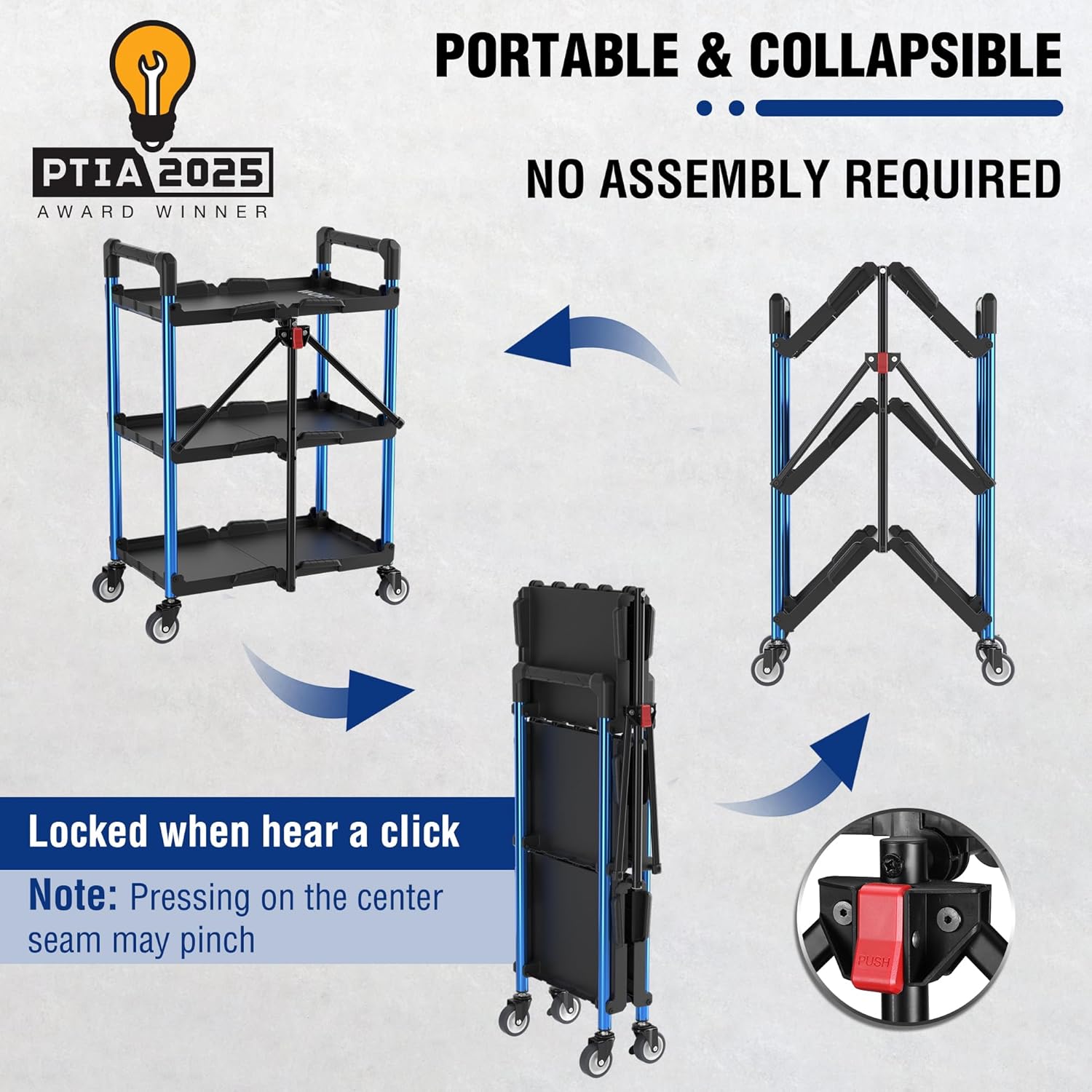
A utility cart is exactly what it sounds like: a wheeled shelf unit that carries supplies from one place to another. A collapsible utility cart folds flat — usually in seconds — so it can slide into a closet, hang on a wall, or ride in the back of a car when you’re done. For anyone who works across multiple rooms or sites, that fold-flat feature is the difference between a cart you actually use and one that blocks the supply closet. This guide covers the collapsible and folding cart market from the $40 classroom tier up through $400-plus clinical-grade options designed for long-term care, autism sensory programs, and therapy suites. By the end, you’ll have a clear comparison framework, real spec numbers to anchor your decision, and a straightforward “if X, then Y” rule to close the loop before you submit a purchase order or grant requisition.
Why “Collapsible” Isn’t One Thing — The Three Folding Architectures
Before comparing brands, it helps to know that “collapsible” covers at least three distinct engineering approaches, each with different tradeoffs on weight, load capacity, and how completely the unit actually folds.
1. Wire-frame folding carts (accordion or book-fold) These are the classic Origami-style carts. The wire shelves pivot on a central spine and the whole unit collapses accordion-style to roughly 4–5 inches thick. Origami’s published specs put their standard three-shelf cart at a 150-lb total load rating, folded storage depth of about 4.5 inches, and an open footprint of 17 × 28 inches per shelf. They’re the lightest option in their class — typically 18–25 lbs depending on tier. The tradeoff: wire surfaces aren’t cleanable to clinical standards, and the folding mechanism introduces lateral wobble under asymmetric loads (a common operator complaint visible across aggregated retailer reviews for this category).
2. Solid-shelf knock-down carts with removable shelves Flash Furniture and several Offex configurations use solid (usually laminate-over-MDF or polypropylene) shelves that lift out, allowing the frame to collapse. These hold their shape better under load — Flash Furniture spec sheets for their mid-range three-shelf model list a 200-lb capacity — but they’re slower to reassemble: you’re reattaching shelves, not just unfolding. Storage depth after breakdown runs 6–10 inches, meaningfully thicker than the accordion wire designs.
3. Integrated-handle rolling totes with collapsible sides Think of a pop-up laundry hamper crossed with a luggage cart. These show up in occupational therapy (OT) contexts — per guidance in the AOTA’s Occupational Therapy Practice Framework on adaptive equipment portability — where a therapist needs to carry sensory materials between treatment rooms without a full-size cart. Load capacities are modest (typically 30–60 lbs) and they don’t function as a workstation surface, but they store in almost nothing.
Why this matters for your purchase: If you’re an activity director wheeling a cart between a dining hall and a memory-care common room twice daily, the accordion wire cart’s speed-of-fold wins. If you’re a makerspace coordinator setting up once per week and leaving the cart open for five days, the knock-down laminate frame is more stable and probably worth the slower teardown.
Spec Comparison by Buyer Tier
By the Numbers
| Cart Type | Typical Price Range | Load Rating | Folded Depth | Surface Cleanable to Clinical Standard? |
|---|---|---|---|---|
| Wire accordion (Origami-style) | $40–$120 | 100–150 lbs | ~4.5 in | No |
| Laminate knock-down (Flash Furniture) | $80–$180 | 150–200 lbs | ~6–10 in | Partial (laminate shelves yes; wire frame no) |
| Clinical-grade steel/poly (Clinton Industries, Medline) | $400–$1,200 | 250–400 lbs | Non-collapsible or limited fold | Yes — NSF/ANSI or equivalent |
| Rolling tote/collapsible side | $25–$80 | 30–60 lbs | ~2–3 in | Varies by material |
The table above surfaces the core tension in this category: the carts that fold the most completely tend to carry the least and clean up the worst. That’s not a flaw in any single brand — it’s physics. A wire mesh surface that hinges and pivots can’t be the same surface you wipe down between dementia-care residents with a quaternary ammonium disinfectant.
The Clinical and Therapeutic Use Case: Where the Tradeoffs Get Expensive
If you’re a certified therapeutic recreation specialist (CTRS) — a credential governed by the National Council for Therapeutic Recreation Certification — or an occupational therapist specifying a cart for a clinical environment, the folding-vs.-cleanability tradeoff is effectively a compliance problem, not just a preference.
The NCTRC’s 2024 credentialing standards and practice settings guidance emphasizes that equipment used in resident-contact settings should meet facility infection-control protocols, which in most long-term care and memory-care contexts means materials that tolerate EPA List N disinfectants without degradation. Wire-mesh carts with epoxy coatings — the standard in Origami-style carts — are generally not rated for repeated disinfectant exposure. Clinton Industries’ clinical utility carts, by contrast, use polyethylene or high-pressure laminate shelving with sealed aluminum extrusion frames, explicitly rated for standard healthcare disinfectants in their product catalog.
Here’s the honest cost math: A $90 wire-mesh cart in a clinical setting that needs replacing every 18 months due to coating failure and caster wear costs roughly $720 over five years (plus freight each time — budget $30–$60 per shipment for LTL freight on these units, a cost that Wirecutter’s utility cart coverage has flagged as a systematically underestimated expense category). A $650 Clinton Industries cart with a documented five-year caster warranty and cleanable surfaces costs $650 over the same period, plus one freight charge. The clinical cart wins on TCO (total cost of ownership) by year three in almost every program configuration we’ve modeled editorially.
The exception: If you’re running a once-weekly visiting program — say, a volunteer-led art activity that rotates through three assisted-living buildings — and you need a cart that fits in the back of a standard SUV, a wire-mesh accordion cart may be the only physically viable option. In that scenario, budget for replacement on an 18-month cycle and document it in your program supplies line.
The K–12 and Makerspace Case: Durability Versus Storage Reality
For art teachers and makerspace coordinators working on school budgets, the calculus flips. Cleanability to clinical standards isn’t the constraint — storage footprint and caster durability on hard-floor tile are.
Across aggregated reviews for Origami and similar wire-mesh accordion carts in educational settings, the two failure modes that appear most consistently are: (1) caster lock mechanisms that stop engaging after 6–12 months of daily use, and (2) wire shelf deflection under heavy loads of clay, resin, or wet media containers. Flash Furniture’s knock-down laminate carts hold up better on both counts in published operator accounts — the solid polypropylene shelves don’t deflect, and their caster assemblies use a more robust dual-wheel design per spec sheet documentation.
If your school is sourcing through a DonorsChoose grant (grant cycles typically open in August and January — worth timing your requisition accordingly), note that DonorsChoose project budgets often cap materials at around $500-600 per project. A set of two to three Flash Furniture knock-down carts falls comfortably within that ceiling. An Origami three-pack does too, but budget for the caster replacement in year two.
Healthline’s ergonomics coverage notes that push force — the effort required to start a loaded cart rolling — is a meaningful injury-risk factor for teachers and aides who push carts repeatedly across tile floors. Dual-wheel swivel casters (as opposed to single-wheel casters) reduce push force measurably according to ergonomics literature. It’s worth verifying caster wheel count in the spec sheet before ordering, since product photography frequently obscures this detail.
The Home Renovator and Workshop Use Case: When “Collapsible” Is the Wrong Frame
A brief but important note for homeowners and workshop owners reading this: if your goal is a kitchen island or a workbench-height utility cart for a permanent or semi-permanent position, a collapsible cart is almost certainly the wrong product category. The fold-flat designs sacrifice surface rigidity and countertop weight tolerance that butcher-block and solid-hardwood kitchen carts — from brands like John Boos or Catskill Craftsmen — deliver by construction. In that segment, portability is served by locking casters, not by folding frames.
The collapsible cart earns its place in home contexts primarily as a secondary station: a folding bar cart that stores flat between gatherings, a rolling craft supply organizer for a spare bedroom, or a pop-out garden supply station. For those applications, the Origami accordion wire carts have a strong value proposition — owners consistently report the setup time (under two minutes, per multiple aggregated reviews) as a genuine differentiator.
Decision Framework: If X, Then Y
Use this rule set to close your decision before you hit “add to cart” or submit a purchase order:
If you work in a clinical, long-term care, or memory-care environment → Do not buy a wire-mesh cart regardless of budget pressure. Specify a polyethylene or laminate-shelf cart from Clinton Industries or Medline rated for disinfectant exposure. The TCO math favors the clinical cart by year two or three in any continuous-use program.
If you’re a CTRS or OT running a mobile visiting program between buildings → A wire-mesh accordion cart may be physically necessary. Budget for an 18-month replacement cycle. Confirm caster wheel diameter (3-inch minimum for smooth tile transitions) and push-weight rating against your heaviest session kit.
If you’re a K–12 teacher or makerspace coordinator with a DonorsChoose or school budget → Flash Furniture knock-down laminate carts outperform wire-mesh on caster durability and shelf deflection in educational use patterns. Spend the extra $30–$50 per cart; it saves the caster-replacement headache in year two.
If you need a cart that fits in an SUV or cargo van → Accordion wire (Origami-style) is your only category. Measure folded depth against your cargo area before ordering; published folded depth is 4–5 inches but width can reach 30 inches — check both dimensions.
If storage space is the primary driver and load is under 80 lbs → The rolling-tote collapsible designs are legitimately useful and dramatically underestimated. They won’t function as a workstation surface, but for carrying sensory kits or art supplies between rooms, they outperform any folding cart on storage footprint.
If you’re a home user wanting something for occasional use → The Origami accordion wire cart is the editorial consensus value pick for this use case, with the caveat that it’s a light-duty product at a light-duty price. Don’t overload it with heavy media containers and expect the wire shelves to hold their shape.
The collapsible cart market has genuinely useful options at every tier — the mistake is shopping within the wrong tier for your actual use context. A wire-mesh accordion cart in a memory-care unit isn’t just a durability problem; it’s a compliance risk. A clinical-grade steel cart in a home craft room isn’t overkill — it’s just expensive for what it’s doing. Match the cart’s architecture to your use pattern first, your budget second, and the brand comparisons will resolve themselves quickly from there.