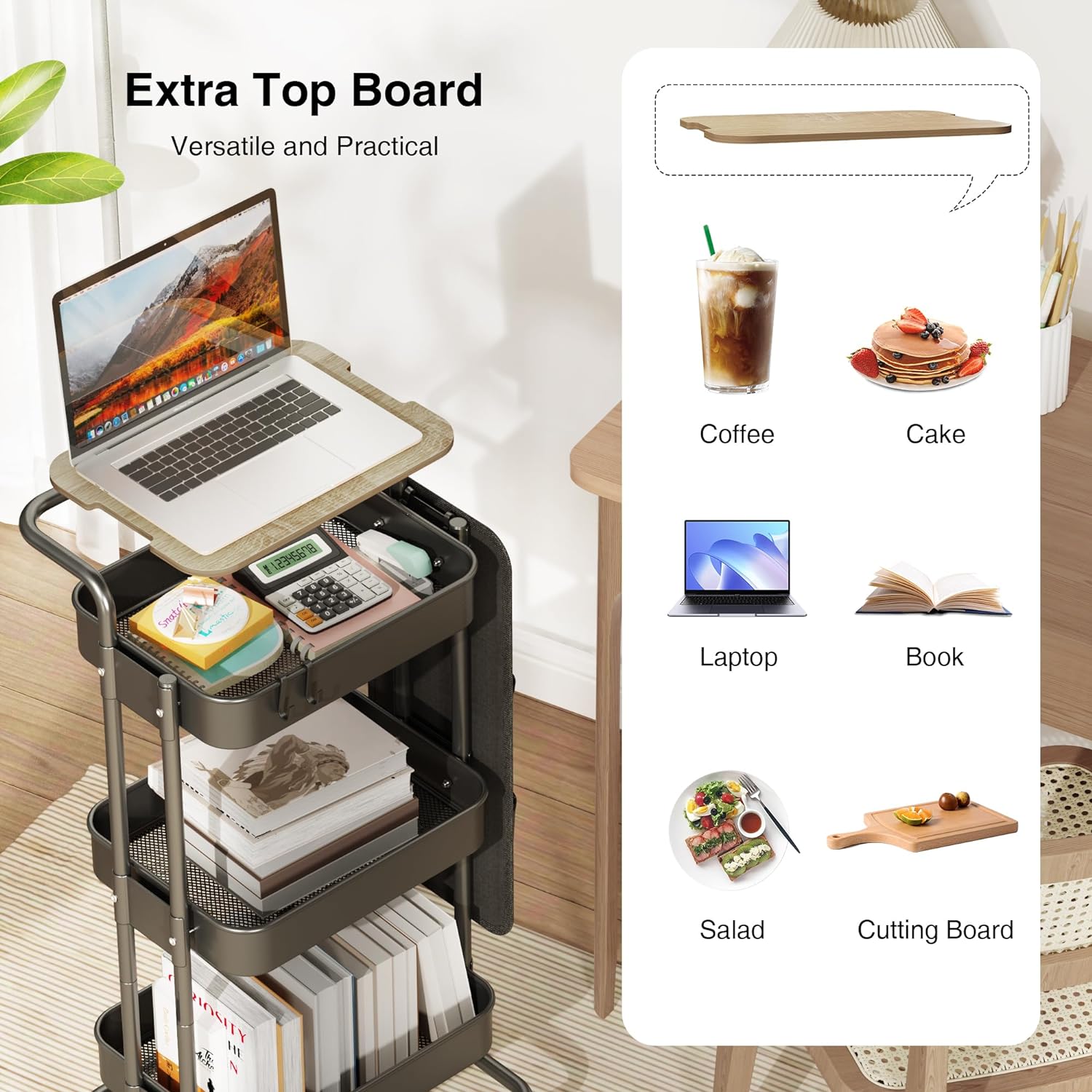
If you’ve recently bought a rolling craft cart — a wheeled storage unit designed to hold art supplies, tools, or hobby materials — you’ve probably noticed a familiar gap within a few weeks: the cart holds a lot, but it doesn’t hold everything the way you’d imagined. The drawers are great, the shelves work, but where do the scissors hang? Where does the power go for the Cricut cutting machine (a computer-controlled blade tool for cutting vinyl and paper)? How do you stop the paint jars from rolling off the wire shelf mid-transit? This isn’t a design failure; it’s a nearly universal experience. Across dozens of owner reviews aggregated for this guide, the same four or five accessories come up again and again, unprompted, as things buyers added almost immediately. This article maps those modifications, names the tradeoffs between approaches, and gives you a clear decision rule so you’re not improvising with zip ties.
| EDITOR'S PICKMEEDEN Art Cart Storage Organiz… | Mid-tierSunnyPoint 3-Tier Delicate Comp… | Budget pickPipishell 3 Tier Rolling Cart | |
|---|---|---|---|
| Material | Beechwood | Metal | Metal |
| Handle | — | — | ✓ |
| Dimensions | — | 15.35" x 10.24" x 26.8"H | — |
| Color | — | Army | White |
| Price | $132.95 | $43.99 | $26.99 |
| See on Amazon → | See on Amazon → | See on Amazon → |
Why Owners Modify Their Carts (And What the Pattern Tells You)
The short answer: manufacturers optimize for the median use case. If you’re using your cart for a specific workflow — a vinyl-cutting station, a watercolor setup, a sensory activity station, a photography corner — you’re not the median user.
Reviewers of the DTK rolling cart (a steel-frame utility cart in the $60–$120 range) spontaneously describe adding a USB power hub and a power strip and calling the resulting setup a “photography station.” That phrasing is notable: the cart didn’t change, but the accessories created a new functional category. MEEDEN taboret (a tall, narrow artist’s cart with tiered shelves, typically $90–$180) owners describe adding magnetic knife strips with hanging hooks to double effective vertical storage. YASONIC mesh-shelf cart owners add hanging magazine racks for overflow storage. The pattern across all of these is the same: the cart provides the structural chassis; the accessories define the workflow.
This matters for your purchasing sequence. If you know you’ll need powered tools at the cart, that changes which cart you buy (more on clearance and cord routing below). If you know you’ll need vertical hanging storage, a cart with a flat vertical panel is worth more than one without it, regardless of drawer count.
The Four Accessory Categories Worth Buying First
1. Power: Strips, USB Hubs, and Cord Management
Power is the modification with the highest consequence if you get it wrong, and the highest payoff if you get it right.
The basic setup: A power strip — a surge-protected multi-outlet bar — zip-tied or clamped to the cart’s frame, with the cord routed along a vertical strut to a wall outlet. This works, and it’s what most owners do first.
The better setup: A surge-protected power strip rated for at least 1,875W (15A × 125V, standard U.S. household circuit capacity) with a USB-A/USB-C combo bar mounted beside it. The DTK cart owners who describe building “photography stations” are running LED ring lights, laptop chargers, and phone charging simultaneously — that’s why they specify the USB hub as a separate component rather than relying on USB ports built into the power strip, which are often limited to 5W total shared output.
The tradeoff you need to name: Zip-tying a power strip to a cart frame is not a permanent or code-compliant installation. In a home studio or makerspace, that’s fine. In a school, clinic, or licensed care facility, it may not be. Apartment Therapy’s craft room organization coverage notes that in shared or institutional spaces, buyers should confirm with their facility manager whether mounted power accessories require conduit or a dedicated outlet. If you’re outfitting a school art cart for a K–12 classroom, check with your district’s facilities office before assuming a zip-tied strip is compliant — some districts prohibit extension cords on wheeled equipment entirely.
Can you damage a metal cart by adding a power strip? Owners consistently report no structural issues, but the risk is cord damage from pinch points. Route the cord away from caster pivot points and shelf edges. Use spiral cable wrap (available in hardware stores for under $5) to protect any cord length that contacts the frame.
2. Magnetic Strips: Vertical Real Estate That Most Carts Leave Empty
A magnetic strip — the same form factor as a kitchen knife rail — is one of the highest ROI accessories for any cart with a flat steel or powder-coated panel. MEEDEN taboret owners describe adding a magnetic strip with S-hook hangers to the side panel as the single modification that most increased usable capacity. Scissors, palette knives, and rulers hang within arm’s reach without consuming drawer space.
Compatibility check: This only works on ferromagnetic steel panels. Aluminum-frame carts, plastic-body carts, and wood taborets will not hold a magnet. To test your cart before buying a strip: hold a refrigerator magnet against the panel. If it sticks firmly, a magnetic strip will work. If it slides or doesn’t stick, you’re in the non-magnetic category (see adhesive hooks below).
By the numbers:
- A standard 12-inch magnetic knife rail holds 6–10 tools depending on width
- Neodymium-backed magnetic hooks (rated 10–15 lbs each) cost roughly $8–$15 for a set of 6
- Side-panel magnetic strips on a MEEDEN taboret add approximately 8–12 hanging positions per side
- Total added capacity cost: $15–$30 vs. buying a larger cart tier
For wood taborets (like upper-tier MEEDEN models): Wood Magazine’s studio cart coverage notes that magnetic strips can be surface-mounted to a wood panel using countersunk screws into the side rail — effective if you’re comfortable with a drill. The alternative is a self-adhesive strip rated for wood, though owners report adhesive strips on painted or finished wood surfaces eventually delaminate under the weight of steel tools.
3. Hooks: Adhesive, Over-Shelf, and S-Hook Variants
Not every cart has a magnetic panel, and not every accessory is steel. For mesh-shelf carts (wire grid shelves on a rolling frame — the YASONIC style), S-hooks are the native attachment method: you loop them directly through the wire grid to create hanging points for bags, cups, or small tools. YASONIC owners describe adding hanging magazine racks this way to create a dedicated overflow zone for flat stock like cardstock sheets, vinyl rolls, or foam sheets.
For non-magnetic, non-mesh carts (plastic-body rolling carts like the GOFLAME 15-drawer line), the options narrow to adhesive hooks rated for the surface weight, or over-shelf clips that grip a shelf edge. Owners of the GOFLAME 15-drawer cart specifically flag the lack of designated label spots as a gap — a related problem, solved by the same adhesive surface that works for hooks: adhesive label holders (the kind used in warehouse shelving) stick to the drawer front and give you a write-in or insert label without damaging the plastic.
4. Surface Protection and Functional Overlays
One of the most useful product evolution signals in owner reviews: a MEEDEN taboret owner describes placing a sheet of tempered glass on top of the cart for paint mixing (using the glass as a palette surface), and notes that MEEDEN subsequently released an updated model with a glass shelf built in. That’s a manufacturer responding to a documented owner behavior — worth knowing if you’re deciding between model generations.
Glass on wood — the safety question: A sheet of tempered glass (the kind sold as a desk pad or cut-to-size at hardware stores, typically 3/16-inch thick) is safe on a wood taboret top for paint mixing under normal studio use. Wood Magazine’s studio cart coverage distinguishes between tempered glass (heat-treated, fractures into small cubes if broken) and annealed glass (standard, fractures into sharp shards) — for a cart surface that may get bumped or dropped, tempered is the correct specification. Owners report that a non-slip silicone mat under the glass prevents lateral shifting on the wood surface.
For plastic-shelf carts, a glass overlay is less advisable: the shelf deflection under a glass sheet’s weight (a 12×18-inch piece of 3/16-inch tempered glass weighs roughly 3–4 lbs) can stress-crack injection-molded shelves over time, especially at the edge supports.
Stopping Items From Sliding on Wire Shelves
Open wire shelves are a ventilation and visibility win — you can see what’s on the shelf from below, and liquids drain rather than pool. But everything slides. The standard fix is a shelf liner cut to fit: a non-slip rubberized mesh mat (sold in hardware and dollar stores, roughly $4 per linear foot in 12-inch width) lays directly on the wire grid and stops jars, bottles, and small containers from migrating. This Old House’s workshop storage coverage consistently recommends rubberized shelf liner as the single highest-value accessory for any wire-shelf system, noting that adhesive-backed liners are harder to clean and should be avoided in food or art-material contexts where spills are likely.
For carts in motion — specifically for transport between rooms or stations — a bungee cord threaded through the wire shelf edges at the front acts as a lip guard. It’s not elegant, but owners of mesh-shelf carts in active classroom or therapy settings consistently describe it as reliable enough for daily transit.
Frequently Asked Questions
Can I add a power strip to a standard metal rolling cart without damaging it? Yes, consistently reported as structurally safe by owners. The risk is cord damage from pinch points at casters or shelf edges, not frame damage. Use cable wrap on any cord segment that contacts the frame, and confirm institutional compliance if the cart is in a licensed facility.
Which rolling carts are compatible with magnetic accessory strips? Any cart with a ferromagnetic (iron-based) steel panel. Test with a refrigerator magnet before buying. Most powder-coated steel utility carts (DTK, Seville Classics, Origami) are compatible. Aluminum, plastic, and wood surfaces are not.
What is the best way to label drawers on plastic rolling carts? Adhesive label holders — the insert-style holders used in warehouse shelving — adhere to plastic drawer fronts without permanent marking. Owners of the GOFLAME 15-drawer cart specifically flag this gap; warehouse-style label holders (3M and Avery both make them) are the standard fix.
Is a glass sheet on top of a wood taboret safe for paint mixing? Tempered glass, yes. Annealed (standard) glass, no — wrong fracture pattern for a work surface. Specify tempered, 3/16-inch minimum, cut to the taboret top dimensions. Use a silicone mat underneath to prevent sliding.
What aftermarket hanging cups or hooks fit the YASONIC and similar mesh-shelf carts? Standard S-hooks sized for the wire diameter (typically 3mm–4mm wire on budget mesh carts) are the universal fit. Owners describe threading S-hooks through the grid for cups, tool holders, and magazine racks. Measure your cart’s wire diameter before ordering — S-hooks come in 2mm, 3mm, and 4mm throat sizes.
How do I stop items from sliding off open wire shelves on a moving cart? Non-slip rubberized mesh shelf liner, cut to fit, handles stationary and slow-transit situations. For active daily transport between rooms, a bungee cord threaded through the front wire edge as a lip guard is the owner-reported standard. Both solutions together cost under $10 total.
The Decision Rule
If your primary need is power at the cart: buy the cart with the best frame clearance for cord routing first, then add a 15A surge strip and a USB-A/USB-C hub as your first accessories. Budget $25–$45 for both.
If your primary need is vertical tool storage: confirm your cart has a ferromagnetic steel panel before purchase. If it does, a magnetic strip and a set of neodymium hooks ($15–$30 total) will likely double your accessible tool count without adding a square inch of floor space.
If your cart is wood or aluminum and you need hanging storage: over-shelf S-hooks on mesh shelves, or adhesive rail systems on flat panels, are your path — plan for $20–$35 and expect to re-evaluate adhesive attachment after 6–12 months of use.
And if you’re looking at a MEEDEN taboret and wondering whether to buy the base model and add glass yourself, or buy the updated version with the built-in glass shelf: the updated model is the cleaner answer unless the price delta is more than $40, at which point the DIY tempered glass route (typically $15–$25 cut-to-size at a hardware store) is the better value.