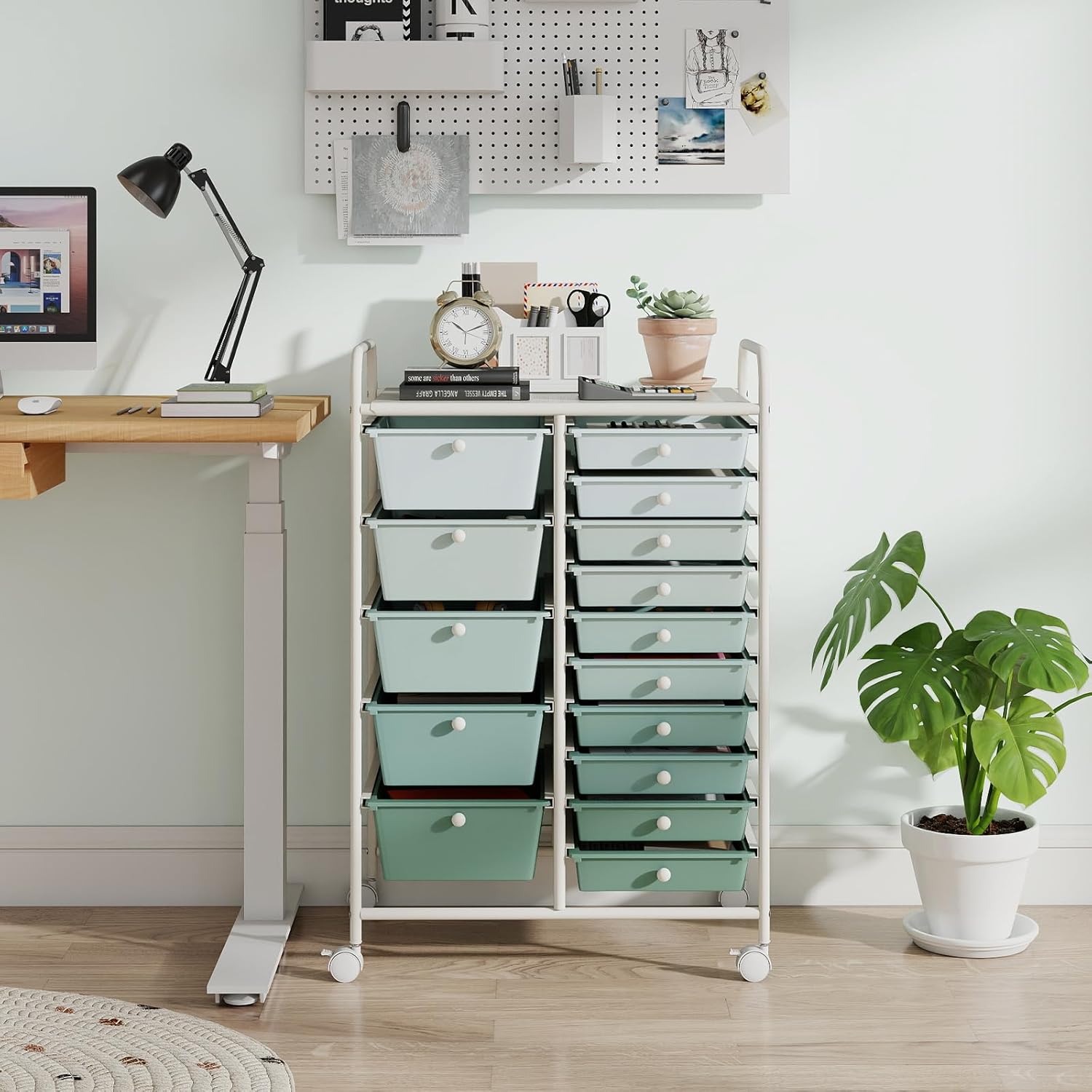
A rolling craft cart — a wheeled cabinet on locking casters (the small wheels that let it roll and then stay put when you push a lever) with drawers for storing supplies — sounds like a simple purchase. It isn’t. The decision that trips up most buyers isn’t price or brand; it’s drawer count. Buy too few drawers and you’re stacking dissimilar supplies on top of each other, losing small items, and spending the first ten minutes of every project session just finding things. Buy too many and you’re paying for empty real estate, the cart takes up more floor space than your project table, and the individual drawers are so shallow you can barely fit a bottle of glue. This guide is built around one practical framework: count what you actually own, match it to a drawer configuration, then cross-check that decision against the carts whose published specs support it. By the end, you’ll have a clear decision rule rather than a gut feeling.
Why Drawer Count Is a Proxy for a Dozen Other Decisions
Here’s the thing most buying guides skip: when you’re comparing a 5-drawer cart to a 15-drawer cart, you’re not just comparing storage capacity. You’re simultaneously choosing:
- Drawer depth (shallower individual drawers on high-count carts, deeper bins on low-count carts)
- Cart footprint (more drawers usually means taller, not always wider)
- Category granularity (can each drawer hold one supply type, or are you doubling up?)
- Weight distribution (a 15-drawer cart loaded with paint bottles sits differently on casters than a 5-drawer loaded with paper)
The Wirecutter team’s coverage of art and craft organizers consistently flags this: buyers who report dissatisfaction with their carts almost always describe a mismatch between what they intended to store and the actual drawer dimensions — not the brand or the price point. Apartment Therapy’s craft room organization guide echoes the same pattern: the most-cited regret is “drawers that are too small for what I actually use.”
So before you filter by brand or budget, do a five-minute supply audit.
The Supply Audit: Count Categories, Not Items
A supply audit (a quick inventory of what you’re storing, grouped by type) doesn’t need to be exhaustive. You’re not counting every pencil. You’re counting category groups — the number of distinct supply types that need their own dedicated drawer to stay usable.
Here’s a simple three-column exercise:
Column 1 — Tall or bulky items (paint bottles, spray cans, glue guns, scissors, rulers): these need drawer depth of at least 3 inches, ideally 4–5 inches.
Column 2 — Flat or medium items (paper pads, foam sheets, washi tape rolls, ribbon spools): these work in shallower drawers, 2–3 inches deep, but need wider footprint.
Column 3 — Small loose items (beads, brads, buttons, sticker sheets, small stamps): these need shallow drawers with some kind of divider, or they migrate into each other constantly.
Count the rows in each column. Add them up. That’s your minimum useful drawer count. In practice, most active craft rooms — whether a home studio or a K–12 art classroom activity station — fall into one of three inventory profiles:
By the Numbers
| Inventory Profile | Typical Category Count | Recommended Drawer Range | Cart Tier |
|---|---|---|---|
| Light hobby (one or two crafts, limited materials) | 4–8 categories | 5–8 drawers | Entry $40–$80 |
| Active multi-craft studio | 9–16 categories | 10–15 drawers | Mid-range $90–$180 |
| Institutional / classroom rotation station | 17–25+ categories | 15–20 drawers, or dual-cart setup | Institutional $180–$400+ |
What the Specs Actually Say: Entry and Mid-Range Carts Compared
Once you’ve done the audit and landed on a drawer-count target, the next step is cross-checking that target against what real carts actually offer — because manufacturers don’t always label their products intuitively. A cart marketed as “10-drawer” might have four large drawers and six shallow ones, which suits a mixed inventory; a different “10-drawer” cart might have ten identical shallow drawers, which suits a small-loose-items-heavy inventory and not much else.
Offex’s rolling storage cart series (targeting the K–12 and small studio segment) publishes drawer dimensions openly in their specification sheets. Their 10-drawer configurations typically run approximately 2.5 inches of interior drawer depth on the smaller drawers and around 4 inches on the larger ones. Owners in aggregated reviews note that the mixed-depth configuration works well for craft rooms where you’re storing both paper goods and bottled supplies in the same cart — but that the locking casters have received mixed feedback for long-term durability under heavier loads.
Flash Furniture’s mobile storage and utility cart line is the most commonly cited in the institutional-supply segment for school environments. Their spec sheets for the multi-drawer craft series show consistent 3-inch drawer interior depth across most configurations, with weight ratings typically around 200 lbs overall cart capacity. Reviewers at multiple outlets note that the powder-coat finish holds up well in shared-use environments, which matters for classrooms where carts get knocked around during transitions.
Origami’s folding utility cart system takes a different structural approach: instead of a fixed-frame cabinet, the Origami design uses a collapsible frame with removable bins. Their manufacturer documentation shows bin depth configurations from approximately 2 inches to 5 inches depending on the bin size selected. This modular approach means you can configure your own drawer count rather than being locked into a fixed number — useful if your inventory audit produces an odd number like 11 or 13 categories. The tradeoff, per owners who use them in active craft rooms, is that the collapsible frame introduces slight lateral flex that fixed-frame carts don’t have. For a home studio, that’s rarely a problem. For a high-traffic classroom where a cart might get rolled forcefully into a wall, that flex accumulates over time.
The Deeper Tradeoff: Drawer Count vs. Drawer Depth
This is the decision point that most buyers don’t fully think through until they’re already living with their cart, and it’s worth naming explicitly.
High drawer count (12–20 drawers) optimizes for category separation. Each supply type gets its own home. You open a drawer and everything in it belongs to the same project phase or material type. The cost is that individual drawer depth shrinks — often to 1.5–2.5 inches on the shallow drawers. That’s fine for flat items and small loose materials. It’s not fine for anything taller than about two inches standing upright. If your inventory is dominated by paint bottles, spray adhesive, or tall tool handles, a 15-drawer shallow-drawer cart will force you to lay those items on their sides, which creates leak risk and makes labels unreadable.
Low drawer count (4–6 drawers) gives you deep bins — often 5–6 inches — that can hold tall items upright and accommodate bulky materials without force-fitting. The cost is category mixing. With only five drawers and sixteen supply categories, you’re doubling and tripling up in each drawer. Experienced studio organizers and classroom coordinators who’ve written about this — including contributors to Apartment Therapy’s craft room coverage — consistently note that doubled-up drawers create a hidden time tax: each project session starts with a brief dig-and-sort cycle that erodes the value of having a cart in the first place.
The honest answer for most mid-range buyers is a mixed-configuration cart in the 10–12 drawer range, with at least half the drawers at 3 inches deep or more. That configuration handles approximately 60–70% of active craft room inventory profiles without forcing you to either stack dissimilar supplies or lay tall bottles sideways.
When to Run Two Carts Instead of One
If your supply audit lands above 20 categories, or if you have both tall/bulky items and high volumes of small loose items, a single cart is probably never going to feel right — because no single cart configuration is optimized for both. The This Old House workshop storage guides make a similar point for tool storage: trying to find one cabinet that handles both hand tools and small hardware usually produces a mediocre solution for each, while two purpose-specific storage units — one for depth, one for small-parts organization — each do their job well.
For craft rooms and classroom activity stations, the two-cart approach often works out cost-effectively. A 5-drawer deep-bin cart (often available in the $60–$100 range in the Offex and Flash Furniture tiers) paired with a 10-drawer shallow cart ($90–$150) gives you 15 total drawers with appropriate depth variation, frequently for less than a single premium mixed-configuration cart at $200+. The published specs on Flash Furniture’s lineup, for example, show their deep-bin and shallow-drawer models are designed with matching heights and similar footprint dimensions — they nest side by side without an awkward height gap.
The tradeoff is floor space: two carts take more room than one, and if your workspace is constrained, that math doesn’t work. But if you have the floor space, the two-cart approach gives you better long-term flexibility — you can replace one unit independently if a caster fails or a drawer track breaks, rather than retiring a whole cart because half of it wore out.
The Decision Rule
If you’ve done the supply audit and you’re still staring at two or three options, here’s the framework that resolves most decisions cleanly:
If your dominant inventory is tall or bulky items (paint, adhesives, tools): prioritize drawer depth over count. A 5–8 drawer cart with 4–5 inch interior depth serves you better than a 15-drawer cart where nothing stands upright. Look at the Offex deep-bin configurations or Flash Furniture’s utility cart series.
If your dominant inventory is small loose items and flat goods (beads, paper, stickers, tape): prioritize drawer count. A 12–15 drawer cart with 2–3 inch drawers gives every category its own space and prevents the migration problem. The Origami modular configurations or Flash Furniture’s high-count shallow-drawer series are worth a close look at the spec sheets.
If your inventory is genuinely mixed (tall items and small items in roughly equal proportion): a 10–12 drawer cart with tiered depth — some drawers at 2.5 inches, some at 4+ inches — is the right call. Verify the actual published drawer dimensions before purchasing; don’t assume “10-drawer” tells you anything about depth distribution.
If your category count is above 18 and your budget allows: two purpose-built carts will outperform one catch-all cart at almost every price point. The combined cost is usually equal to or less than a single premium option, and the functional result is better on both ends of the inventory spectrum.
The drawer count decision isn’t glamorous, but it’s the one that determines whether your cart earns its floor space every single day — or becomes the thing you reorganize every six months and never quite solve.