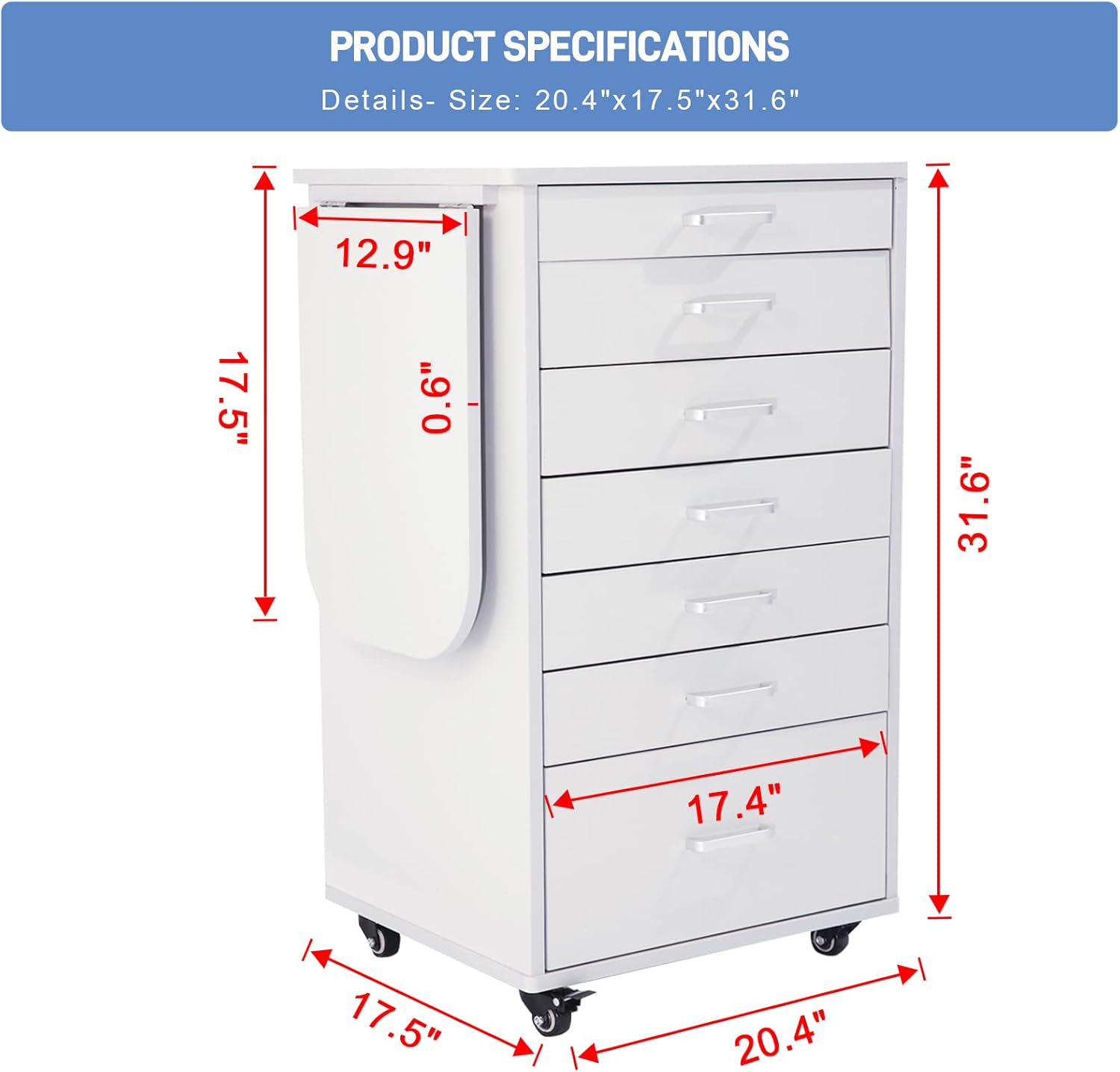
A clinical trolley cart is simply a mobile cart — usually on lockable wheels — designed to hold instruments, supplies, or equipment at a workstation where cleanliness and quick access are non-negotiable. In a dental office, that cart sits beside the patient chair holding drills, mirrors, and suction tips. In a modern beauty suite — think medical-grade facial rooms, lash studios, or cosmetic tattoo stations — that same style of cart holds sterilized implements, single-use needles, and pigment trays. The crossover sounds obvious once you see it, but the purchasing decision is trickier than it looks. A cart built purely for aesthetics will fail infection-control requirements; a cart built purely for hospital sterilization rooms may crack the budget of a solo esthetician. This guide maps exactly where the two worlds overlap, where they diverge, and how to match a trolley to your actual regulatory and workflow requirements.
Why “Clinical Grade” Means Different Things in Each Setting
Let’s be precise about the term. “Clinical grade” has no single legal definition — it’s marketing shorthand that loosely means the cart can be wiped down with disinfectant chemicals without degrading, holds a meaningful working load, and is built to survive daily professional use. Beyond that general spirit, the standards that govern cart selection differ substantially between dental and beauty environments.
In dental settings, the governing framework is stricter and federally anchored. The CDC’s Guidelines for Infection Control in Dental Health-Care Settings (published by the CDC’s Division of Oral Health) requires that surfaces in the operatory — including mobile cart tops and drawer faces — be either barrier-protected or capable of withstanding intermediate-level disinfectants, which typically means EPA-registered hospital disinfectants like quaternary ammonium compounds or sodium hypochlorite solutions. OSHA’s Bloodborne Pathogens Standard (29 CFR 1910.1030) adds a layer: any surface that may contact blood or OPIM (other potentially infectious materials) must be decontaminable. Practically, this rules out uncoated wood surfaces, porous plastics, and powder-coat finishes with microcracking tendencies at cart joints and drawer edges.
In licensed cosmetology and esthetics settings, state boards — not federal agencies — govern surface sanitation. Most states reference either their own cosmetology board rules or the Professional Beauty Association’s Salon Safety and Infection Control Guidelines. These typically require that surfaces contacting implements be non-porous and cleaned with an EPA-registered disinfectant, but they stop short of the intermediate-level requirement that dental operatories carry. That gap matters: it means a beauty suite can legally use a cart with a melamine-laminate top (highly durable, non-porous, but not rated for repeated bleach exposure), while a dental operatory should be looking at stainless steel tops, solid phenolic resin, or clinical-grade ABS plastic.
The practical takeaway: a cart that meets dental-operatory standards will almost certainly satisfy any state cosmetology board. The reverse is not reliably true — and that asymmetry is where buyers get into trouble.
The Four Specs That Actually Transfer (and Two That Don’t)
When evaluating whether a cart built for one environment can serve the other, focus on these six criteria:
1. Top Surface Material — Transfers with Caveats
Stainless steel (Type 304 or 430) is the gold standard for chemical resistance. Clinton Industries’ stainless-top treatment carts, for example, are spec-sheeted to withstand repeated exposure to quaternary ammonium compounds, iodophors, and diluted bleach — exactly what the CDC infection-control guidelines call for in dental settings. Stainless also satisfies every state cosmetology board’s non-porous requirement.
Phenolic resin tops (a hard, compressed-resin laminate common on Hausmann carts) perform similarly for chemical resistance and are lighter than stainless. They’re a practical crossover choice.
High-pressure laminate (HPL) tops are common in mid-tier beauty carts. They handle quats (quaternary ammonium disinfectants) well but can delaminate at edges with repeated bleach exposure. Fine for a state-licensed beauty suite; not appropriate for a dental operatory where bleach wiping is routine.
2. Caster Quality — Transfers Fully
Both environments share the same enemy: caster failure. A cart that wobbles or drifts mid-procedure is a patient safety problem in dentistry and a workflow breakdown in a beauty suite. Look for casters rated at a minimum of 40 lbs each on a four-caster cart (giving a 160-lb working load), with ball-bearing swivel heads and stainless or chrome-plated stems that won’t rust from floor-cleaning chemicals. Manufacturer-rated caster loads are listed on Clinton and Hausmann spec sheets; third-party equivalents should carry similar documentation.
Dual-locking casters (locking both the wheel and the swivel simultaneously) are the right call in any procedure environment. Procedure rooms — dental or aesthetic — should not have supply carts creeping during treatment.
3. Drawer Configuration — Transfers with Layout Adjustments
Both settings favor shallow instrument drawers (2–3 inches deep) lined with removable, autoclavable or washable liners. The difference is quantity: a dental operatory cart typically needs 3–5 drawers, often with a tray slide for a secondary instrument tray. A beauty suite often gets by with 2–3 drawers and prioritizes a flat work surface and side-mounted holder for tools in active use. Carts with modular drawer inserts — available from Medline’s clinical cart line and several Hausmann configurations — let you reconfigure for the layout without buying a new cart.
4. Frame Load Rating — Transfers Fully
Both environments involve meaningful working loads: dental setups add handpiece holders, light-cure units, and suction tips; beauty setups add steamers, wax warmers, and ultrasonic devices. A frame rated for 150 lbs or more (distributed across the structure) is appropriate for either. Published spec sheets from Clinton Industries put their mid-tier stainless treatment cart at 200-lb distributed load capacity — that holds up in either context.
5. ADA Clearance Requirements — Does NOT Reliably Transfer
In healthcare settings subject to ADA Title III or Title II (which covers most dental offices that serve the public), cart dimensions must not obstruct the 36-inch minimum clear floor path or 60-inch turning radius defined in the ADA Standards for Accessible Design. Most clinical carts are designed with this in mind; always confirm the parked footprint. Cosmetology settings have variable ADA obligations depending on whether they meet the threshold for public accommodation, but boutique beauty suites in smaller facilities sometimes operate without the same scrutiny. If you’re buying for dental, ADA clearance is non-negotiable; for beauty, it depends on your local authority having jurisdiction.
6. Color and Finish Options — Does NOT Transfer to Dental
For beauty suites, cart aesthetics carry real business weight — a matte-black or warm-wood-wrap cart signals brand identity in a way that a bare stainless cart simply doesn’t. Several manufacturers, including Pedigo (known for hospital carts) and a range of mid-tier beauty equipment suppliers, offer powder-coat finishes in neutral palettes. The catch: powder-coat finishes on drawer faces and cart bodies can micro-crack over time with repeated disinfectant exposure at dental-frequency use. For a dental operatory, plain stainless or phenolic resin is the honest choice even if it costs some warmth. For a beauty suite running lower-level disinfectants at lower frequency, a powder-coat cart is defensible and may be the right call aesthetically.
By the Numbers
| Spec | Dental Operatory Minimum | Beauty Suite Minimum |
|---|---|---|
| Top surface | Stainless 304 or phenolic resin | Non-porous (HPL acceptable) |
| Chemical resistance | Intermediate-level disinfectants (bleach, quats) | EPA-registered disinfectant (quats typical) |
| Caster load rating | 40 lb/caster, dual-lock | 40 lb/caster, dual-lock |
| Frame load (distributed) | 150 lb minimum | 100 lb minimum |
| Typical budget range (2026) | $400–$900 | $200–$700 |
Brand Landscape: Who Actually Makes Carts That Cross Over
Clinton Industries (based in Port Chester, NY) is the most frequently specified brand at the dental-meets-clinical intersection. Their stainless treatment carts are stocked by major dental supply distributors and carry detailed published specs for chemical resistance. Operators in long-run reviews note the stainless tops hold up to daily disinfection routines without the edge delamination that haunts budget alternatives. The drawback: bare stainless doesn’t photograph beautifully in a luxury beauty suite context.
Hausmann Industries produces both laminate and stainless-top carts with phenolic resin options, and their caster documentation is more detailed than most competitors — a meaningful advantage when you’re arguing a cart purchase to a facilities committee or an infection-control officer. Their published load ratings are conservative (a good sign), and their frame construction uses welded tubular steel rather than the knockdown hardware common in lower-tier units.
Medline offers a broader catalog that spans everything from economy procedure carts to carts that overlap with the dental requirement space. Their mid-tier poly-top carts are a reasonable choice for beauty suites with moderate disinfectant exposure; their stainless line is appropriate for dental. Medline’s advantage is distribution: their carts are often available through dental supply channels, medical supply channels, and spa equipment distributors simultaneously, which simplifies procurement for a multi-location operator.
Pedigo Products serves hospital and surgical environments but their carts appear in high-end dental suites due to their build quality and finish options. Price point is higher ($700–$1,200 for standard configurations), but owners report caster and drawer-slide longevity that justifies the premium over a five-year operating horizon.
For beauty-suite buyers who want clinical specs without clinical aesthetics, the honest answer in 2026 is that the crossover catalog is thin. A handful of aesthetic equipment suppliers — Oakworks and Custom Craftworks among them — make carts that are non-porous and chemically durable while offering finish options that read as spa-appropriate. These aren’t rated for dental-operatory infection control, but they’re defensible for state cosmetology-board compliance.
The Decision Rule
Here’s how to cut through the noise:
If your setting is a dental operatory or any clinical space subject to OSHA Bloodborne Pathogens compliance: Start with stainless-top carts from Clinton Industries or Hausmann. Budget $500–$900. Confirm intermediate-level disinfectant compatibility in the published spec sheet — not just the marketing copy. Dual-lock casters and a minimum 150-lb distributed load rating are baseline.
If your setting is a licensed cosmetology or esthetics suite operating under state board rules (not federal clinical standards): A high-pressure laminate or poly-top cart rated for EPA-registered disinfectants is sufficient and gives you more finish options. Medline’s mid-tier carts or dedicated spa equipment carts from suppliers like Oakworks cover this range at $200–$600. Don’t pay for stainless if your disinfection protocol doesn’t require it — but do confirm non-porous surfaces in writing for your state board compliance file.
If you’re outfitting a hybrid space — a cosmetic dentistry practice with an adjacent aesthetics suite, or a medical spa that handles both injectable services and skin procedures — buy to the higher standard. A cart that meets dental-operatory specs will satisfy the cosmetology board; a cart specced only for the beauty side will fail an infection-control audit the first time a dentist or nurse practitioner uses that room. The price delta between the two tiers (roughly $200–$400 per cart) is the honest cost of not having to replace carts when your scope of services expands.
The crossover between dental and beauty is real, but it only runs one direction: up. Spec to the stricter environment, document the chemical resistance claims from the manufacturer’s published spec sheet, and the cart earns its place in either room.