A utility cart rated for 500 pounds sounds straightforward until you start comparing models: one is molded high-density polyethylene (HDPE, a tough engineered plastic), another is powder-coated steel, and both carry the same capacity number on the box. Capacity is the maximum weight a cart is engineered to carry distributed across all its shelves under ideal conditions. The problem is that “ideal conditions” — flat floors, stable temperatures, no moisture — describes almost no real environment where these carts actually work. A church kitchen cart gets steam and grease. A garage cart gets Michigan winters. A classroom cart gets dragged across textured tile by a substitute teacher who doesn’t know better. The material underneath that capacity number is what determines whether your cart looks the same in five years or looks like a regret. This guide breaks down exactly where plastic beats steel, where steel beats plastic, and how to use documented buyer experience and published spec guidance to make a call you won’t second-guess.
| EDITOR'S PICKCasual Home Kitchen Island with… | Mid-tierRubbermaid Commercial Products… | Budget pickWEN Service Utility Cart | |
|---|---|---|---|
| Load limit | — | 500 lb | 500 lb |
| Shelf count | — | 2 | — |
| Cart width | 40" | — | 40" |
| Cart depth | — | — | 17" |
| Lipped shelf | — | ✓ | — |
| Handle | — | ✓ | — |
| Price | $137.75 | $125.49 | $58.96 |
| See on Amazon → | See on Amazon → | See on Amazon → |
The Capacity Number Is the Floor, Not the Ceiling of the Decision
When a manufacturer prints “500 lb capacity” on a cart, that number describes a static load test — weight placed evenly, not rolled over a bump or stacked unevenly on one shelf. What it doesn’t tell you is how the material distributes that load over time, how it responds to temperature swings, or whether the casters will still roll freely after a year of real use.
The utility cart buyer’s guide published by hcdmag.com (Utility Cart Buyer’s Guide: Steel vs. Polymer Construction) identifies caster specification — wheel diameter, swivel lock availability, and wheel material (polyurethane vs. rubber vs. hard nylon) — as the most underread section of any cart spec sheet. A cart’s capacity rating tells you nothing about whether its wheels will survive the environment. That guidance also notes that a five-year caster warranty on a mid-range steel cart is not a minor detail; it is the spec that determines whether you are buying one cart over five years or two.
Here is the short version of how the two materials behave differently under the same 500-lb rating:
| Factor | Heavy-Duty Plastic (HDPE) | Powder-Coated Steel |
|---|---|---|
| Moisture resistance | Excellent — will not rust | Vulnerable at scratches and welds |
| Cold-weather performance | Can become brittle below approximately 0°F | Maintains structural integrity |
| Long-term sag risk | Low on quality units; higher on budget shelf spans over 24 inches | Near-zero at 18-gauge or better |
| Typical caster warranty | 1–2 years, varies widely | 1–5 years, varies widely |
| Cart self-weight | 20–35 lbs typical | 35–60 lbs typical |
Three Real-World Use Cases — and Which Material Wins Each
Budget Garage and Classroom Use: Plastic as the Practical Default
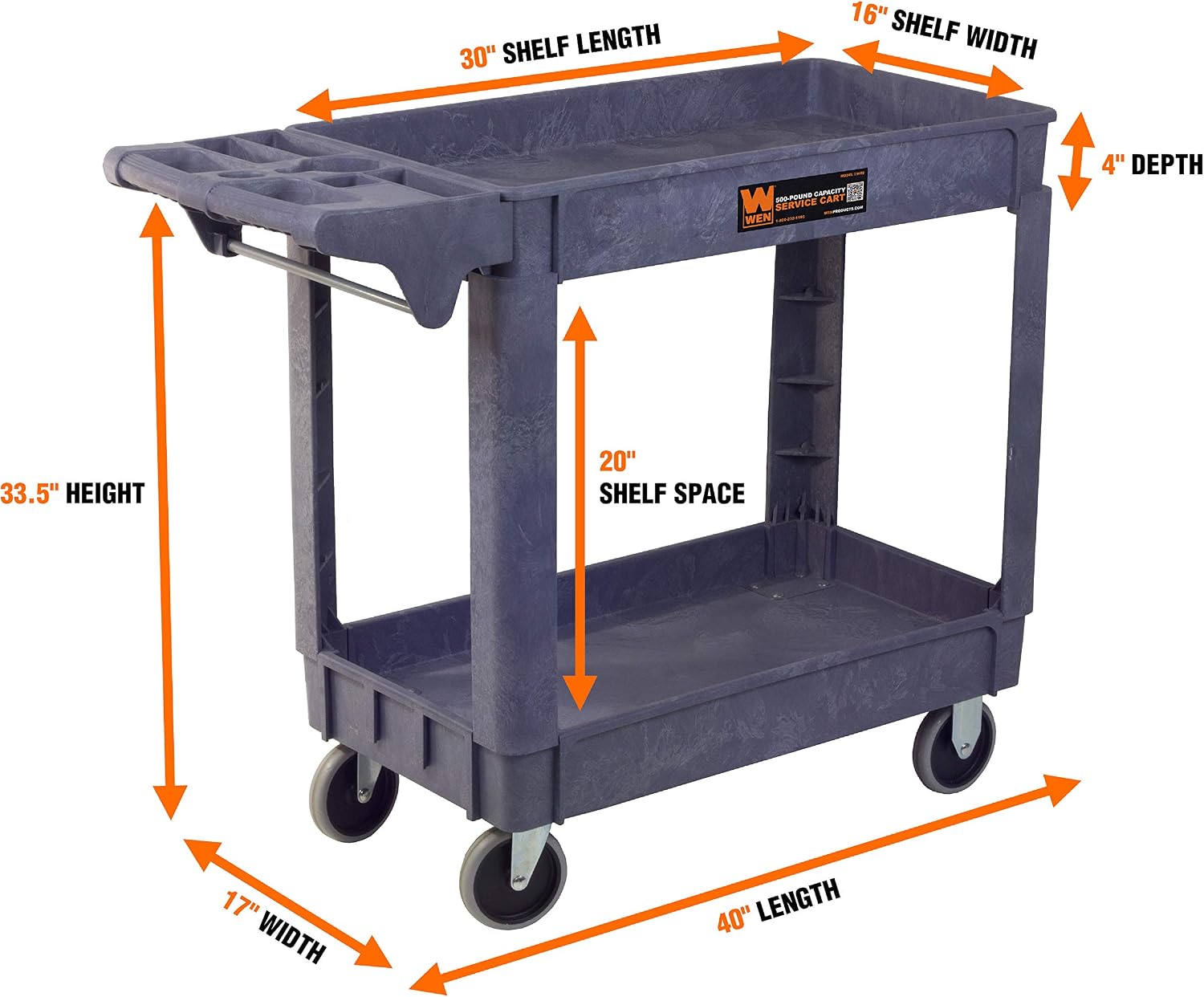
WEN
$58.96
In stock on Amazon
Check price on AmazonFor buyers working a tight budget in a dry indoor environment — a classroom supply closet, a church hall storage room, a home garage without a moisture problem — heavy-duty plastic carts in the VEVOR line represent the most commonly purchased entry point in this category. Verified purchaser Q&A archives for VEVOR heavy-duty plastic carts (2024–2025 product listing archive) show buyers loading bulk paper goods, art supplies, and pantry overflow without structural complaints at the one-year mark.
The honest caveat from the same source: VEVOR owners who used their carts on outdoor gravel specifically flagged noise and rolling resistance. The plastic-on-gravel contact is loud, and on loose gravel the casters can catch and require extra force. This is not a structural issue, but it is a real ergonomic problem in the wrong setting. For unpaved or loose-surface rolling, look for carts spec’d with 5-inch polyurethane casters, which absorb surface variation better than hard nylon wheels.
Budget plastic carts also carry a legitimate risk on shelf spans over 24 inches: HDPE can develop a permanent slight bow if the same heavy weight sits centered on a wide shelf for months. This does not cause structural failure, but it is visible and can affect how items sit. In a classroom supply cart, this probably does not matter. In a workshop storing calibrated equipment, it does.
WEN
$58.96
In stock on Amazon
Check price on AmazonMid-Range Moisture and Mobility Environments: Plastic Earns Its Place
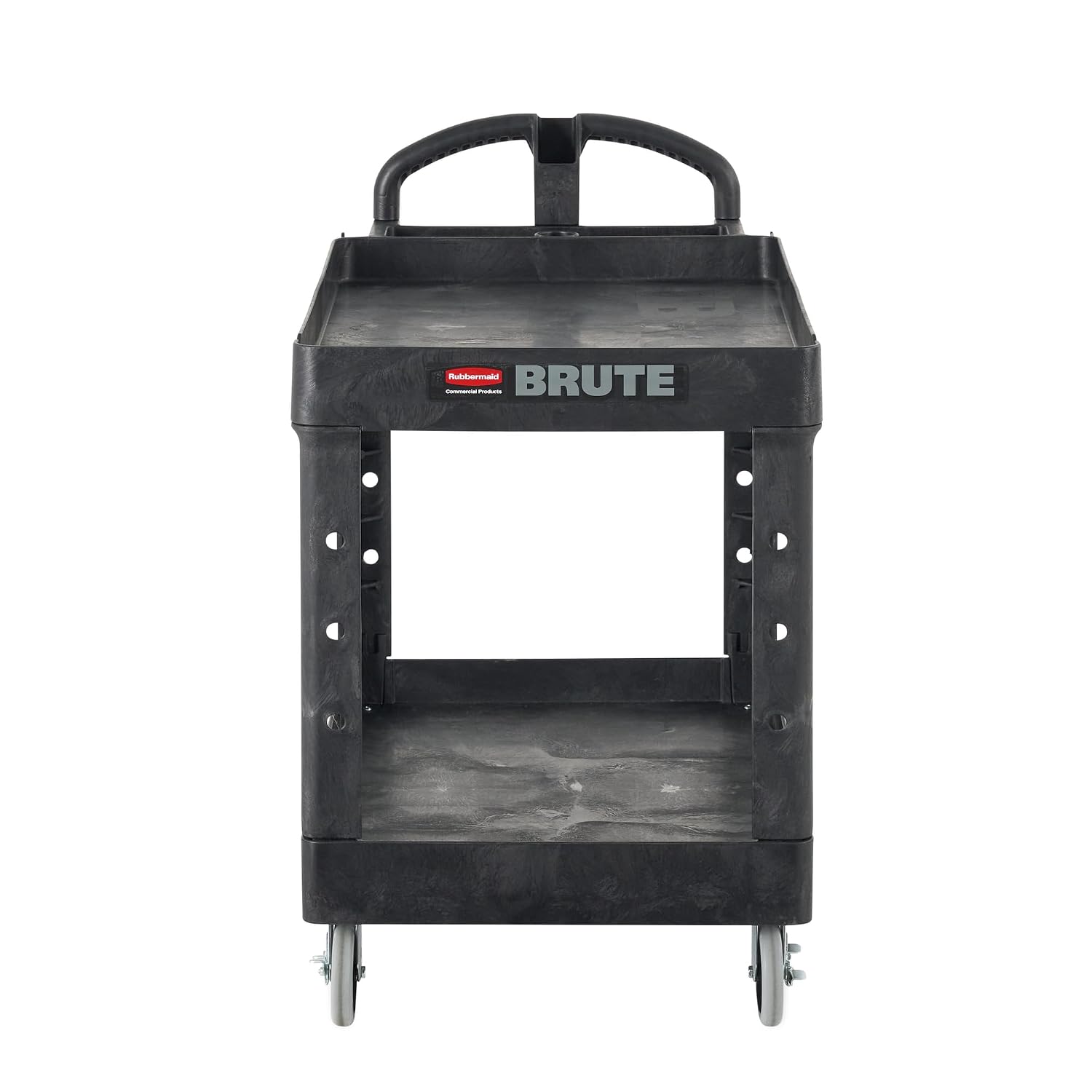
Rubbermaid
$125.49
In stock on Amazon
Check price on AmazonThe most durable long-run evidence for heavy-duty plastic carts comes from outdoor and moisture-prone use cases. Rubbermaid Commercial Products utility cart specification sheets (2025 edition) document HDPE construction rated for commercial food-service environments — steam, chemical cleaning agents, and temperature cycling. Independently, verified purchaser accounts for Rubbermaid Commercial carts describe multi-year outdoor use on covered patios, including loading configurations involving heavy planters, with no reported shelf sag or surface rust after extended exposure. That is the kind of use case that would surface structural fatigue within a season or two on an underbuilt cart.
This matters for church kitchens, outdoor event staging, and any garage where the door stays open and humidity is a variable. Powder-coated steel will rust at any point where the coating is scratched or where water pools at a weld — and in a working environment, scratches are inevitable.
The ELAFROS plastic cart (verified purchaser reviews, 2025 listing) surfaces a less expected mid-range use case: mobile car detailing, specifically as a station for a pressure washer and cleaning supplies. The owner needed the cart to hold up to wet conditions and chemical splashing while remaining easy to reposition around a vehicle. A steel cart in that environment requires diligent drying and attention at the welds to stay rust-free. The ELAFROS held up precisely because HDPE is indifferent to moisture.
A second mid-range use case worth naming explicitly because it reframes what a cart is: the WEN model FT500 (owner documentation, WEN Products) has drawn consistent attention from buyers managing mobility limitations — specifically, people who cannot lift a laundry basket or heavy items from floor level. In these accounts, the cart is not a storage product; it is an independence tool that eliminates the need to lift entirely. The WEN’s documented specification supports a 500-lb distributed capacity across three shelves, and owners in this use context report that rolling mobility — getting items from one room to another without carrying them — is the actual value proposition. If you are sourcing carts for an adaptive living environment, this framing matters more than the material comparison.
Rubbermaid
$125.49
In stock on Amazon
Check price on AmazonPremium Workshop and Commercial Kitchen Use: Steel Earns Its Rigidity Premium
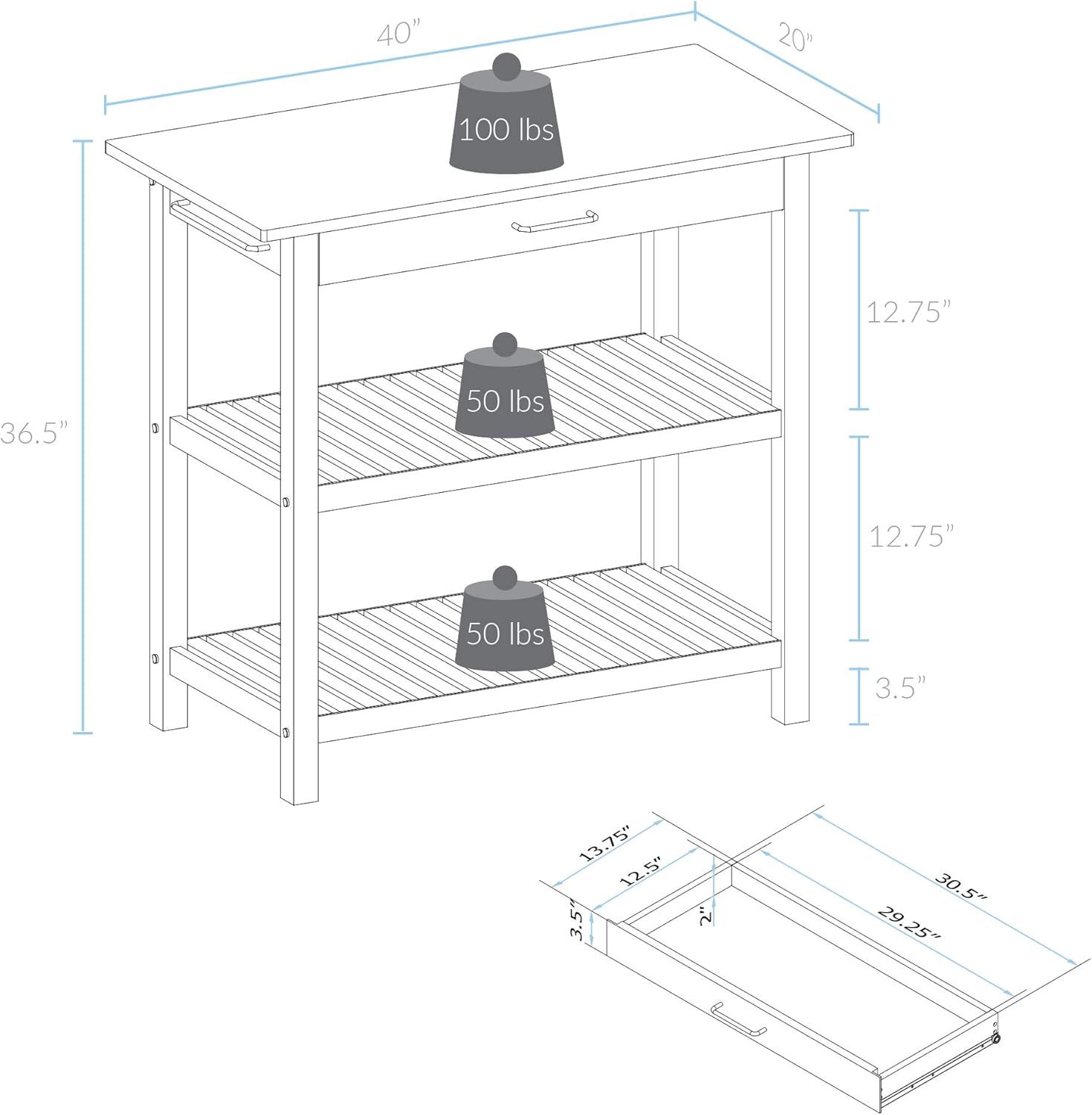
Casual 373-91
$137.75
In stock on Amazon
Check price on AmazonSteel earns its premium in two specific scenarios: shelf spans over 24 inches carrying concentrated loads, and settings where the caster warranty actually matters to the total cost calculation.
The Tubstr steel cart (product listing and comparative buyer reviews, 2025) has become a reference point in buyer comparisons because multiple purchasers describe it as roughly one-third the price of comparable-capacity steel alternatives while delivering equivalent build quality. That is a meaningful data point if you are outfitting a school shop classroom or a church kitchen on a restricted budget and need steel rigidity without an institutional-grade price. Buyers in these reviews consistently note that shelves showed no flex under heavy tools and that assembly required minimal time.
For garage and workshop use, the core steel advantage is that an 18-gauge shelf does not develop memory under sustained static load. In a workshop where precision matters — storing molds, sheet material, or calibrated equipment — a shelf that holds its geometry over years matters. In a school supply cart, it probably does not.
The church kitchen context surfaces one specific buyer insight that does not appear in spec sheets: the only verified purchaser in this category who explicitly preferred a two-shelf configuration over three cited item height as the reason. A chafing dish, large stockpot, or commercial catering tray often runs 12 to 16 inches tall. On a three-shelf cart with standard 13-inch shelf spacing, these items either do not fit between tiers or must sit sideways. A two-shelf cart on the same frame gives 24 or more inches of vertical clearance per tier, which accommodates the actual geometry of commercial kitchen equipment. This is a decision point the spec sheet will not surface. If your use case involves tall items — commercial kitchen gear, large classroom project tubs, or garage bins — measure your tallest item before you count your shelves.
The hcdmag.com buyer’s guide reinforces this principle at the premium tier: caster diameter, not just load rating, determines whether a heavily loaded cart is actually maneuverable by one person in a tight kitchen or workshop. A 5-inch or 6-inch caster on a premium steel cart is not cosmetic; it is what makes 400 pounds steerable over a floor transition or a rubber threshold mat.
Casual 373-91
$137.75
In stock on Amazon
Check price on AmazonThe Decision Rule: Four Questions That Settle the Material Choice
Is your environment wet, steamy, or chemically active? Go plastic — specifically Rubbermaid Commercial or a comparable HDPE cart with documented food-service or outdoor ratings. The rust risk on steel in these settings is a maintenance burden, not a theoretical one. Rubbermaid Commercial Products utility cart specification sheets (2025 edition) explicitly list chemical resistance as a design parameter for their HDPE line.
Will your shelves carry sustained static loads over 24-inch spans? Go steel, and look for 18-gauge or better with a caster warranty of at least three years. The hcdmag.com utility cart buyer’s guide identifies shelf gauge and caster specification — not capacity rating alone — as the two specs that predict long-term performance in workshop and commercial environments.
Are you buying for a mobility-assistance or adaptive living context? The WEN FT500’s documented use case among buyers with physical limitations makes it a starting point worth evaluating specifically on those terms. The cart’s value in that context is rolling mobility, not storage volume.
Are your items tall? Count before you configure. A two-shelf cart may serve you better than three. More shelves is not always more useful — it can make a cart actively frustrating for the items you actually own.
Frequently Asked Questions
Do heavy-duty plastic carts actually hold up outdoors over multiple years without sagging or rusting?
Quality HDPE plastic carts from brands like Rubbermaid Commercial — whose 2025 specification sheets document food-service-grade material standards — show no rust over extended outdoor exposure in multi-year verified purchaser accounts. Budget plastic carts with thinner wall construction or undersized shelf spans are more likely to sag. Quality matters more than material category, and the Rubbermaid commercial line has the most documented long-run outdoor evidence in this segment.
What tools do I actually need to assemble a 500-pound-capacity utility cart?
Most utility carts in this category arrive with the required hardware and are designed for tool-free or near-tool-free assembly. Owners consistently report needing at most a rubber mallet for snapping shelf posts into position on plastic carts, and a basic Phillips screwdriver for bolt-fastened steel frame connections. A second pair of hands is more useful than specialized tools — the main assembly challenge is holding the frame steady while tightening connections. Budget at least 30 to 45 minutes for a first assembly.
Does it matter which wheels go in which position during assembly?
Yes. On carts with a mix of locking and non-locking casters, the locking casters should go on the end of the cart you push from, not the load end. This positions the brakes where you naturally stop the cart. On carts where all four casters lock, placement matters less — but published assembly guidance for VEVOR and Rubbermaid carts both note that swivel casters should be at the push end and fixed casters at the lead end for easier directional control.
Can these carts handle rolling over outdoor surfaces like gravel or uneven pavement?
With caveats. Larger-diameter casters — 5-inch or 6-inch — handle uneven pavement meaningfully better than 3-inch or 4-inch wheels, which catch on small surface irregularities. On gravel specifically, VEVOR cart owners (2024–2025 reviewer Q&A archive) flagged substantial noise and resistance. For regular outdoor use on anything other than smooth concrete, look for carts spec’d with 5-inch polyurethane casters.
Is a steel utility cart worth the premium over a heavy-duty plastic one for garage or classroom use?
If your garage shelves will carry static concentrated loads or span more than 24 inches, steel’s rigidity advantage is real and worth paying for. If your cart will live in a moisture-prone environment, plastic eliminates the rust risk that steel introduces the moment the coating is scratched. The Tubstr steel cart’s documented value proposition — roughly one-third the price of comparable-capacity steel alternatives — narrows the premium over quality plastic significantly, making the steel choice accessible at a closer price point than the category average suggests.