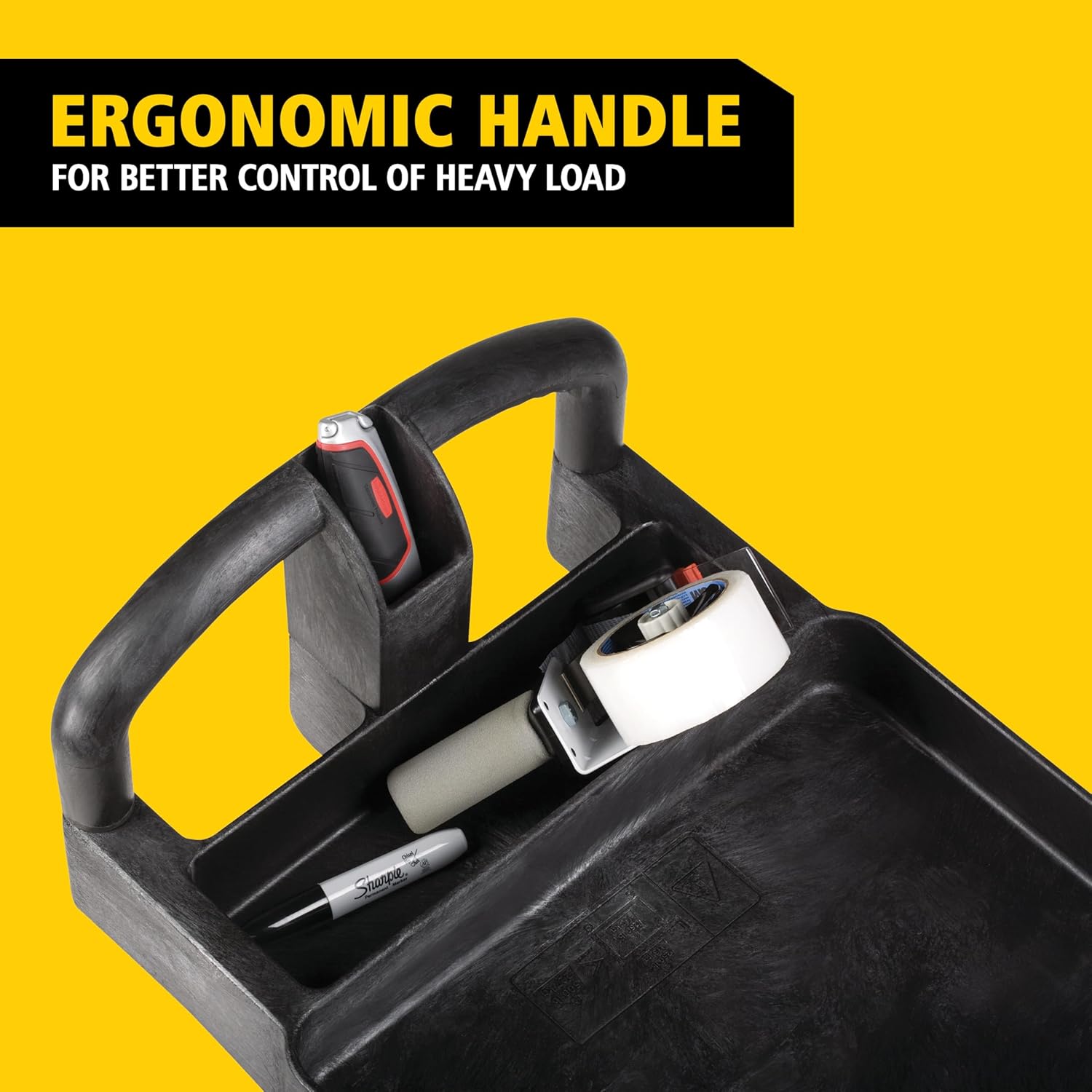
A heavy-duty utility cart is simply a wheeled, shelved platform built to carry loads that would buckle a standard office or kitchen cart — typically 500 pounds (lbs) or more distributed across two or three shelves. In a garage or workshop, that load might be engine blocks, stacked lumber, power tools, or bags of concrete. The “heavy-duty” label gets applied loosely by manufacturers, so the number that actually matters is the static load rating (what the cart holds while sitting still) versus the dynamic load rating (what it can safely roll while loaded — usually 60–70% of static). Most buyers focus on price and shelf count, then discover six months later that the casters (the wheels and their mounting hardware) have seized, bent, or cracked. This guide walks through the specs that predict long-term performance, the total cost of ownership (TCO) math that makes a $300 cart cheaper than an $89 one, and clear decision rules so you can close your current purchase with confidence.
| EDITOR'S PICKRubbermaid Commercial Products… | Mid-tierRubbermaid Commercial Products… | Budget pick[WEN Service Utility Cart](https://www.amazon.com/dp/B00H1V4EB2?tag=greenflower20-20) | |
|---|---|---|---|
| Shelf Qty | 2 | 2 | — |
| Shelf Lips | ✓ | ✓ | — |
| Handle Type | Ergonomic | Ergonomic | — |
| Price | $150.43 | $125.49 | $58.96 |
| See on Amazon → | See on Amazon → | See on Amazon → |
Why Casters Are the First Thing to Evaluate — Not the Last
If you’ve looked at utility carts on any retail shelf, you’ve noticed that two carts with identical shelf dimensions and nearly identical price tags can have wildly different lifespans. The culprit is almost always the caster assembly — the wheel, its mounting stem or plate, and the ball-bearing (or plain-bore) swivel mechanism.
What to look for in caster specs:
- Caster diameter: 3-inch casters are standard on budget carts; 5-inch casters roll more easily over concrete seams, garage door tracks, and shop floor debris. For a 500-lb cart, 5-inch is the practical minimum on uneven floors.
- Caster material: Polyurethane (PU) wheels are the right choice for hard floors — they grip without marking, absorb vibration, and resist solvent splashes. Hard plastic (polypropylene) casters are cheaper and crack under sustained heavy loads or temperature swings common in unheated garages.
- Swivel bearing type: Precision ball-bearing swivels maintain smooth turning under load for years. Plain-bore (unball-bearing) swivels are fine for light loads; under 500 lbs, they wear oval-shaped and start binding within 12–18 months of regular use.
- Caster warranty: Budget-tier carts from no-name vendors typically carry a 90-day or 1-year caster warranty. Mid-tier brands like Akro-Mils and Durham Manufacturing publish 3- to 5-year structural warranties that explicitly cover caster assemblies. That gap in warranty coverage is a proxy for the gap in component quality.
The Material Handling Industry’s cart and truck selection guide (published by MHI.org) recommends specifying casters rated for at least 25% above your anticipated load per wheel — so a four-caster cart carrying 500 lbs needs casters individually rated for at least 156 lbs each, ideally 175–200 lbs. Most budget carts rate their casters at exactly the minimum, leaving zero margin for dynamic loading or off-center weight distribution.
Steel Gauge: The Number Everyone Gets Backwards
Steel gauge is counterintuitive: a lower gauge number means thicker, heavier steel. A cart built from 18-gauge steel shelves is substantially sturdier than one built from 22-gauge, even though 18 is the smaller number. The hcdmag.com garage storage buying guide covers this clearly and is worth bookmarking if you’re new to reading steel specs.
Practical gauge reference for workshop carts:
| Gauge | Thickness (approx.) | Typical application |
|---|---|---|
| 14-gauge | 0.075 in | Industrial pallet carts, heavy shop use |
| 16-gauge | 0.060 in | Professional-grade utility carts, 500–1,000 lb rated |
| 18-gauge | 0.048 in | Mid-duty garage carts, 300–500 lb rated |
| 20-gauge | 0.036 in | Light-duty home or craft use, under 300 lbs |
| 22-gauge | 0.030 in | Budget-tier shelf liners, not structural |
A cart advertising “500-lb capacity” built from 20-gauge steel is technically possible with the right weld geometry, but owners consistently report shelf deflection (visible sagging) under sustained loads above 300 lbs in that construction. Published spec sheets from brands like Durham Manufacturing and Edsal specify both gauge and welding method (MIG vs. spot) — if a product listing omits gauge entirely, that omission is itself a signal.
Powder coat vs. paint: This matters for garage use specifically. Bare or painted steel will surface-rust within one season in a humid climate or wherever road salt gets tracked in. Powder-coated finishes (electrostatically applied, then oven-cured) are chemically bonded to the steel and resist chipping, chemical splash, and abrasion far better. Most reputable mid-tier and above carts specify powder coat; budget carts typically use spray paint that chips at the first wrench contact.
The TCO Calculation: What “Cheap” Actually Costs Over Three Years
Here’s the math that changes most buying decisions. Let’s run two real-world scenarios side by side.
By the numbers — 3-year TCO comparison:
| Budget Cart (~$89) | Mid-Tier Cart (~$280) | |
|---|---|---|
| Purchase price | $89 | $280 |
| Freight/shipping (heavy items often not “free”) | $0–$35 | $0–$45 |
| Caster replacement at ~18 months (set of 4) | $28–$55 | $0 (within warranty) |
| Lost productivity (1–2 hrs sourcing/replacing) | $40–$80 est. | $0 |
| Second cart if first fails before 3 years | $89 | $0 |
| 3-year total | $246–$323 | $280–$325 |
The math is close — and that’s the honest version. The budget cart can come out even if you’re lucky with a light or static load in a climate-controlled space. But under real garage conditions — temperature swings, concrete floors, dynamic rolling with 400+ lbs — the failure rate accelerates. Across aggregated owner reviews on major retail platforms, the pattern for budget utility carts is consistent: caster binding or failure between months 12 and 24, with a secondary failure mode of shelf weld cracking at the corner gussets under repeated loading and unloading.
The mid-tier cart’s advantage isn’t the sticker price — it’s that the 3-year TCO is predictable. You’re not playing caster roulette.
Where freight charges hide: This Old House’s utility cart buying guide flags something most buyers miss: heavy carts (those over 70 lbs assembled weight) frequently don’t qualify for standard free shipping thresholds. A $99 cart that ships via freight carrier can add $40–$80 to the landed cost. Always confirm shipping method and cost before finalizing, and factor that into your per-unit comparison.
Brands Worth Naming at Each Tier
Budget tier ($60–$130): Carts from Cosco, Suncast, and generic private-label brands dominate this space. They’re appropriate for light, static storage — hand tools on shelves you rarely move. For regular rolling under load above 200 lbs, the caster and gauge specs don’t hold up to sustained use based on published specifications and owner-reported patterns.
Mid-tier ($150–$350): This is where the value-to-durability curve gets favorable. Akro-Mils (known for their industrial bin and storage systems) produces welded steel utility carts with 16-gauge shelves and 5-inch polyurethane casters that are frequently specified in automotive shops and light manufacturing. Edsal manufactures in the U.S. and publishes complete gauge and load rating documentation — a transparency signal that matters when you’re comparing apples to apples. Seville Classics sits at the accessible end of this tier; their UltraHD line uses 16-gauge steel and has a documented 3-year warranty that covers structural components including casters.
Professional/industrial tier ($350–$800+): Durham Manufacturing and Relius Solutions (a subsidiary of Global Industrial) produce carts to ANSI material handling standards with documented weld procedures and 5-year structural warranties. These are overkill for most home workshops but appropriate if your cart is rolling in a professional shop, rental facility, or commercial space where OSHA documentation or liability coverage might reference equipment ratings. Lista International builds modular shop carts with interchangeable drawer and shelf configurations; the upfront cost is high, but the per-year cost over a 10–15 year commercial lifespan frequently beats mid-tier replacement cycles.
Decision Rules: If X, Then Y
You’re probably in one of three situations. Here’s the honest guidance for each:
If your load stays under 300 lbs, the cart is mostly stationary, and you’re in a climate-controlled space: A well-reviewed mid-budget cart in the $100–$150 range is defensible. Prioritize 18-gauge steel and polyurethane casters even at this price — both are available at this price point if you read the spec sheet rather than the headline weight rating.
If you’re rolling 300–500 lbs regularly on concrete, in a garage that freezes in winter: Go mid-tier, $200–$350, and verify: (a) 16-gauge steel or better, (b) 5-inch PU casters with ball-bearing swivels, (c) powder coat finish, (d) warranty that explicitly names casters and welds. Akro-Mils and Edsal both hit these marks and publish the specs to verify. Don’t buy based on the stated weight capacity alone — confirm the gauge.
If this is a commercial or professional environment, or if downtime has a real dollar cost: The Durham/Relius/Lista tier is the right frame. Calculate your TCO over five years, not one. A $500 cart that runs five years without service beats two $200 carts replaced at years two and four — and in a shop environment, the second replacement also costs you downtime and the labor to transfer your setup. The cost-per-year math almost always favors the professional tier once you account for that.
One final note: if you’re sourcing multiple units — outfitting a full shop, a rental fleet, or a commercial facility — ask vendors directly about volume pricing and lead times. As of mid-2026, domestic steel supply constraints have extended lead times on some custom-configured industrial carts to 8–12 weeks. Build that into your project timeline before you’re waiting on carts to open a space.
The honest bottom line: the 500-lb capacity label is a starting point, not a finish line. The casters, the gauge, the coating, and the warranty are where the real specification lives — and those are the numbers that determine whether you’re buying a cart once or twice.