Home infusion therapy — receiving medication, fluids, or nutrition through an IV (intravenous) line at home rather than in a clinic — has grown sharply since 2020, and home dialysis (kidney-filtering treatment done in your own living space instead of a dialysis center) has followed the same arc. According to the National Home Infusion Association’s 2023 patient safety guidance, more than three million Americans now receive some form of infusion therapy at home each year. That’s a lot of people suddenly needing a place to put IV tubing, saline bags, alcohol swabs, medication vials, and a small forest of single-use supplies — without turning their bedroom or living room into something that looks like a storage unit.
A rolling cart — specifically a mobile cart on wheels that you can position next to a recliner, a bed, or a dialysis machine and roll out of sight when company comes — has become the practical solution most patients land on. This guide synthesizes what actual home-infusion and dialysis patients have reported buying, what worked, what failed, and how to make the right call before you’re stuck with a 40-pound cart you can’t return.
| EDITOR'S PICKJaboEquip Commercial Heavy Duty… | Mid-tierMobile Medical Carts 3 Tier Pro… | Budget pickAmazon Basics 3-Tier Rolling Ut… | |
|---|---|---|---|
| Lockable | ✓ | — | ✓ |
| Tiers | — | 3 | 3 |
| Max load | — | 330 LBS | — |
| Wheels | — | ✓ | ✓ |
| Drawers | — | ✓ | — |
| Sharps box | — | ✓ | — |
| Price | $398.99 | $152.99 | $34.77 |
| See on Amazon → | See on Amazon → | See on Amazon → |
The Real Buyer Landscape: Who Is Actually Shopping This Category
The home medical supply cart market is a patchwork. On one end sit purpose-built clinical carts designed for hospitals; on the other end sit beauty salon trolleys and lab utility carts that patients have quietly repurposed. Neither extreme is obviously wrong — but each comes with tradeoffs that matter in a home setting.
Healthline’s overview of home infusion therapy notes that patients typically manage supplies across multiple daily or weekly sessions, meaning a cart gets touched constantly, often by someone managing fatigue or limited hand strength. That changes the spec requirements quickly. A cart that a healthy nail technician loads once a week and a patient who opens drawers three times per infusion session, three sessions per week, are not the same buyer.
The patient reviews that surface most reliably in this category cluster around four distinct use cases:
- Frequent IV infusion patients (three-plus sessions weekly) prioritizing drawer count, tray depth, and mobility
- Home peritoneal dialysis or hemodialysis patients needing a stable platform for a machine plus secure medication storage
- Elderly or limited-mobility buyers for whom pre-assembly level and wheel noise are primary decision filters
- Caregivers and family members purchasing on behalf of a patient, often prioritizing lockable compartments and aesthetic fit with a living space
These groups overlap, but their purchase triggers are different. Knowing which one you are shapes which tradeoff is acceptable.
The Beauty Trolley Question: Can a Salon Cart Actually Work for IV Supplies?
The short, honest answer: yes, with caveats — and real patients are doing exactly this.
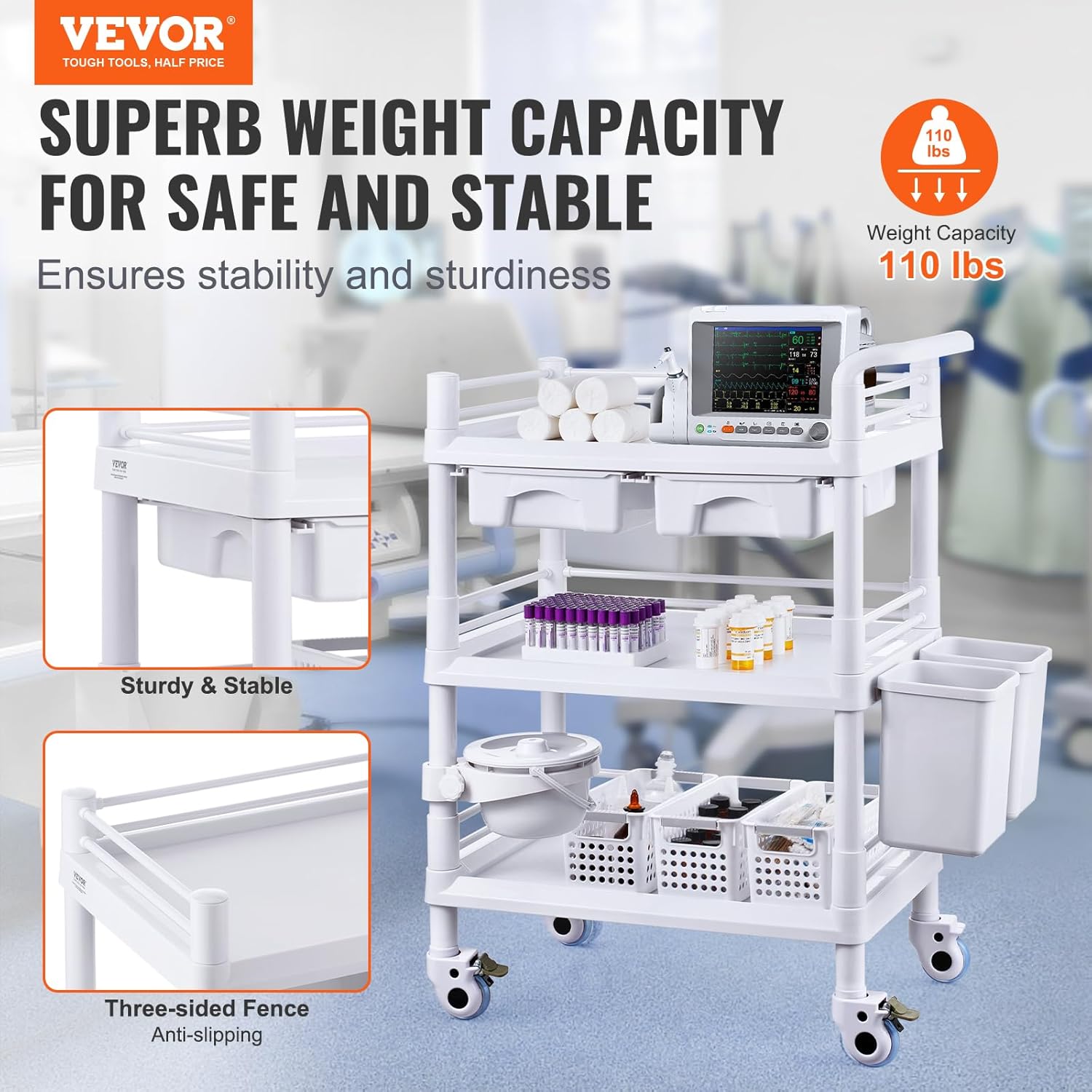
The VEVOR beauty and IV trolley has earned a documented following among home infusion patients. One reviewer with a three-infusions-per-week schedule described the cart as meeting all their organizational needs for IV supplies and medications — citing tray height, surface area, and mobility as the decisive factors. That’s not an incidental endorsement; someone treating their own infusion setup three times weekly is operating at a cadence that exposes any cart weakness fast.
Why does a salon trolley translate? The design intent — a lightweight, mobile surface at accessible height, with small-parts storage — maps neatly onto infusion supply management. IV tubing, alcohol prep pads, needles, and flush syringes are all small-format items that benefit from shallow, divided trays rather than deep drawers.
The tradeoffs are real, though. Beauty trolleys are typically not built to ASTM medical-grade surface standards. They won’t carry the cleanability certifications that institutional buyers require. And a buyer from Home Care Magazine’s Spring 2024 organizing feature would likely point out that an unlocked salon cart in a shared household creates medication security exposure. If your infusion supplies include controlled substances or medications that shouldn’t be accessed by children or others in the home, a standard salon trolley is insufficient on its own.
The decision rule here: If your supplies are non-controlled and your household is low-traffic, a repurposed beauty trolley is a legitimate budget-efficient choice. If you need medication security, move to a cart with a lockable compartment.
Dialysis-Specific Needs: When the Machine Sets the Spec
The JaboEquip cabinet cart earns its clinical reputation for a specific reason: a dialysis patient reported that their machine fit the cart platform precisely, and the lockable lower cabinet directly addressed their medication security concern. That’s a rare combination — enough surface area and load capacity to support a dialysis machine, plus integrated lockable storage.
Home dialysis — particularly peritoneal dialysis, where fluid exchanges happen at home several times daily — generates a consistent, predictable supply volume. The American Journal of Kidney Diseases’ 2023 study on home dialysis barriers found that supply organization and storage access rank among the top practical friction points patients cite when considering whether to continue home therapy versus returning to a center. A cart that resolves both the machine placement and the medication lockdown in one unit isn’t just convenient; it’s a retention factor for home therapy adherence.
By the numbers:
- Home dialysis patients typically consume 60–90 individual supply items per week (tubing sets, solution bags, caps, syringes)
- A lockable cart with a minimum 2-cubic-foot lower cabinet accommodates a week’s supply buffer
- Machine platforms should support at minimum 50 lbs distributed load for most portable home dialysis units
- NHIA’s 2023 guidance recommends dedicated, locked storage for all prescription medications in home infusion settings
Pre-Assembly and Silent Wheels: The Accessibility Factors That Reviews Keep Surfacing
Two features appear in home medical cart reviews with unusual consistency: how much assembly the buyer had to do, and how loud the wheels are.
The pre-assembled mobile medical trolley category draws specific praise from reviewers for arriving ready to use with only wheel attachment required on delivery. For a patient who is immunocompromised, post-surgical, or managing fatigue, “attach four wheels and you’re done” is not a minor convenience — it’s the difference between a cart that gets set up and one that stays in the box.
Silent casters (wheels engineered to roll without vibration noise, typically using polyurethane rather than hard plastic wheel material) surface repeatedly in home-use reviews in a way they don’t in warehouse or clinic reviews. The reason is context: a home is quiet. A cart rolled from a supply closet to a bedroom at 6 a.m. past sleeping family members is a very different use environment than a hospital corridor. Reviewers who mention silent wheels in medical cart reviews are overwhelmingly home users or caregivers in shared living situations.
If you’re purchasing for a hospital-style clinical setup, wheel noise is rarely a specification. If you’re purchasing for home use, it should be near the top of your checklist.
The Defect and Return Problem: Why Cart Quality Control Matters More in This Category
The forimo dental cart serves as the cautionary case study for this guide. Two consecutive units arrived with manufacturing defects — damaged screws and a missing support rod — and the reviewer explicitly flagged that returning a large, heavy cart is logistically impractical for most buyers.
That observation captures a dynamic that affects the entire category. Medical carts are heavy. They ship freight. Return windows are narrow, restocking fees are common, and the logistics of getting a 60-pound cart back into a box when you have limited mobility or a scheduled infusion the next morning is a genuine hardship. The National Home Infusion Association’s patient safety guidance notes that supply chain reliability in the home setting is a patient safety issue, not just a convenience issue — if your organizational system fails on delivery, your therapy routine is disrupted.
This is why seller responsiveness and post-purchase support weight heavily in buyer decisions in this category. Multiple medical cart reviews across sources cite the seller’s willingness to ship replacement parts or respond quickly to defect reports as a purchase factor — sometimes retroactively validating a purchase despite an initial problem.
What to do if your cart arrives defective: Document with photos immediately, before assembly. Contact the seller within 24–48 hours. Ask specifically for part replacement rather than full return — most manufacturers will ship a replacement screw kit or missing component far faster than processing a full return. If the seller is unresponsive within 72 hours, escalate through the marketplace platform rather than waiting.
ABS vs. Steel vs. Repurposed Lab Carts: The Material Tradeoff Explained
ABS plastic (acrylonitrile butadiene styrene — the same material used in clinical carts in many institutional settings) draws a notable endorsement in the VEVOR 4-tier lab cart reviews: a buyer with an engineering background projected a 20-year lifespan from the ABS construction based on material properties and use conditions. That’s the kind of analysis that’s worth taking seriously — not because any single reviewer is definitive, but because it reflects the actual durability profile of ABS in low-chemical-exposure environments.
The practical comparison looks like this:
| Material | Weight | Cleanability | Corrosion Risk | Lifespan Estimate |
|---|---|---|---|---|
| ABS Plastic | Light | Excellent (non-porous) | None | 15–25 years with normal use |
| Powder-coated steel | Moderate–heavy | Good (watch chip points) | Low-moderate at edges | 10–20 years |
| Chrome steel (lab/salon) | Moderate | Good | Moderate in wet environments | 8–15 years |
| Solid wood | Heavy | Poor (porous) | N/A | Not recommended for clinical supply |
For home IV and infusion use, where alcohol wipes, saline, and occasional medication spillage are routine, ABS is the honest material recommendation. Steel carts work well until the coating chips — and in a home setting, chips don’t get addressed the way they do in an institutional maintenance program.
Frequently Asked Questions
1. Can a beauty salon rolling trolley actually work for home IV or infusion supply storage? Yes — and real patients use them. The tray geometry and mobility profile translate well to infusion supply management. The limitation is medication security: salon trolleys don’t lock, and NHIA’s 2023 patient safety guidance recommends locked storage for prescription medications in the home. For non-controlled supplies only, a quality salon trolley is a legitimate choice.
2. How important are silent wheels for a home medical cart used in shared living spaces? More important than most product listings suggest. Clinical carts are spec’d for corridor use; home environments are acoustically much more sensitive. Reviews from home users cite wheel noise more frequently than any other single feature. Prioritize polyurethane casters over hard plastic if the cart will move through sleeping areas or during early morning routines.
3. Which carts arrive mostly pre-assembled so a patient or elderly buyer doesn’t have to build them? The pre-assembled mobile medical trolley category is specifically designed for this. Look for listings that specify “attach wheels only” or “minimal assembly required” — this is distinct from “easy assembly,” which can still mean 45 minutes with a screwdriver. Reviews from limited-mobility buyers are your most reliable signal here.
4. What should I do if my medical cart arrives with missing parts and I can’t easily return it? Photograph everything before assembly. Contact the seller within 48 hours and request part replacement specifically — manufacturers almost universally can ship a replacement screw, rod, or bracket faster than processing a full return. If the seller doesn’t respond within 72 hours, escalate through the retail platform immediately. Do not attempt to substitute hardware — medical cart structural components are sized to spec.
5. Is a lockable cabinet necessary for home medical carts, and which models include one? If any of your supplies are controlled substances, prescription medications, or items that shouldn’t be accessed by others in the household, a lockable cabinet is not optional — it’s what the NHIA’s 2023 patient safety framework recommends. The JaboEquip cabinet cart is the most frequently cited model with this feature among dialysis and infusion patients specifically.
6. How do I choose between an ABS medical cart and a repurposed lab or beauty cart for home use? ABS wins on cleanability and long-term durability in wet or chemical-exposure environments, which describes most home infusion setups accurately. Lab and salon carts in chrome steel work, but chip points and joint corrosion accelerate with repeated alcohol and saline exposure. If you’re projecting 5+ years of regular use, ABS is the cleaner long-term call. For short-term or lower-frequency use, the cost difference may favor a repurposed cart.
The decision frame, plainly: If you infuse three or more times per week and need medication security, the JaboEquip or a comparable ABS cart with a lockable lower cabinet is your bracket. If you infuse once or twice weekly with non-controlled supplies and mobility is a primary concern, a pre-assembled mobile medical trolley with silent casters is the right trade. If budget is the binding constraint and your supplies are non-controlled, the VEVOR beauty trolley has earned its place in real patient setups — just go in clear-eyed about what it doesn’t do.