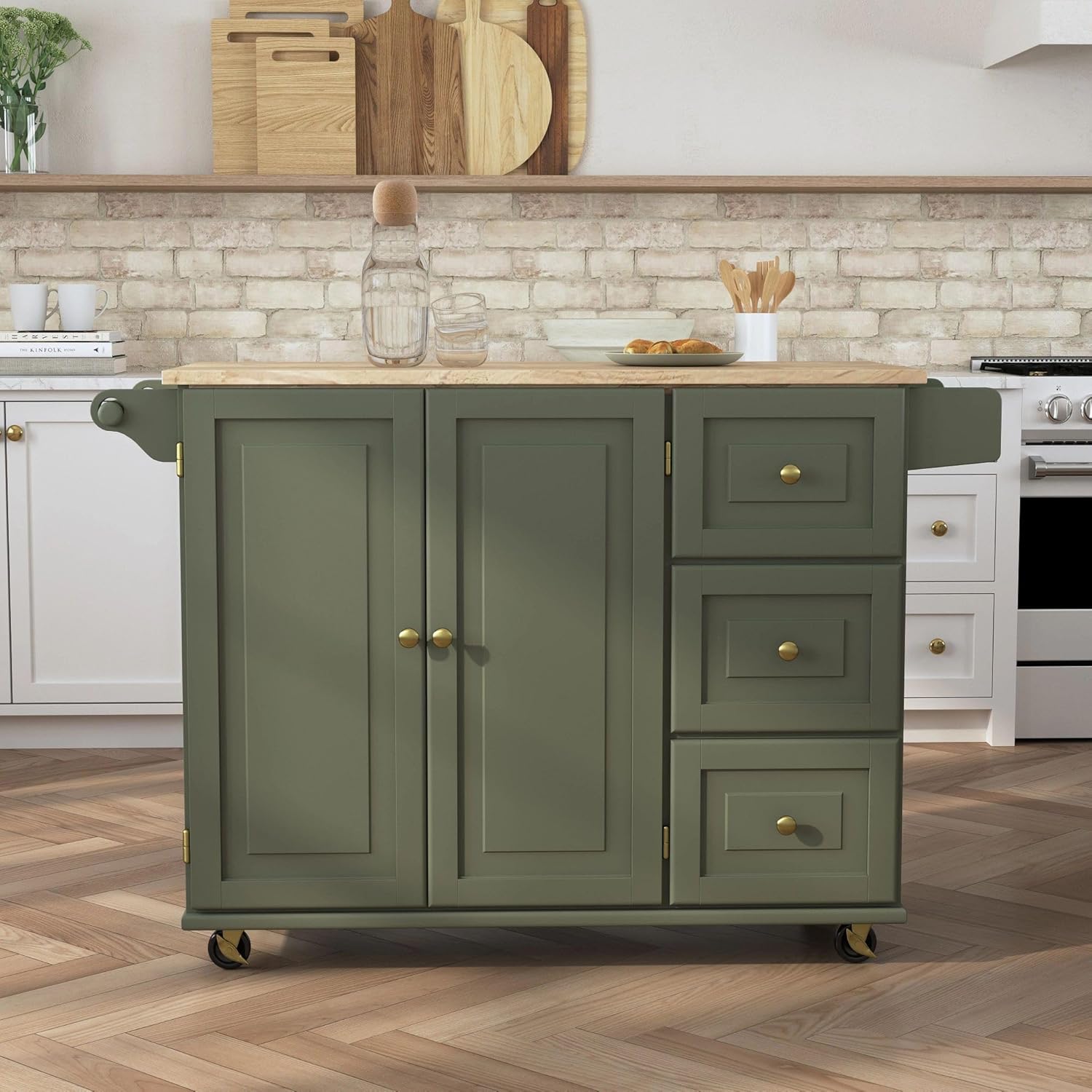
If you’ve ever ordered a piece of flat-pack furniture — furniture shipped disassembled in a box, requiring the buyer to build it at home — you already know the gap between the product photo and the reality of opening the box. A rolling kitchen island (a freestanding prep and storage unit on wheels, typically with a wood or laminate top and cabinet or drawer storage below) looks deceptively simple in listing photos. But across hundreds of verified owner reviews and reports, one theme emerges more consistently than any other: assembly difficulty is almost always worse than the product page suggests, and buyers who go in prepared have dramatically better experiences than those who don’t. This guide surfaces everything those buyers wish they’d known — the tools, the time, the tradeoffs, and the decision rules — before the first screw goes in.
| EDITOR'S PICKHomestyles Mobile Kitchen Islan… | Mid-tierCasual Home Kitchen Island with… | Budget pickHOOBRO Kitchen Island with Powe… | |
|---|---|---|---|
| Length | 53.5" | 40" | — |
| Width | 18" | — | — |
| Height | 36" | — | — |
| Color | Green | Natural/White | Natural/White |
| Wheels | ✓ | — | ✓ |
| Wood top | ✓ | ✓ | — |
| Price | $225.58 | $137.75 | $104.67 |
| See on Amazon → | See on Amazon → | See on Amazon → |
Why Assembly Difficulty Is the Most Underrepresented Attribute in Kitchen Island Buying
Product listings are optimized to sell, not to set accurate expectations. Star ratings aggregate the finished experience — and many buyers who ultimately love their island still describe the build as “harder than expected,” “took way longer than the instructions implied,” or “stopped mid-build to go buy a better screwdriver.” That last detail is telling: the included screwdriver (a short, manual Phillips-head driver packed as a courtesy tool) is universally described as inadequate for a comfortable build across every price tier reviewed.
This matters more than it sounds. A buyer who starts assembly unprepared — flat surfaces covered with parts, wrong tools at hand, no second person available — is more likely to cross-thread a bolt, misalign a door hinge, or overtighten a cam lock (a type of barrel-shaped fastener common in flat-pack furniture that locks panels together with a quarter-turn). Mistakes made under frustration are the root cause of most of the “poor quality” complaints that actually trace back to assembly errors, not manufacturing defects. Consumer Reports’ kitchen storage coverage consistently notes that perceived quality correlates strongly with whether the assembly process went smoothly.
The honest framing: this is a build event, not an afternoon task. Plan accordingly.
The Tools You Actually Need (That Aren’t in the Box)
Here’s the practical short list, drawn from patterns across owner accounts:
Non-negotiable:
- Power drill with a Phillips #2 bit — Not optional. The included screwdriver generates hand fatigue within the first 20 minutes on a full-cabinet unit. Owners who used a cordless drill consistently report faster builds with better screw seating.
- Socket wrench or adjustable wrench — Most islands include carriage bolts or hex-head bolts for structural connections; the included tool handles these poorly or not at all.
- Rubber mallet — For seating dowels and panels without marring finished surfaces.
Strongly recommended:
- Second adult — More on this in the FAQ section, but the short answer is: technically optional, practically close to necessary on any unit with a cabinet body taller than 36 inches or a solid-wood top.
- A flat, clean floor surface — Assembling on carpet introduces leveling errors that compound into misaligned doors and uneven casters.
- Painter’s tape — Useful for temporarily holding sub-assemblies in position while you reach for a fastener.
This Old House’s assembly guidance for flat-pack furniture notes that the single highest-impact upgrade any buyer can make is swapping the included driver for a variable-speed drill — it reduces build time by roughly a third on cabinet-body units.
The Hinged Drop-Leaf vs. Rod-Through-Hole Divide: A Differentiator Most Buyers Miss
One structural detail that owners rarely know to look for before purchase — but consistently cite after — is how a drop-leaf extension (a fold-down surface panel that extends the island’s working area when raised) is supported.
There are two common systems:
Rod-through-hole support: A metal rod slides through a hole in the cabinet body to prop up the leaf. Simple and cheap to manufacture. The tradeoff: the rod protrudes through the cabinet interior when the leaf is down, occupying space and often interfering with shelf use or door swing.
Hinged bracket support: A hinged arm folds out from the cabinet face to support the leaf, then folds flush when not in use. The interior cabinet space remains fully usable regardless of leaf position.
Reviewers of the Homestyles island specifically called out the hinged support design as a genuine differentiator — one reviewer used the phrase “competing products use rod-through-hole systems that reduce cabinet functionality,” which is an unusually precise observation from a non-trade buyer. That kind of detail doesn’t surface in listing copy. It surfaces after someone has already bought the rod-through-hole version, tried to store a cutting board inside, and hit the rod.
Decision rule: If interior cabinet storage is part of your use case (not just the top surface), confirm the drop-leaf support mechanism before purchase. The spec sheet won’t always name the system — look for owner photos showing the cabinet interior with the leaf lowered.
The VEVOR Solid Wood Top Experience: When a Two-Day Build Still Earns Five Stars
The VEVOR Solid Wood Top island generated the most detailed assembly narratives in the owner review set. One reviewer described what they called a “serious build event” — a solo assembly spanning two full days — and still rated the product five stars because the finished unit met their quality expectations. That combination (brutal process, satisfied outcome) is instructive.
What made it hard: the solid hardwood top is heavy enough that positioning it during assembly essentially requires two people, or creative use of furniture sliders and a low work surface. The cabinet body, assembled first, must be stable and level before the top goes on — and achieving that stability on the first try without a second set of hands to hold panels during fastening is genuinely difficult.
What made it worth it: owners consistently report that the finished surface — a real wood top, not a laminate overlay on MDF (medium-density fiberboard, a wood composite material) — responds differently to use over time. Wood Magazine’s coverage of hardwood vs. laminate work surfaces notes that solid hardwood can be sanded and refinished if scored or stained, while laminate cannot be meaningfully repaired once the surface layer is breached. For buyers who plan to use the island for active prep work over years, the repairability argument is real.
By the Numbers:
| Surface Type | Upfront Cost | Repair After Scoring | Typical Lifespan (Heavy Use) |
|---|---|---|---|
| Solid hardwood top | Higher | Sand + refinish | 15–25+ years |
| Laminate over MDF | Lower | Replace panel or full unit | 5–10 years typical |
| Butcher block composite | Mid-range | Spot-sand + oil | 10–20 years with maintenance |
Sources: Wood Magazine hardwood surface guide; Apartment Therapy kitchen island buying coverage.
The Use Case Nobody Markets: Laundry Rooms, Entryways, and Beyond
A surprising pattern across owner reviews: a meaningful share of buyers who purchased “kitchen islands” deployed them in laundry rooms, entryways, mudrooms, and home offices. The reasons are consistent — the combination of a durable work surface, enclosed storage, and mobility (via locking casters) is useful in any room where you need a temporary or semi-permanent work station.
This matters for two reasons:
-
If your use case isn’t the kitchen, the spec details that matter shift. A laundry room installation cares more about caster lock reliability (to keep the unit stationary during use) and surface moisture resistance than about whether the top matches cabinet finish. An entryway deployment cares more about vertical footprint and aesthetics.
-
The product title undersells the actual use case population. If you’re reading kitchen island reviews trying to evaluate a laundry room cart purchase, the relevant signal is there — you’re just looking at the right product under the wrong keyword.
Apartment Therapy’s kitchen island coverage notes this cross-room trend explicitly, observing that freestanding island designs have absorbed a share of the utility cart market in non-kitchen rooms as home layouts have shifted toward open-plan and multi-use spaces.
Frequently Asked Questions
Can one person assemble a rolling kitchen island alone, or is a second adult genuinely necessary?
Technically, most islands can be solo-assembled — the instructions assume one person. Practically, a second adult makes a meaningful difference on any unit with a cabinet body (as opposed to an open shelf unit). The moments where two people matter most: holding cabinet side panels square while driving fasteners, and positioning a solid or butcher-block top without dropping it on an already-assembled base. If you’re assembling solo, plan extra time, use painter’s tape to temporarily hold panels, and work on a hard floor where you can brace components against a wall.
What tools do you actually need that aren’t included in the box?
A power drill with a Phillips #2 bit, a socket wrench or adjustable wrench, and a rubber mallet cover 95% of builds. The included screwdriver is adequate for light assembly tasks but generates fatigue on a full cabinet unit. Multiple owners across reviewed products report stopping mid-build to purchase an electric screwdriver — that’s a pattern, not an outlier.
How long does door alignment adjustment realistically take, and can you fix it after full assembly?
Door alignment (adjusting hinges so cabinet doors hang level and close flush) is adjustable after full assembly on all reviewed units that use European-style cup hinges (the standard recessed hinge on most modern flat-pack cabinets). Adjustment typically takes 5–15 minutes per door once you understand the three-axis adjustment screws on the hinge plate. If doors are misaligned at first hang, don’t assume it’s a defect — check the hinge screws before concluding anything is wrong with the unit.
Do the rolling wheels hold up under the weight of a fully stocked island on tile floors?
Owner reports are mixed at the budget end and more consistently positive at the mid-range and above. The failure mode on lower-cost casters is not usually catastrophic — wheels don’t break off — but they develop flat spots or lose rolling smoothness over 12–18 months under constant load on hard floors. For buyers planning to keep the island in one position most of the time with occasional moves, caster longevity matters less. For buyers who genuinely roll the unit regularly (the laundry room use case, for example), caster quality is worth verifying in owner reviews before purchase.
Is a solid hardwood top meaningfully more durable than the laminate-top options at a lower price point?
Yes, with nuance. Solid hardwood is more durable against the specific failure mode that ends laminate tops: a deep score or moisture breach that reaches the MDF substrate. Once laminate is breached, the MDF beneath swells and the surface is permanently compromised. Hardwood scores can be sanded; hardwood moisture damage can often be addressed with oil and drying. The tradeoff is upfront cost and assembly weight. For buyers who use the surface for active food prep — cutting, rolling, heavy pot placement — the repairability argument favors solid hardwood over a 3–5 year horizon. For buyers who primarily want the storage and use the top lightly, laminate at a lower price point is a reasonable call.
The Decision Rule
If you’re still deciding whether to invest the time and money in a mid-range or solid-wood island versus a lighter-duty option: match the surface type to how the top will actually be used, not how you hope it will be used. Owners who bought laminate tops intending to use them lightly and then used them heavily are the ones writing replacement reviews 18 months later. Owners who bought solid hardwood tops, survived the build, and use the island daily are the ones writing five-star reviews two years in.
The build is harder than the product page says. Go in with a drill, a second adult if you can get one, and a clear afternoon. The finished unit will earn its place — in the kitchen or wherever else you put it.