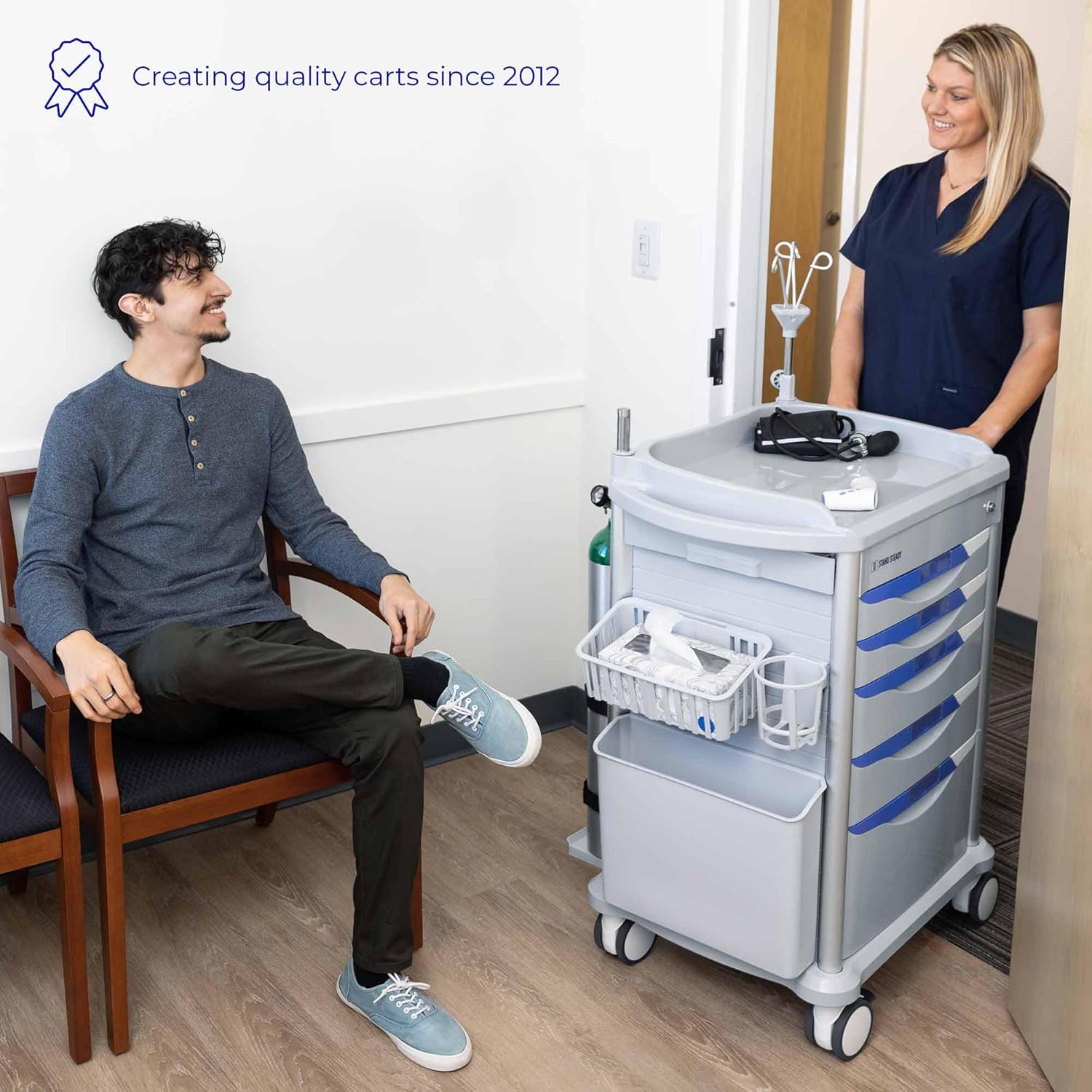
If you’ve ever stood in a supply room staring at two steel carts — one labeled “crash cart” and one that your facility ordered for an activity program — and wondered whether they’re really that different, you’re not alone. A crash cart is an emergency-response mobile unit stocked with resuscitation supplies, designed for fast access by clinical staff under pressure. A clinical trolley (also called a therapy or activity cart) is a rolling workstation built for planned, repeated use — delivering sensory materials, craft supplies, ADL (activities of daily living) training tools, or rehabilitation equipment directly to a patient’s room or group space. The carts can look nearly identical from ten feet away. Under the hood, the differences in drawer configuration, weight rating, surface material, and locking systems will either serve your program well or create daily friction, compliance headaches, and premature equipment failure. This guide walks through how to read those differences and match the right cart configuration to the specific kit you’re running.
| EDITOR'S PICKStand Steady Emergency Crash Ca… | Mid-tierVEVOR 4 Tiers Lab Carts | Budget pickMobile Medical Carts 3 Tier Pro… | |
|---|---|---|---|
| Drawers | — | 3 | — |
| Tiers / Shelves | — | 4 | 3 |
| Max load | — | — | 330 lbs |
| IV pole | ✓ | — | — |
| Power strip | ✓ | — | — |
| Sharps box | — | — | ✓ |
| Price | $1,099.99 | $199.90 | $152.99 |
| See on Amazon → | See on Amazon → | See on Amazon → |
Why Drawer Configuration Is the Actual Decision
Most buyers anchor on price or brand first. The smarter anchor is drawer configuration — the number, depth, and weight rating of individual drawers — because that determines whether your supply kit actually fits the cart you’re buying.
Here’s the mismatch that shows up repeatedly in long-term care procurement: a facility orders a general clinical trolley with six shallow drawers (each roughly 2 inches deep, rated for 15–20 lbs) because it photographs well in a catalog. Then the activity director tries to load it with a sensory kit — weighted lap pads, fidget tools, textured fabric swatches, aromatherapy diffusers, and an adaptive art supply tray. The shallow drawers won’t accept the weighted pads. The total loaded weight exceeds the caster rating. Within six months, two drawers are warping and one caster has failed.
The AOTA’s Occupational Therapy Practice Framework (4th Edition) describes activity-based intervention as requiring context-specific material access — meaning the practitioner needs the right item at the right moment, without digging. That’s a drawer architecture problem as much as it is a clinical one.
Drawer Depth Categories You’ll See in Spec Sheets
| Drawer Depth | Typical Use Case | Watch Out For |
|---|---|---|
| 1.5″ – 2.5″ (shallow) | Gloves, small instruments, paperwork | Sensory items won’t fit; prone to overloading |
| 3″ – 4″ (mid-depth) | Craft supplies, fidget kits, small adaptive tools | Best all-around for activity programs |
| 5″ – 7″ (deep) | Weighted items, splinting material, large supply rolls | Fewer drawers total; heavier loaded weight |
| Full-extension vs. 3/4-extension | Full-extension drawers expose the entire drawer floor | 3/4-extension hides 25% of depth — dead space in a sensory kit |
Spec sheets put full-extension drawer slides at a 30–50% price premium over 3/4-extension slides in the same cart line. For a dementia-care sensory program where a resident or aide needs to see every item without reaching, full-extension is worth that premium. For a back-of-house supply storage cart, it’s not.
Crash Cart Features That Don’t Translate to Therapy Settings
Understanding what crash carts are optimized for helps you recognize when you’re being sold the wrong tool.
Emergency crash carts — the kind specified under CMS State Operations Manual guidance for long-term care and acute facilities — are engineered around three priorities: tamper-evident sealing (usually a numbered breakaway seal or lock that proves the cart hasn’t been accessed between checks), rapid full-access opening (often a single-key or seal-break that opens all drawers simultaneously), and decontamination-grade surfaces (typically cold-rolled steel with powder coat or ABS polymer panels rated for repeated disinfectant exposure).
Those features actively work against a therapy or activity program:
- Tamper-evident seals require resealing after every use, creating administrative burden for activity staff who open the cart 10–20 times per session.
- Rapid-access single-key systems mean you can’t lock individual drawers for sharps or controlled supplies while leaving sensory materials accessible to residents — a common requirement in memory care.
- Decontamination-grade steel interiors are cold, hard, and loud — a sensory consideration that matters in autism programs or dementia care, where the sound of metal-on-metal drawer slides can be dysregulating.
Clinton Industries’ clinical cart specification sheets (2025 catalog) distinguish their therapy and treatment cart lines from emergency response units specifically on these axes: therapy carts offer individual drawer locks, polymer or laminate interior liners, and quiet-close drawer slides as standard or upgrade options. That distinction isn’t marketing language — it’s a functional separation that should drive your specification.
Matching Cart Configuration to Your Specific Kit
Dementia-Care Sensory Programs
Per OT Innovations’ guidance on sensory cart setup for dementia care programs, a well-configured sensory trolley for a memory care unit typically needs:
- 2–3 mid-depth drawers (3″–4″) for tactile kits: textured fabrics, fidget boards, soft balls
- 1 deep drawer (5″+) for weighted items (lap pads, weighted stuffed animals rated 3–5 lbs)
- Open top shelf or removable tray for visual/olfactory items in active use during a session
- Non-locking or push-release drawers on at least two tiers, so residents with limited dexterity can access materials independently if the program supports that
Diversified Woodcrafts’ healthcare cart line (per their 2025 spec catalog) offers solid-maple construction with a water-based lacquer finish that passes ASTM F963 toy safety standards for surface coatings — a meaningful spec if residents will be handling items stored directly in the cart. Their drawer interiors are lined with a smooth melamine surface rather than bare wood or steel, which reduces friction noise and simplifies wipe-down between residents.
The tradeoff: Wood-construction carts in the Diversified Woodcrafts tier run $650–$950 depending on configuration. Steel clinical trolleys from Medline or Hausmann in comparable drawer counts run $400–$600. The wood carts tolerate humidity and cleaning chemical exposure differently — manufacturers rate them for “healthcare-grade cleaner” use, but quarterly inspection of finish integrity is recommended in high-humidity environments like bathing areas.
Autism Sensory Rooms and School-Based OT
The NCTRC’s 2024 CTRS Job Analysis Study identifies portable material delivery as one of the top five workflow constraints for therapeutic recreation specialists working across multiple rooms or units. For school-based OT or autism sensory programs that move between classrooms, the configuration priorities shift:
- Compact footprint (no wider than 24″ to navigate doorways without repositioning)
- Lightweight loaded weight (total cart + contents under 60 lbs for a single practitioner to manage safely)
- Bright or customizable exterior — some programs use color-coded carts by sensory category; this is easier with powder-coat options or panel inserts than with raw stainless
Hausmann’s therapy cart line includes models with ABS plastic drawer fronts available in multiple colors, which operators in long-run reviews note allows programs to build visual systems (e.g., blue drawer = calming tools, red drawer = alerting tools) without labeling. That’s a low-cost differentiation that CMS surveyors won’t flag as a compliance issue the way a hand-painted surface might.
Medication and Supply Hybrid Programs
Some activity directors — particularly in memory care and skilled nursing — run programs that combine sensory materials with OTC (over-the-counter) topical supplies: lotion for hand massage, lip balm for oral motor work, barrier cream for skin-integrity checks during ADL training. This is where individual drawer locks become non-negotiable.
CMS guidance under Appendix PP of the State Operations Manual requires that any cart accessible to residents in a common area that contains topical medications or health-related supplies be secured against unsupervised access. A crash cart’s single-lock-opens-all system fails this requirement for a hybrid activity cart, because locking the medicated items means locking the sensory materials too.
The specification you want: individual drawer keyed locks on 1–2 drawers, with the remaining drawers on a push-release or friction-close system. Both Clinton Industries and Hausmann offer this as a standard configuration option in their mid-tier clinical trolley lines. Ask your rep to confirm it’s specified in writing on the purchase order — it’s occasionally listed as an upgrade that gets dropped in value-engineering conversations.
The Numbers That Matter Before You Sign
By the numbers — cart specification quick-check:
- Caster diameter minimum for carpeted healthcare corridors: 4″ (100mm), per most facility flooring standards; 3″ casters are common on budget carts and will bind on low-pile carpet transitions
- Drawer weight rating to confirm: 30 lbs per drawer minimum for a loaded sensory kit; 15–20 lb-rated drawers are sized for paperwork, not weighted therapeutic items
- Warranty gap to watch: budget clinical trolleys in the $300–$450 range typically carry 1-year caster warranties; Clinton Industries and Hausmann mid-tier carts carry 3–5 year caster and frame warranties — a difference that shifts TCO significantly in a facility that runs carts 5+ hours per day
- ADA aisle clearance: cart parked width must leave 36″ minimum clear passage; confirm your cart’s footprint against your room’s narrowest point before ordering
Decision Rules: If X, Then Y
The comparison above points to a few clean decision rules for the practitioner with a purchase order in front of them:
If your program is dementia-care or sensory-focused and residents will interact directly with the cart: Specify a wood-construction or polymer-lined clinical trolley (Diversified Woodcrafts or comparable), full-extension drawer slides, and quiet-close hardware. Budget $650–$950. The sensory and durability characteristics justify the premium over steel.
If your program moves between rooms daily and is managed by a single practitioner: Prioritize loaded weight under 60 lbs, 4″ casters minimum, and a compact footprint. Hausmann’s mid-tier portable therapy carts meet these specs at $450–$650 and are available through most GPO (Group Purchasing Organization) contracts, which matters if your facility is GPO-aligned.
If your program combines sensory materials with any topical health supplies: Do not spec a crash cart or a crash-cart-adjacent trolley with single-key-opens-all locking. Specify individual drawer locks on at least two drawers. Confirm compliance with your facility’s CMS survey history before finalizing.
If you’re on a restricted budget and must stay under $400: A Medline or basic clinical trolley in the $350–$400 range will function — but build a replacement cycle into your program budget at year 2–3, verify caster diameter before ordering, and don’t load weighted items into shallow drawers. Document the spec limitations in your program files in case of a CMS survey.
The cart is infrastructure. A drawer configuration that fights your supply kit will cost you more in workarounds, failed equipment, and staff frustration than the price difference between tiers. Get the drawer spec right first, then let the budget conversation happen around it.