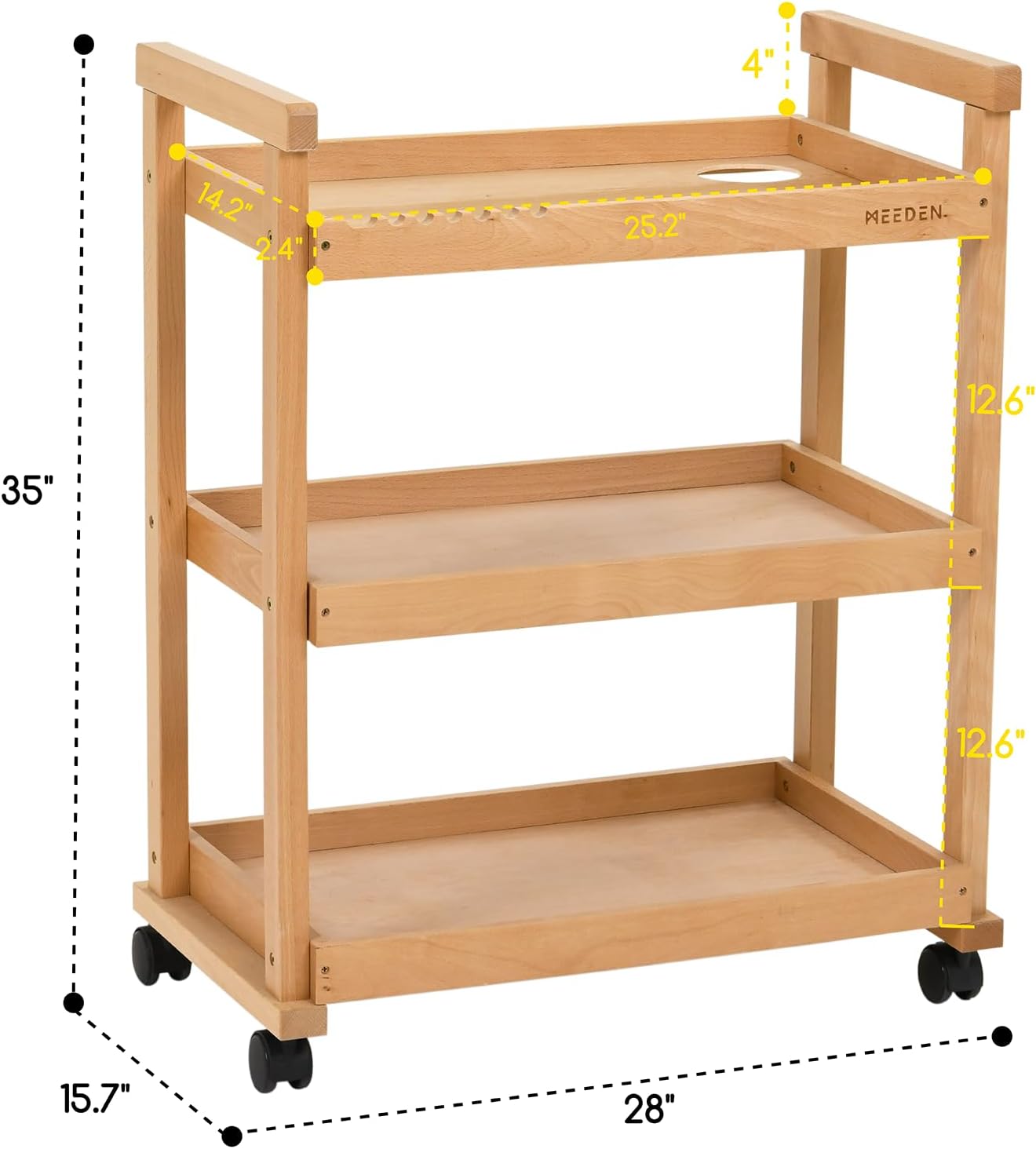
A taboret — pronounced “TAB-uh-ret” — is simply a compact rolling cabinet designed to hold an artist’s materials within arm’s reach of the easel or work surface. Think of it as a mobile side table with drawers, sized to park beside a drafting table or painting station. The name is old French, borrowed from a small drum of similar proportions, and the form has been standard studio furniture since the nineteenth century. What separates a premium solid-wood taboret from the particleboard or steel alternatives cluttering school supply catalogs is roughly what separates a solid hardwood workbench from a flat-pack one: joint integrity over time, surface durability under solvent exposure, and the kind of structural rigidity that keeps drawers tracking cleanly after years of daily use. If you’re at the point of specifying studio furniture rather than just buying storage, this article will help you decide whether solid beech is worth the price premium — and which build details actually matter.
| EDITOR'S PICK[MEEDEN Art Supplies Storage Car](https://www.amazon.com/dp/B0GQXJ78Z3?tag=greenflower20-20)… | Mid-tier[MEEDEN Art Supply Storage Cart](https://www.amazon.com/dp/B087ZG3CBF?tag=greenflower20-20) | Budget pick[MEEDEN Art Cart Storage Organiz](https://www.amazon.com/dp/B09QSQGTFJ?tag=greenflower20-20)… | |
|---|---|---|---|
| Tiers | 5 | 5 | 3 |
| Drawers | 3 | 3 | — |
| Material | Solid Beech Wood | Solid Beech Wood | Solid Beechwood |
| Finish | Natural | Cherry Walnut | — |
| Wheels | 4 | 4 | Caster Wheels |
| Cart type | Utility Rolling | Utility Rolling | Rolling Utility Studio Taboret |
| Price | $373.96 | $336.57 | $132.95 |
| See on Amazon → | See on Amazon → | See on Amazon → |
Why Solid Beech, Specifically
Not all hardwood taborets are created equal, and wood species choice is where many buyers make an underinformed decision. Beech (Fagus sylvatica or Fagus grandifolia) earns its place in studio furniture for reasons that go beyond aesthetics.
Hardness and surface durability. Per the Janka hardness scale — an industry-standard measure of a wood’s resistance to denting, published in reference tables by the Wood Database and cited routinely in Wood Magazine’s construction editorials — European beech scores approximately 1,300 lbf, placing it meaningfully above basswood (~410 lbf) and well above the pine used in economy studio furniture (~870 lbf). In a working studio, that difference shows up as drawer tops that resist palette knife dings and surfaces that don’t telegraph every dropped turpentine bottle.
Stability relative to cost. Beech is a closed-grain species, which means it accepts finishes more evenly than open-grain alternatives like oak, and its moderate movement coefficient makes it less prone to drawer-binding seasonal shifts than, say, ash. Wood Magazine’s editorial guidance on wood movement in furniture construction notes that quartersawn beech exhibits roughly half the tangential movement of flatsawn oak — a meaningful consideration for drawers that need consistent tolerances year-round in a humidity-variable studio environment.
Tool-friendliness in manufacturing. Beech machines cleanly, which is why it’s the dominant species in European woodworking schools and studio furniture traditions. It produces tight dovetails and mortise-and-tenon joints with minimal blowout, meaning that when you’re comparing joinery quality across brands, a beech taboret is more likely to reward close inspection than an equivalent in softer or more variable-grain species.
The practical implication: if you’re comparing a solid beech taboret against a “hardwood” unit that turns out on closer inspection to be beech-veneer over MDF or a softer solid species, you’re looking at a meaningful structural gap — not a cosmetic one.
The Build Details That Actually Separate the Field
Once you’ve confirmed species and solid-wood construction throughout (not just on drawer fronts — check the carcass sides, drawer boxes, and top), the following specifications are where mid-range and premium taborets diverge.
Joinery at the carcass. Dovetail or mortise-and-tenon joinery at the case corners is the signal you want. Pocket screws into end grain are what you’ll find in budget builds; they hold initially but loosen under the lateral stress of rolling across uneven floors. Apartment Therapy’s studio organization editorial roundup notes that readers who’ve owned pocket-screw carts for three-plus years consistently report drawer-track degradation that solid-jointed alternatives don’t show at the same age.
Drawer slide specification. Side-mount metal slides rated at 75–100 lbs per drawer are the working standard for a serious taboret. Under-mount slides feel premium in a furniture showroom but are harder to service when they fail, and they fail more often in environments where drawers are opened under heavy lateral load (common when a cart is at an angle on a sloped studio floor). Full-extension slides — those that let the drawer travel all the way out so you can see the back — are worth the incremental cost for deep drawers storing tubes, brushes, or rolled paper.
Caster grade and warranty. This is where the real total-cost-of-ownership gap appears, and it’s worth spending time on. Economy taborets typically ship with 2-inch twin-wheel casters rated to 150 lbs total — adequate for a light load on a smooth floor, borderline on anything else. Premium units in the $400–$700 range increasingly specify 3-inch polyurethane casters rated to 250–300 lbs with individual locking mechanisms on at least two wheels. Per aggregated owner reviews across woodworking forums and product listings, polyurethane casters on studio carts outlast rubber-wheel alternatives in solvent-exposure environments by a meaningful margin — rubber degrades with repeated contact with mineral spirits and acetone vapors that settle at floor level. Check the caster warranty independently from the cart warranty: a five-year caster warranty versus a one-year warranty is a concrete, comparable data point that reflects the manufacturer’s confidence in the component.
Top surface treatment. A lacquered or oil-wax finished beech top is serviceable but will need periodic renewal in active studios. Some premium taborets ship with a tempered-glass insert over the top drawer — useful if you’re mixing on the surface — while others offer replaceable laminate tops. Neither is categorically superior; the right choice depends on your specific workflow. What matters is that the base wood is substantial enough to support a glass insert without flex (look for tops at least ¾ inch thick) and that the finish is solvent-resistant rather than merely water-resistant.
By the Numbers: Taboret Spec Tiers at a Glance
| Tier | Typical Price | Carcass Material | Caster Rating | Drawer Slides | Warranty |
|---|---|---|---|---|---|
| Entry ($80–$180) | Laminate over MDF or pine | 150 lb total | Plastic, no lock | 90 days–1 year | |
| Mid ($200–$380) | Hardwood veneer or mixed solid | 200 lb total | Rubber, 2-wheel lock | 1–2 years | |
| Premium ($400–$700) | Solid beech throughout | 250–300 lb total | Polyurethane, locking | 3–5 years |
The numbers above are composites drawn from published product specifications across the category as of spring 2026. Individual units vary; always verify with the manufacturer’s current spec sheet before purchasing.
What Reviewers and Owners Consistently Report
Because this is a niche category with limited formal editorial coverage, owner review patterns are particularly useful signals. A few patterns hold across aggregated reviews:
The drawer-fit complaint is the most common failure mode in mid-range units. Owners of veneer-over-MDF taborets at the $200–$300 price point consistently report drawer binding or loosening within two to four years, particularly in climates with pronounced seasonal humidity swings. Solid beech units show this complaint far less frequently in the same review windows, which aligns with what Wood Magazine’s construction editorials predict based on movement coefficients.
Finish durability is the most common premium-tier complaint. Solid beech taborets at the $500+ level receive strong structural reviews but occasional criticism of the factory finish — specifically lacquers that chalk or yellow under UV exposure in skylit studios. This is a manageable issue (a light oil-wax refresh annually is standard studio furniture maintenance) but worth knowing if your studio gets strong direct sun.
Caster replacement is underrated as a purchase criterion. Reviewers who’ve owned taborets for five-plus years consistently note that caster replaceability — whether the manufacturer uses a standard stem diameter or a proprietary fitting — determines whether the cart has a ten-year life or gets retired when a caster fails. Per Wirecutter’s art cart guidance, specifying a cart with standard 7/16-inch or ½-inch stem casters means you can source replacements from any hardware supplier rather than going back to the manufacturer.
This Old House’s storage solution editorial guidance on rolling studio furniture notes a similar pattern: buyers who specify solid-wood units with replaceable hardware components report meaningfully higher satisfaction at the five-year mark than those who prioritized entry price.
The Grant and Budget Timing Window
If you’re purchasing for a school, community arts center, or therapeutic arts program rather than a private studio, the fiscal timing here matters. As of May 2026, many K–12 discretionary budgets are in end-of-year spend-or-lose territory — a solid-wood taboret at $450–$600 is a reasonable single-line purchase that doesn’t require a capital equipment approval process at most institutions. DonorsChoose projects for art room upgrades consistently fund at higher rates in April–June than at any other time of year, per the platform’s own funding-cycle data; if you’re a classroom teacher considering this purchase, a project submitted now with a June close date catches peak donor activity.
For therapeutic recreation and occupational therapy programs, the Alzheimer’s Foundation of America’s program grants and ARPA-funded senior services allocations at the state level have largely moved into disbursement and reallocation phases by mid-2026. Solid-wood activity carts that serve dual purposes — supply storage and activity surface — can qualify under both art therapy and environmental enrichment line items in many program budgets. It’s worth a conversation with your grants administrator before defaulting to a clinical-grade metal cart if a premium wood taboret meets your clinical environment’s cleanability standards (most oil-wax finished hardwood surfaces do, with appropriate solvent-free cleaning protocols).
The Decision Rule
Here’s the straightforward if/then framework, based on the spec and review patterns above:
If you’re outfitting a single serious studio, are keeping the cart for seven-plus years, and have a floor that isn’t perfectly level — solid beech with full-extension slides and polyurethane locking casters is worth the $400–$600 price point. The joinery holds, the drawers track, and the casters survive the chemistry.
If you’re buying multiples for a classroom rotation on a school budget — the premium tier is harder to justify per unit. A mid-range hardwood-veneer unit with a verified two-year warranty and standard-stem casters is the honest recommendation: accept the finish compromises, plan to replace casters at year three, and put the savings toward more units.
If you’re specifying for a therapeutic arts program — weigh the cleanability protocol first. Solid beech with an oil-wax finish cleans well with pH-neutral soap and water, but it is not a clinical-grade surface for programs that require hospital-grade disinfectant. In those environments, a hybrid unit (solid-wood carcass, laminate top insert) or a Diversified Woodcrafts institutional cart is a better fit than a fine furniture taboret.
The artist’s taboret is one of those pieces of studio furniture where the premium is genuinely earned — but only if the build details back it up. Confirm the species, verify the joinery, check the caster stem diameter, and read the warranty language before the invoice goes through. The math on a well-built beech taboret holds over a decade; the math on a cheaper unit often doesn’t make it past year four.