A rolling cart — any wheeled storage unit you can push from room to room — sounds simple until you realize the configuration you pick (open shelves, drawers, or some mix of the two) determines whether the cart actually gets used or becomes a parked obstacle. Open-shelf carts let you see everything at a glance; drawer carts keep loose items corralled and out of sight. Both claims sound like sales copy until you’re the one deciding between a cart that ships in six pieces or one that arrives ready to roll, or figuring out whether your acrylic paint bottles will topple every time you cross a door threshold. If you’re mid-decision right now — comparing SKUs, weighing a second cart, or trying to justify a specific format to a department head — this guide is built for that moment. We’ll name the tradeoffs explicitly, show the numbers where they matter, and land on clear decision rules you can use today.
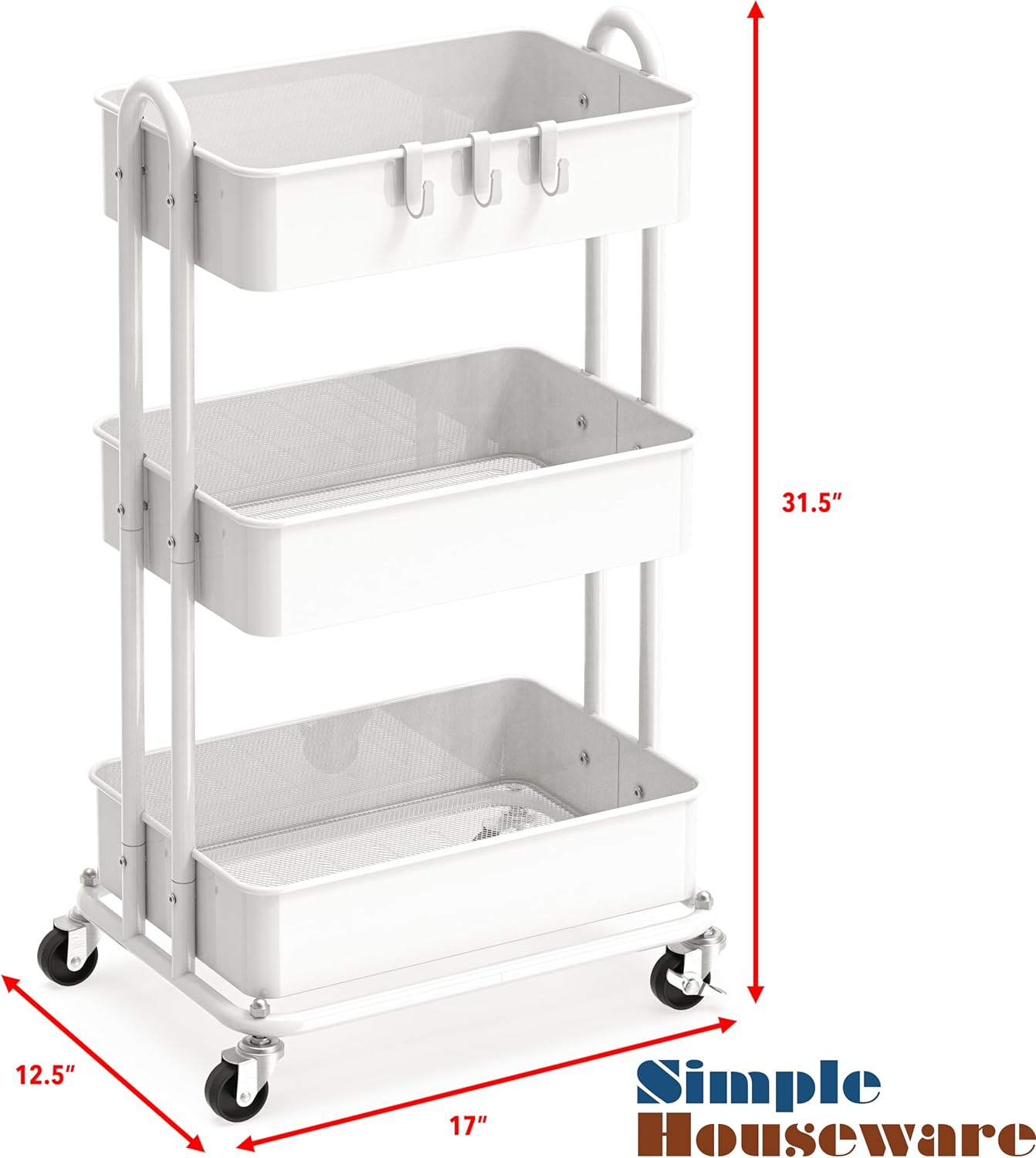
| EDITOR'S PICK[Simple Houseware Utility Cart w…](https://www.amazon.com/dp/B07K6VF8GJ?tag=greenflower20-20) | Mid-tier[Amazon Basics 3-Tier Rolling Ut…](https://www.amazon.com/dp/B07TY1RFH5?tag=greenflower20-20) | Budget pick[Pipishell 3 Tier Rolling Cart](https://www.amazon.com/dp/B07Z3MX5GY?tag=greenflower20-20) | |
|---|---|---|---|
| Tiers | — | 3-Tier | 3 Tier |
| Drawers | 12 Drawers | ✗ | — |
| Wheels | — | Lockable | — |
| Handle | — | — | with Handle |
| Color | Chrome | White | White |
| Price | $79.97 | $34.77 | $26.99 |
| See on Amazon → | See on Amazon → | See on Amazon → |
The Core Tradeoff: Visibility vs. Containment
The open-shelf vs. drawer debate is really a visibility vs. containment debate, and which side wins depends entirely on the size and shape of what you’re storing.
Open shelves (the three-tier wire or powder-coated metal carts popularized by brands like Simple Houseware, Amazon Basics, and Pipishell) are structurally simple: a frame, horizontal grates or solid decks, and casters. Their value proposition is immediate visual inventory — you know what’s on the cart without opening anything. Reviewers across aggregated product feedback consistently praise the ease of assembly on these carts; the Amazon Basics version earns specific callouts for its raised shelf edges, which one reviewer who self-described as clumsy credited with preventing items from sliding off during transit. SunnyPoint’s similar format receives comparable praise for wheel quality. The pattern across these reviews is consistent: for larger items (binders, containers, rolled paper, small appliances), open shelves are hard to beat on convenience and access speed.
Drawer carts solve a different problem. When your inventory is made up of small, loose items — loose screws, marker caps, seed packets, medication blister packs, electronic components — open shelves become a scattering problem in motion. A drawer gives each category a physical boundary. Simple Houseware’s 12-drawer chrome cart is a strong real-world signal here: at least one reviewer reported ordering a second unit after the first held up through regular use for electronics parts sorting. That’s not a ringing product endorsement in the abstract; it’s a durable use-case fit signal. The format works when the items fit the drawer depth, and when the user is disciplined about categories.
The honest tension: drawer carts introduce failure points that open-shelf carts don’t have. Bent or misaligned tracks on arrival are the single most common complaint across drawer cart SKUs, surfacing consistently in aggregated reviews. This isn’t a fringe problem — it’s a structural risk that should factor into your purchase decision and your receiving checklist.
Three-Tier Open Carts: What the Spec Sheets and Reviewers Actually Tell You
If your items are bigger than a deck of cards, open shelves will almost always out-perform drawers on access speed and loading flexibility. The question shifts to: which open-shelf cart, and what frame material?
Powder-coated steel frames (Simple Houseware, Amazon Basics, Pipishell, SunnyPoint) hit the $40–$80 range and are built for light-to-medium loads — typically rated for 30–50 lbs per shelf by the manufacturer. That’s enough for most classroom supply runs, craft room organization, or utility overflow in a garage. Wirecutter’s utility cart coverage (New York Times, 2025) notes that wire-shelf carts offer airflow benefits for food storage contexts but are less ideal when small items need a solid surface to rest on.
The DTK cart is worth a separate mention here because it changes the formula. Its differentiating features — side bags and a wooden tray surface — were praised independently by a cosmetologist and a photographer in separate review contexts. That cross-context validation matters: it tells you the accessory load-out is doing real work, not just marketing work. If your use case involves tools, brushes, or lightweight accessories that you want at arm’s reach without taking up shelf space, the DTK format earns its slightly higher price point. The accessories drive use-case fit more than the shelves alone.
Quick benchmark:
| Format | Typical shelf load rating | Assembly required | Primary failure mode |
|---|---|---|---|
| 3-tier wire/steel (Simple Houseware, Amazon Basics) | 30–50 lbs/shelf | Yes (15–30 min) | None significant at tier |
| DTK hybrid (bags + wood tray) | 25–35 lbs/shelf | Yes | Side bag attachment wear over time |
| IRIS USA pre-assembled drawer cart | Varies by drawer count | No | Track misalignment if shipped damaged |
| GOFLAME multi-drawer | 10–15 lbs/drawer | Yes | No built-in label slots; drawer rattle on uneven floors |
Drawer Carts: When Containment Is Worth the Tradeoffs
The strongest case for a drawer cart is when your items are small, categorically distinct, and accessed by multiple people. Think: a shared makerspace with resistors and connectors sorted by value, a classroom with 30 different colors of specialty tape, or a studio where client-specific supplies need to travel in organized batches.
The GOFLAME multi-drawer format earns genuine praise for two features: removable drawers (which let you pull an entire category and carry it to a workstation) and low drawer height that makes the lower tiers accessible to children. But owners consistently flag the same gap — there are no built-in label slots, which matters significantly in multi-user environments. This is a solvable problem (more on this below), but it’s a cost in time and materials the spec sheet doesn’t mention.
The IRIS USA pre-assembled cart deserves its own paragraph because pre-assembly is, functionally, a different product category for a specific buyer. Contract Design’s 2024 coverage of mobile storage in clinical and education environments notes that facilities increasingly specify pre-assembled or tool-free cart formats to reduce staff setup burden and eliminate the liability risk of an improperly assembled cart used in a clinical or patient-adjacent setting. Reviewers of the IRIS USA format explicitly — and repeatedly — cite pre-assembly as the reason they chose it over alternatives. This isn’t a convenience feature for these buyers; it’s a requirement. If your buyer profile includes people who explicitly say they do not assemble furniture (a phrase that appears verbatim in multiple IRIS USA reviews), the IRIS USA format is the correct answer regardless of the price premium.
Apartment Therapy’s rolling cart coverage (2025) reinforces a point worth naming directly: plastic drawer carts and metal open-shelf carts are not in the same durability tier, but they’re also not always competing for the same job. A plastic pre-assembled cart that gets used twice a week in a low-impact environment will outlast its spec-sheet promise. A metal open-shelf cart used daily in a high-traffic school hallway will wear casters before frames.
Hybrid Formats: When You Need Both
The hybrid configuration — typically an open top shelf or two with a bank of drawers below — is the answer when you have both large items (that benefit from open access) and small loose items (that need containment). This Old House’s tool storage coverage (2025) points to exactly this configuration as the default choice for workshop environments where large tools sit on open decks and hardware lives in drawers below.
For classroom and studio buyers, the hybrid format requires one honest concession: you’re paying more for a cart that does two things adequately, rather than one thing excellently. If 80% of what you store is small and loose, a full drawer cart is a better investment. If 80% is bulky and frequently rotated, the open-shelf format wins. The hybrid earns its place when the split is genuinely close — or when the storage context is shared and diverse enough that no single format would satisfy all users.
Frequently Asked Questions
1. Do the drawers on multi-drawer carts stay closed when rolling across uneven floors? Across aggregated reviews of GOFLAME and similar multi-drawer carts, drawer rattle on uneven or threshold surfaces is a documented issue — not universal, but common enough to flag. Owners who store heavy items in the lower drawers report less movement. If your route crosses tile-to-hardwood transitions or door thresholds regularly, verify whether the drawer format includes any retention mechanism (a lip, a latch, or friction fit) before purchase. Most budget drawer carts do not.
2. Are the drawer tracks on metal-frame drawer carts sturdy enough for heavy supplies like paint or tools? Manufacturer ratings for budget-tier drawer carts typically cap individual drawer capacity at 10–15 lbs. Full paint bottles and hand tools regularly exceed this. Bent tracks on arrival are the most commonly cited complaint across drawer cart SKUs in aggregated reviews — which means the tracks are already near their tolerance limit before loading. For heavy supplies, an open-shelf cart with a higher per-shelf load rating is a more honest match.
3. How do I label drawers on carts that don’t have built-in label slots? GOFLAME owners consistently flag this gap. The practical solutions that appear repeatedly in owner feedback: adhesive label holders (the P-touch-compatible plastic sleeves, available in bulk) adhered to drawer faces, or a strip of washi tape used as a dry-erase surface with a fine-tip wet-erase marker. Neither requires modifying the cart. For clinical or institutional environments where label permanence matters, adhesive label holders rated for repeated adhesive cycles are the more reliable choice.
4. Is a pre-assembled plastic drawer cart as durable as a metal flat-pack open cart? Not in a high-impact daily-use environment. But durability is contextual. IRIS USA’s pre-assembled format is built for moderate use — craft rooms, classrooms, home offices — not for rolling across gravel or supporting 50-lb loads per shelf. The durability question only matters when the use cases actually overlap. If you need a cart that ships ready to use and will see twice-weekly light-to-moderate use, the IRIS USA format holds up well based on owner-reported longevity. If you’re loading it with power tools and rolling it across a workshop daily, a metal cart with higher load ratings is the correct answer.
5. Can I mix open shelves and drawers, or do I have to choose one format? You don’t have to choose. Hybrid carts (open top deck with drawer bank below) are a standard format across multiple brands. Alternatively, if your space allows, two purpose-built carts — one open-shelf, one drawer — often outperform a single hybrid because each is optimized for its job. The hybrid earns its place when budget, footprint, or the nature of your inventory genuinely splits between large and small items.
6. How do the side bags and hooks on hybrid carts hold up over time? The DTK cart’s side bags earned praise from a cosmetologist and a photographer independently — cross-context validation that the format holds up in regular professional use. The long-term failure mode to watch is attachment point wear: the clips or hooks that connect bags to the frame can loosen with repeated loading cycles. Owners who use side bags for heavier items (tools, product bottles) report faster wear than those using them for lightweight accessories. Check the attachment mechanism before purchase: welded hooks outlast clip-on versions.
The Decision Rule
If your items are mostly large and frequently rotated: open-shelf cart (Simple Houseware, Amazon Basics, Pipishell). Fast access, easy loading, no failure-prone tracks.
If your items are small, loose, and categorically diverse — especially in a shared-use environment: drawer cart (Simple Houseware 12-drawer for durability signal, GOFLAME if child accessibility matters, IRIS USA if no-assembly is a requirement).
If you genuinely split between large and small items, or if the cart serves multiple users with different needs: hybrid format or two purpose-built carts if footprint allows.
If pre-assembly is non-negotiable for your buyer profile or facility context: IRIS USA, full stop. The format premium is worth it for the setup time it eliminates and the liability risk it removes.