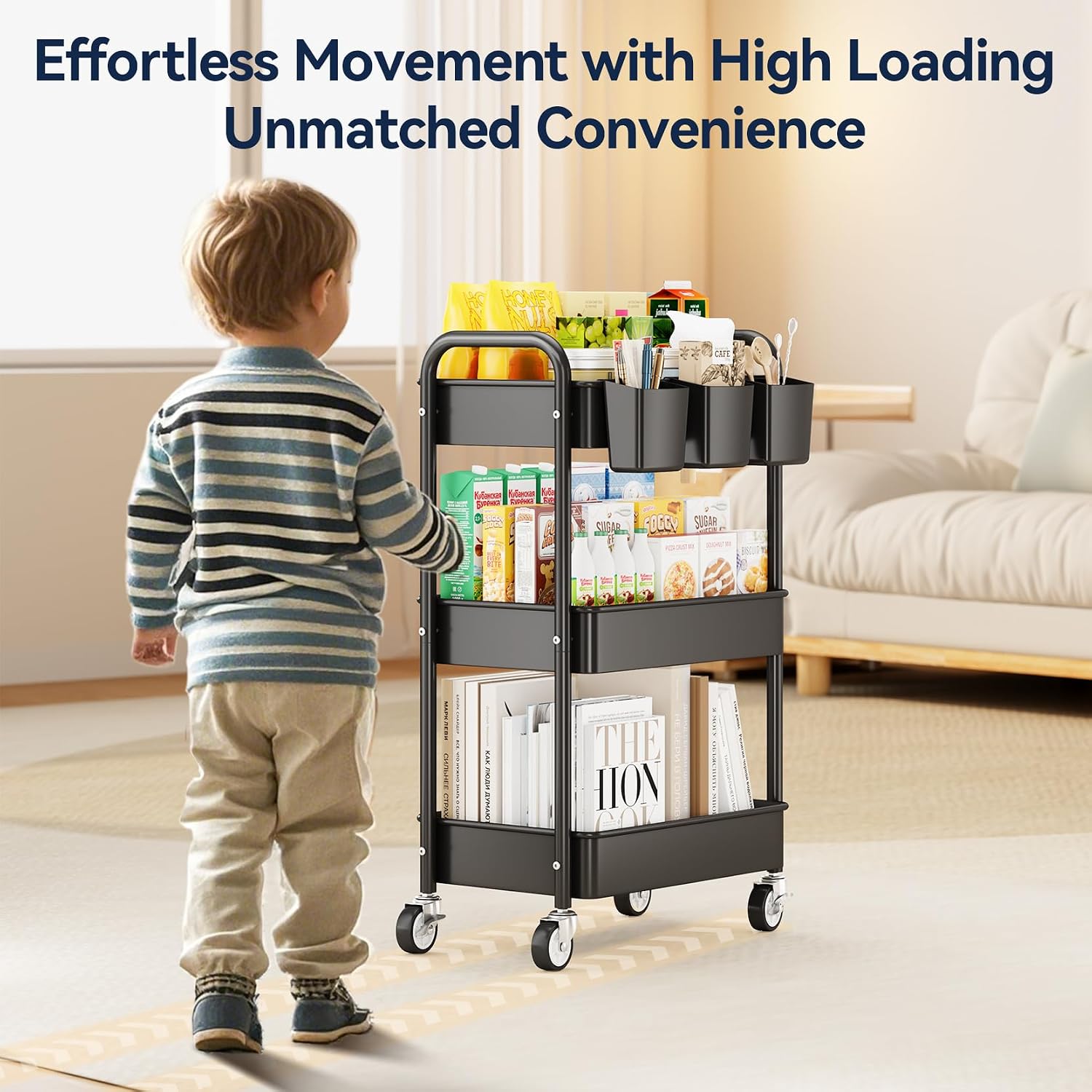
If you’ve ever bought a rolling cart and then spent another $30 on hooks, another $15 on hanging cups, and a weekend afternoon figuring out how to mount a pegboard panel to the side — you already understand the appeal of carts that arrive with all of that built in. A rolling cart (a wheeled storage unit you can move between stations, rooms, or users) with integrated pegboard (the perforated hardboard panel that accepts hooks and accessories), pre-attached hanging cups, and built-in hook rails gives you a complete mobile workstation in one box, rather than a base unit you have to accessorize before it’s actually useful. For art teachers stocking activity stations, nail techs building a mobile service cart, or photographers who need a rolling grip station, the difference between “cart with add-ons available” and “cart with add-ons included” is often two weeks of sourcing time and real money.
This guide is aimed at buyers who are past the “do I need a rolling cart?” stage and into the “which configuration actually fits my workflow?” stage. We’ll compare the YASONIC, DTK, and GOFLAME 15-drawer carts on their built-in organizational features — not just drawer count — and give you the tradeoff framing you need to make a defensible choice.
Why Built-In Attachment Points Change the Calculus
The standard pitch for rolling carts focuses on drawer count and weight capacity. Those matter, but they miss the thing that separates a storage unit from a mobile workstation: the ability to keep frequently-accessed tools visible and reachable without opening anything.
Pegboard panels, hook rails, and hanging cups serve a specific function: they move your “top-of-drawer” items — scissors, markers, rulers, paintbrushes, nail files, clamps — off the work surface and onto a vertical plane. For a classroom rotation station, that means a student can grab what they need without rummaging. For a nail tech, it means tools are at eye level and within reach without turning away from the client. This Old House’s workshop storage guide frames it clearly: vertical storage at a mobile station reduces reach distance and keeps the work surface clear for the actual task.
The catch is that “built-in” is doing a lot of work in product listings. Some carts include a pegboard panel on one side with hooks pre-installed. Others include hook rails — horizontal bars from which cups hang — but no pegboard compatibility. Still others include hanging cups but no hooks for tools. Knowing exactly what ships in the box, versus what you’ll need to source separately, is the core decision variable.
The Three Carts Worth Comparing
YASONIC Rolling Cart: The Surprise Hook Set
Reviewers of the YASONIC cart consistently flag the included hooks and hanging cups as the feature that exceeded expectations — language like “these carts are genius” appears in aggregated reviews specifically in reference to the hook set, not the baskets. That’s an unusual pattern: most positive cart reviews lead with drawer smoothness or build quality, not organizational accessories. When the hooks are the headline, it tells you the included accessory set is genuinely above the category baseline.
Published specs put the YASONIC in the mid-tier organizational cart segment: multi-tier open baskets, casters with locking capacity, and a hook-and-cup set that ships attached rather than in a separate bag. The practical implication is that you’re not making assembly decisions about where to mount accessories — the cart arrives configured.
The tradeoff: open-basket designs like the YASONIC trade enclosed storage for visibility and airflow. That’s ideal for art supplies, craft materials, or clinic activity kits where staff need to see inventory at a glance. It’s less ideal if your use case involves dust-sensitive materials or anything that needs to be contained.
DTK Rolling Cart: The Photographer’s Build Platform
The DTK cart generates a notably specific review pattern: a photographer who built a complete mobile photography station by combining the DTK’s built-in hooks with a user-added USB hub and battery-powered light. That’s a meaningful data point. It means the built-in attachment points are sturdy and positioned well enough to serve as a genuine build platform for creative reconfiguration — not just a place to hang one pen cup.
This is the key differentiation of the DTK versus a cart with hanging cups as decoration: the hook placement and rail design appear to be load-bearing in a practical sense, supporting real-world add-ons that extend the cart’s function past what the manufacturer designed for. For makerspace coordinators or workshop setups where the cart will be reconfigured as projects change, that flexibility has real value.
The honest tradeoff: reviewers consistently note that the DTK’s top bin lid doesn’t fit precisely. If you’re using that bin for anything that needs to be secured or protected, that’s a functional issue, not just an aesthetic one. If you’re using the top as an open-access tray, it matters less.
The DTK also benefits from an underreported feature: metal mesh basket construction on some configurations creates magnetic compatibility that owners discover after purchase and treat as an unexpected bonus. This is relevant for anyone managing labels, instruction cards, or color-coded markers — small magnets hold directly to the basket walls without any additional hardware.
GOFLAME 15-Drawer Cart: Specialist Depth with Side Pegboard
The GOFLAME 15-drawer cart earns its place in this comparison because of a specific real-world use case: a nail tech who uses the side pegboard for tools and the drawers for polish. That’s a single-category professional application — one person, one workflow, maximum drawer count for deep product storage, plus a pegboard surface for instrument organization. If that profile matches yours (deep vertical storage in drawers, plus a tool display surface on the side), the GOFLAME is purpose-built for it.
The pegboard holes on the GOFLAME side panels are a recurring question in owner reviews, and we address it specifically in the FAQ below. Short answer: compatibility with standard pegboard hook sizing is the relevant spec to verify before purchasing aftermarket hooks.
The honest tradeoff: assembly takes approximately 1.5 hours based on aggregated owner reports, and that time is almost entirely attributable to drawer count. Fifteen drawers means fifteen drawer tracks, fifteen drawer units, and a significant number of fasteners. Budget the time, especially if this is going into a clinical or institutional setting where the cart needs to be operational by a specific program start date.
By the Numbers
| Cart | Built-in Verticals | Magnetic Mesh? | Assembly Time (reported) | Key Complaint |
|---|---|---|---|---|
| YASONIC | Hooks + hanging cups (included) | No (open basket) | ~45 min | Basket depth limited for bulky items |
| DTK | Hook rail + top bin | Yes (metal mesh config) | ~60 min | Top bin lid fit imprecise |
| GOFLAME 15-drawer | Side pegboard panels | Varies by config | ~90 min | Assembly time due to drawer count |
Assembly times based on aggregated owner reviews as of Q1 2026. HCD Magazine’s 2024 mobile storage overview notes that drawer-heavy carts consistently run 30–45 minutes longer to assemble than equivalent open-shelf configurations.
The Tradeoff That Doesn’t Get Named Enough: Side Bags vs. Open Shelves
Several carts in the built-in-accessories category include side fabric bags or pouches rather than — or in addition to — open shelving. The DTK includes this option on some configurations. It’s worth naming the real tradeoff explicitly.
Side bags increase total capacity without increasing the cart’s footprint. That matters in tight spaces — a classroom aisle, a clinic hallway, a client’s nail station. But side bags trade accessibility for containment: you can’t see what’s in them at a glance, and retrieving an item requires opening or reaching into the pouch. For items that are accessed infrequently (backup supplies, paperwork, charging cables), side bags are efficient. For items accessed constantly during a session, open shelves or hanging cups win on speed.
Apartment Therapy’s rolling cart roundup frames this as a storage-versus-workflow distinction: closed pouches are good for storage, open surfaces are good for workflow. If your cart is a supply depot that gets raided once at the start of an activity, bags are fine. If your cart is a live workstation that you’re pulling from continuously, prioritize open, visible surfaces.
If X, Then Y: The Decision Rules
If your priority is zero sourcing time and a complete workstation out of the box: The YASONIC’s included hook-and-cup set means you’re organized before you’ve ordered anything else. Reviewers flag this specifically. If you have a program starting in two weeks and you need functional now, this is the lowest-friction path.
If you anticipate reconfiguring the cart over time as your workflow changes: The DTK’s hook rail and magnetic mesh compatibility (in metal configurations) make it a genuine build platform. The photographer use case — adding a USB hub and light — is a model for how this cart adapts. If your use case will evolve, the DTK rewards the investment.
If you need maximum enclosed drawer storage plus a tool display surface: The GOFLAME 15-drawer with side pegboard is the specialist answer. Budget 1.5 hours for assembly and verify pegboard hook compatibility before buying aftermarket accessories.
If your setting involves dust-sensitive materials or anything that needs containment: None of these three carts is the right answer — enclosed drawer carts without open baskets or pegboard will serve you better.
Frequently Asked Questions
Are the included hooks and hanging cups strong enough to hold scissors, craft tools, or heavier items? Based on owner reports across the YASONIC and DTK product lines, the included metal hooks handle scissors, markers, and light hand tools without deformation. Heavier items — wire cutters, corded tools, anything over roughly half a pound per hook — should be evaluated against the hook gauge specified on the product sheet. Wirecutter’s craft storage guide recommends testing hook load with your heaviest intended item before fully loading a new cart.
Do the hanging cups detach so they can be washed separately? On the YASONIC and DTK, hanging cups that attach via S-hooks or rail clips can be removed by lifting off the hook — no tools required. This makes hand-washing or sanitizing straightforward. Cups that are permanently welded to frames are less common in this category but do exist; check the product listing’s assembly diagram to confirm detachability before purchasing.
Are the pegboard holes on the GOFLAME cart compatible with standard pegboard hook sizes? The GOFLAME side pegboard panels use a hole pattern that owners report as compatible with standard 3/16-inch peg hooks — the most common size sold at hardware retailers. However, because panel thickness varies between product runs, aftermarket hook fit is not guaranteed. The safest approach is to purchase a small set of hooks first and confirm fit before buying in bulk.
Can magnets be used on metal mesh basket carts for labels or additional attachments? Yes — this is one of the more useful features that owners of DTK metal mesh configurations discover post-purchase. Standard neodymium magnets (the flat, coin-style ones used for label holders and whiteboard accessories) adhere well to the wire mesh walls. This works for color-coded labels, instruction cards, and small magnetic clips. Ceramic magnets are weaker and may not grip reliably on thicker wire gauges.
How do side bags on carts like the DTK compare to open shelves for accessibility? Side bags add capacity without adding footprint, but they slow retrieval because you can’t see contents at a glance. Open shelves and hanging cups are faster for items you access repeatedly during a session. Apartment Therapy’s rolling cart coverage consistently frames this as a storage-versus-workflow choice: bags for supplies you retrieve once, open surfaces for tools you reach for continuously.
Is the tabletop surface on carts with built-in tops large enough to work on? Most rolling carts in this category have tops sized for staging and light work — enough surface to sort materials, write a label, or lay out tools before a session. They’re generally not sized for extended seated work. If your use case involves the cart top as a primary work surface (cutting, assembling, detailed hand work), a dedicated worktable is a better foundation; the cart serves the worktable rather than replacing it.