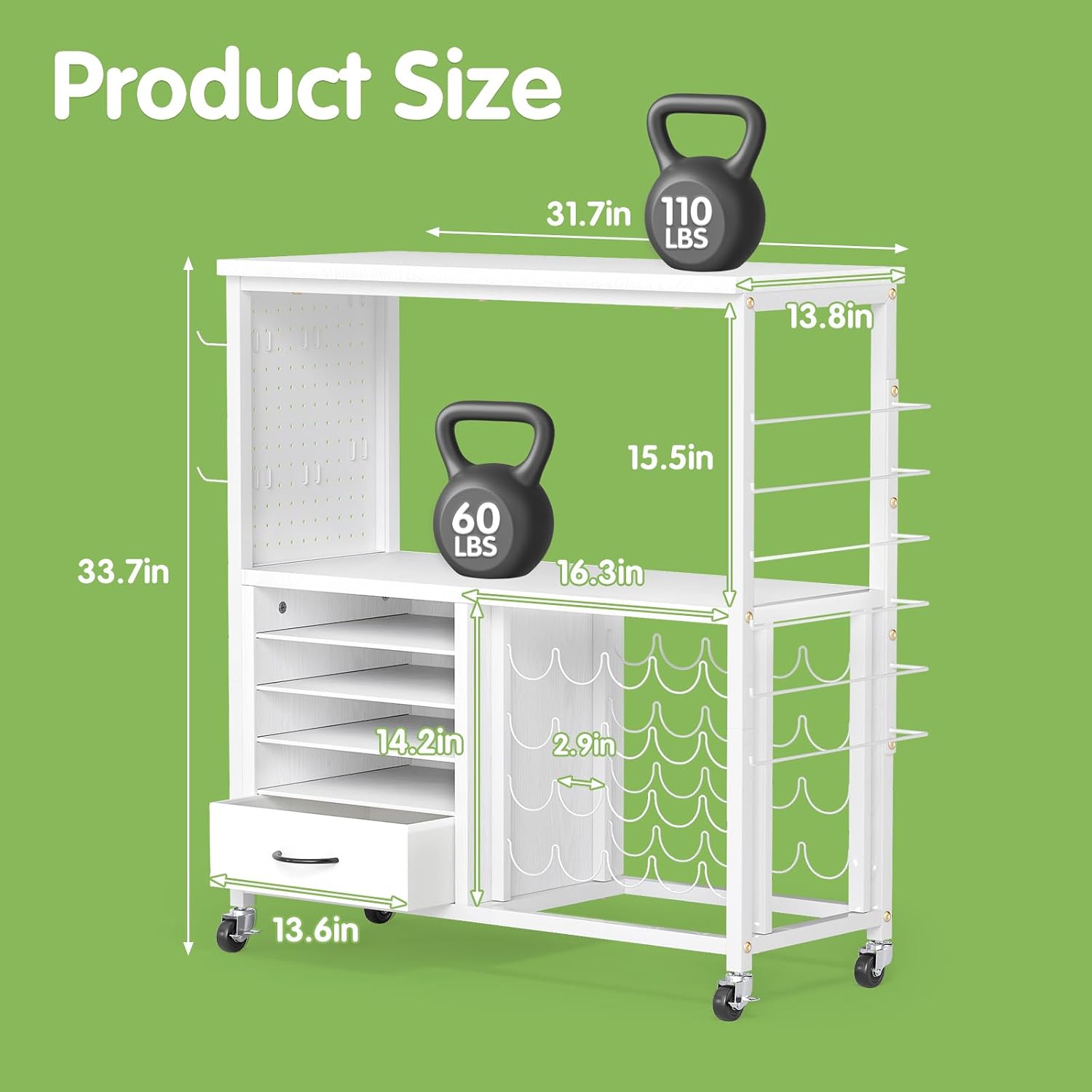
If you’ve ever set a Cricut Maker (that’s Cricut, pronounced “cricket” — it’s a brand of precision electronic cutting machine) or a vinyl cutter on one of those lightweight three-tier wire rack carts and felt the shelf deflect under the weight, you already know the problem this article is here to solve. A standard wire craft cart is designed to hold bottles of acrylic paint and rolls of washi tape — not a 22-pound cutting machine with a 24-inch footprint. The result is a warped shelf, a wobbly cart that shifts during a precision cut, and, eventually, a machine teetering on a surface it was never designed to support. This guide is for buyers who are past the impulse-purchase stage and need a cart that actually matches the machine: right shelf depth, real weight capacity, stable casters (the rolling wheels on the cart’s legs), and enough surface area for a two-machine setup if that’s where you’re headed.
| EDITOR'S PICKMEEDEN Art Supply Storage Cart | Mid-tierCraft Storage Cart | Budget pickSunnyPoint 3-Tier Delicate Comp… | |
|---|---|---|---|
| Tiers | 5 | — | 3 |
| Drawers | 3 | ✓ | — |
| Material | Solid beech wood | — | Metal |
| Width | — | — | 15.35" |
| Depth | — | — | 10.24" |
| Height | — | — | 26.8" |
| Price | $336.57 | $109.99 | $43.99 |
| See on Amazon → | See on Amazon → | See on Amazon → |
Why Standard Craft Carts Fail Heavy Machines
Let’s start with numbers, because the mismatch is more dramatic than most product listings suggest.
By the numbers:
- Cricut Maker 3: ~22 lbs, 22.6” × 7.1” footprint
- Silhouette Cameo 4 Pro (24” model): ~17 lbs, 27.6” × 7.3” footprint
- Brother ScanNCut DX: ~18.3 lbs, 25.4” × 7.8” footprint
- Typical three-tier wire craft cart top shelf: rated 20–30 lbs total, wire spacing may not support machine base evenly
The wire-spacing issue is the one that gets overlooked. A machine base that spans only the gaps between wires — rather than resting on a solid or closely spaced surface — creates point-load stress rather than distributed weight. Consumer Reports’ framework for evaluating mobile storage carts flags point loading as the primary cause of shelf deformation on wire-grid shelving, even when the machine’s weight technically falls within the shelf’s rated capacity. The rating assumes distributed load; a rigid machine base that bridges across open wire creates bending stress that accelerates warp.
Shelf warp compounds over time. The cart that looks fine in month one starts to bow by month six, and a bowed shelf on a cutting machine is a functional problem, not just an aesthetic one — any slope changes the cutting surface alignment and increases the chance the machine walks or vibrates during a pass.
The second failure mode is casters. Budget carts — the category that runs roughly $40–$80 — often use 1.5-inch swivel casters with no locking mechanism, or a locking mechanism that engages a single wheel rather than all four. Reviewers across multiple aggregated review compilations, including those tracked by Apartment Therapy in their craft storage roundups, consistently note that a single-lock or no-lock caster situation means the cart creeps during machine operation. On a vinyl cutter running a long horizontal pass, even 2–3mm of cart movement mid-cut ruins the job.
The VEVOR Stainless Cart: The Underdog That Earns Its Place
One cart comes up repeatedly in owner accounts when the conversation turns to heavy or oversized machines: the VEVOR stainless steel utility cart. It’s worth understanding exactly why, because the marketing copy for this cart is aimed at restaurant kitchens and workshops — not craft rooms — and that underselling is precisely the point.
The VEVOR stainless cart is built around a solid stainless steel work surface (no wire, no open grid) with a manufacturer-rated capacity of 330–440 lbs across the full cart, depending on configuration. More relevant for craft machine buyers: the top shelf is rated independently at 110–220 lbs depending on model tier, which is a different world from the 30-lb wire shelf. Owners who’ve documented trying multiple carts before landing here consistently surface one observation: this was the only cart large enough to hold their full-size vinyl cutter on the lower shelf while the Cricut sat on top — a two-machine configuration that no marketing copy for craft carts addresses directly, but that a surprising number of serious home crafters actually run.
The solid surface also solves the point-load problem entirely. A machine base sitting on stainless steel is supported edge-to-edge; there’s no wire gap to bridge, no bowing risk at craft-machine weights.
The honest tradeoffs: stainless steel carts are heavier than the wire alternatives (typically 30–45 lbs for the cart itself), which makes them harder to reposition when not loaded. The aesthetic is utilitarian — this reads as a kitchen cart in a craft room, not a purpose-built craft station. If visual coherence matters in a home studio, that’s a real consideration. This Old House’s workshop cart buying guide notes that stainless steel utility carts also accumulate visible scratches over time on the work surface, though this has no bearing on structural performance.
The Purpose-Built Cricut Cart: When the Rolling Rod Is the Whole Point
There is exactly one feature on the purpose-built Cricut-specific rolling cart that no general utility cart replicates: the horizontal rolling vinyl rod built into the cabinet. If you’re cutting 12-inch or 24-inch wide vinyl from a roll — not a pre-cut sheet — that rod is a meaningful workflow feature. Feeding vinyl from a roll positioned directly below the machine, at a consistent height and angle, reduces drag and misalignment at the start of each cut.
Owner reviews of purpose-built Cricut carts are consistent on two things. First, the rolling rod works as advertised for standard 12-inch vinyl rolls, though 24-inch rolls on some configurations receive mixed reports about lateral slipping (addressed further in the FAQ below). Second, the assembly strips screws. This is not a minor complaint buried in one review — it’s a pattern across aggregated owner feedback that Wirecutter’s craft organizer roundup also flags as a common failure point in MDF-and-particleboard flat-pack furniture when buyers use power drivers rather than hand-screwdrivers for the final tightening pass. The fix is simple and cheap: hand-tighten the last quarter-turn on every screw during assembly, use a manual screwdriver for that final step, and the stripped-screw problem effectively disappears. But it’s worth knowing before you’re three panels deep with a cordless drill.
The weight capacity on purpose-built Cricut carts is typically specified in the 50–75 lb range for the top shelf — adequate for a single Cricut Maker 3 but not for a two-machine setup. If your plan is one dedicated machine, the purpose-built cart’s workflow features (organized drawer layout, vinyl rod, pegboard side panel on some models) justify the price premium over a plain utility cart at a similar price point. If your plan involves any machine wider than 22 inches or heavier than a standard Cricut, the cart’s shelf depth becomes the limiting factor.
Adding Power to a Metal Utility Cart: The Right Way
The DTK-brand cart, reviewed favorably by buyers using it as a photography station with added USB hubs and power access, is an instructive model for craft machine users. A vinyl cutter, Cricut, or sewing machine all require power at the cart — and most metal utility carts ship with zero power management built in.
The cleanest approach is a power strip with a surge protector, mounted to the cart’s lower shelf or secured to a side rail with cable management clips. A few specifics matter here:
Mount, don’t drape. A power strip sitting loose on a lower shelf can slide and fall when the cart moves. Two heavy-duty hook-and-loop fastener strips rated for the strip’s weight, or a purpose-made power strip mounting bracket, keep it fixed.
Surge protection is non-negotiable for cutting machines. The Cricut Maker 3’s onboard electronics are sensitive to power spikes. Consumer Reports’ guidance on home electronics protection consistently recommends surge-protected power strips over basic extension cords for any device with onboard processors or stepper motors.
Cable routing matters more than most buyers anticipate. A cable that drapes from the cart’s surface to a wall outlet becomes a trip hazard and gets pinched when the cart rolls. A cable reel or velcro cable ties routed along the cart’s leg from the power strip down to a short floor-level extension gives you mobility without the hazard.
One thing to avoid: daisy-chaining extension cords to reach a distant outlet rather than repositioning the cart. Craft machines draw modest amperage individually, but a Cricut plus a heat press or laminator on the same strip can approach 12–15 amps — approaching the limit of a 15-amp household circuit. If your craft station runs multiple heat-generating tools, position the cart near a dedicated outlet rather than running a cord across the room.
Frequently Asked Questions
What is the actual usable surface dimension on the top shelf of the VEVOR stainless cart — will a full-size Cricut Maker 3 fit?
The Cricut Maker 3’s footprint is approximately 22.6 inches wide by 7.1 inches deep. The most common VEVOR stainless cart configuration offers a top shelf measuring 35.4” × 19.7”, with the usable flat surface running nearly the full dimension (unlike wire carts, there’s no lip height to account for). A Cricut Maker 3 fits comfortably with several inches of clearance on all sides. The wider Silhouette Cameo 4 Pro at 27.6 inches also fits within the 35-inch width, though you’ll want to confirm the specific model’s shelf dimensions before ordering, as VEVOR produces multiple size configurations.
Do the locking wheels on craft carts hold securely enough that the cart won’t shift during a precision cutting pass?
It depends on the caster mechanism. Carts with four independently locking casters (each wheel locks individually) hold significantly better than carts with a single locking wheel or a center-brake system. For precision cutting applications, owner reports consistently recommend engaging all four locks, and positioning the cart so the locked casters are bearing weight evenly on a level floor. On carpet, even good locking casters can allow micro-movement; a hard floor tile or a hard-surface mat under the cart eliminates that variable.
Can the Cricut-specific cart’s rolling rods hold 12-inch vinyl rolls without the roll slipping off?
For 12-inch rolls: yes, consistently, based on owner accounts. For 24-inch rolls: the rod on most purpose-built Cricut cart configurations is specified for 12-inch roll widths, and owners using full 24-inch rolls report that without end caps or a DIY stop (a wrapped rubber band at each rod end works), the roll drifts laterally. If 24-inch vinyl roll feeding is core to your workflow, this is the cart’s most significant limitation.
Is a purpose-built Cricut cart worth the premium over a general metal utility cart at the same price?
If you’re running a single standard-size Cricut machine and regularly cut from vinyl rolls, the purpose-built cart’s integrated rod and drawer organization are genuine workflow advantages that a general cart doesn’t replicate without modification. If your machine is wider than 22 inches, heavier than 25 lbs, or if you plan to run two machines, the general utility cart — specifically the solid-shelf stainless configurations — handles the load and footprint requirements the purpose-built cart was not designed for.
How do you add a power strip to a metal utility cart safely when using a machine that requires a dedicated outlet?
Mount a surge-protected power strip to the lower shelf using rated hook-and-loop fasteners or a mounting bracket. Route the cord along the cart’s leg using velcro cable ties, and connect to a wall outlet close enough that the cord isn’t under tension when the cart is in its working position. For machines with stepper motors or onboard processors (Cricut, most vinyl cutters), surge protection is not optional — it’s the difference between a recoverable power event and a damaged mainboard. Avoid daisy-chaining extension cords, and if running multiple tools simultaneously, verify your circuit’s amperage before loading the strip.
The Decision Rule
Here’s the clean if/then for where you are right now:
If your machine is a standard Cricut Maker or Explore series (under 23 inches wide, under 25 lbs) and you regularly cut from vinyl rolls: the purpose-built Cricut cart is the right call. Assemble with a hand screwdriver for final tightening and the stripped-screw issue is effectively a non-problem.
If your machine is a wide-format vinyl cutter (24 inches or wider), a heavy sewing machine, or you’re planning a two-machine setup: the VEVOR stainless steel utility cart is the cart the market hasn’t properly aimed at you, but owners in your exact situation consistently end up here. The workflow isn’t as polished, but the structure is.
If you’re on a tight budget and need to make a wire cart work in the short term: go solid-shelf over wire — even an inexpensive solid-surface utility cart is meaningfully better than wire-grid for heavy machines — and plan your power strip installation before you start cutting, not after.
The casters, the shelf material, and the surface dimensions are the three variables that make or break this decision. Get those right and everything else is refinement.