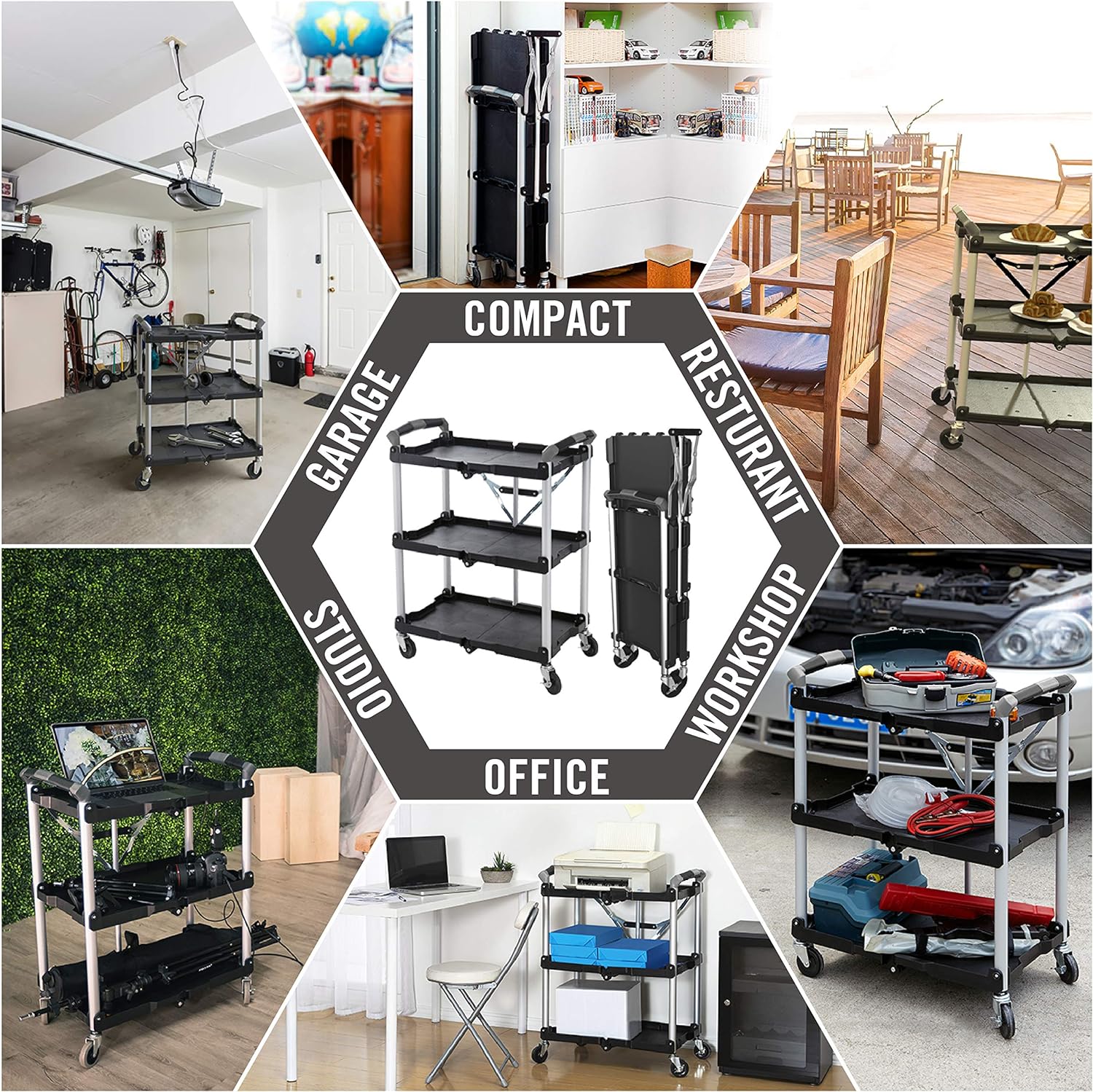
If you’ve ever watched a family member use the kitchen counter as a handhold while walking through the house, you already understand the instinct behind this article. A rolling cart — the kind sold in the craft aisle or marketed for workshop storage — sits at an interesting crossroads: it’s not a medical device, it’s not a certified walker (a wheeled frame designed specifically to support body weight while a person walks), but a growing number of disabled and elderly buyers are using these carts exactly that way. They’re staging home dialysis supplies on them, leaning on them for support between rooms, and traveling with them to treatment centers. The gap between what manufacturers intend and what real buyers actually do is wide. This guide surfaces the owner-reported patterns, names the specs that matter most in this use case, and gives you the decision frame to choose well — whether you’re buying for yourself, a family member, or a client.
| EDITOR'S PICKOlympia Tools 85-188 Pack-N-Rol… | Mid-tierSimple Houseware 3-Tier Heavy D… | Budget pickAmazon Basics 3-Tier Rolling Ut… | |
|---|---|---|---|
| Tiers | — | 3 | 3 |
| Weight Capacity | 150 lb | — | — |
| Wheels | — | Rolling | Lockable |
| Folding | ✓ | — | — |
| Material | — | Metal | — |
| Price | $108.97 | $37.97 | $34.77 |
| See on Amazon → | See on Amazon → | See on Amazon → |
Why Buyers Are Repurposing Utility Carts as Mobility and Medical Aids
The pattern shows up repeatedly across aggregated reviews for several popular utility carts. One WORKPRO cart buyer purchased four units explicitly to use as walker-like supports throughout their home, describing them in their review as an ADA disability aid. Multiple buyers of the Olympia Pack-N-Roll and JaboEquip rolling cabinet lines report using those carts specifically for home peritoneal dialysis (PD) staging — “peritoneal dialysis” meaning a home kidney-treatment process where sterile supplies must be organized, within reach, and kept off the floor to reduce infection risk. These aren’t edge cases; the review clusters are consistent enough that several models have developed a secondary reputation in disability and elder-care communities that their product listings don’t reflect at all.
Why does this happen? The honest answer is pricing and friction. A certified rollator walker (a four-wheeled walking aid with a built-in seat and hand brakes, designed to bear partial body weight) typically runs $80–$300 and requires a prescription for insurance reimbursement in most states. A utility cart in the $45–$130 range ships in two days, requires no prescription, no insurance paperwork, and — critically — doubles as actual storage. For someone managing a chronic condition at home, that multifunctionality has real value.
OT Innovations’ overview of low-cost assistive device substitutions in home settings acknowledges this improvisation as a documented phenomenon, noting that occupational therapists frequently encounter clients who have already self-selected non-medical devices for mobility support before any professional assessment occurs. The publication recommends practitioners evaluate the actual device in use rather than dismissing it.
That context matters for how you read the rest of this guide.
The Specs That Actually Matter in This Use Case — and the Ones That Don’t
If you’re evaluating a cart for mobility support or home medical staging, the standard marketing metrics (tier count, color options, weight capacity when loaded) are almost irrelevant. Here’s what the owner-report pattern says actually matters:
Wheel lock reliability. This is the single most cited failure point across the disability and elder-care review cluster. Reviewers describe wheel locks (also called caster brakes — small levers on individual wheels that, when pressed, pin the wheel in place) as the difference between a safe staging surface and a hazard. Budget casters on sub-$80 carts frequently use plastic brake tabs that degrade within months of regular use. Owners in the dialysis staging cluster are especially consistent on this: a cart that drifts two inches while a sterile bag is being connected to a catheter is not acceptable. The Healthline guide on home peritoneal dialysis setup recommends a completely stable work surface as a non-negotiable infection-control measure.
Empty weight, not loaded capacity. Manufacturers almost universally advertise maximum load capacity. For elderly buyers who may need to carry or tilt a cart up a step, the figure that matters is the empty weight of the cart itself — which is often buried in the spec sheet or absent entirely. The JaboEquip 3-tier rolling cart, frequently mentioned in the dialysis staging reviews, spec-sheets at approximately 11 lbs empty. The Olympia Pack-N-Roll 300-series comes in around 18–22 lbs depending on configuration. That 7–11 lb difference is meaningful when you’re 74 and navigating a doorstep.
Frame material and joint construction. Aluminum-frame carts (like most Pack-N-Roll configurations) resist rust in bathroom and clinical environments better than powder-coated steel. Reviewers in the dialysis staging cluster consistently praise aluminum for this reason. That said, aluminum frames tend to flex slightly more under lateral load — which matters if the cart is being used for physical support while walking. Steel frames (common in WORKPRO and Simple Houseware utility carts) are stiffer but heavier and more susceptible to surface corrosion in humid bathroom environments.
Shelf lip depth. A 1-inch shelf lip — the raised edge around a shelf that keeps items from sliding off — sounds trivial. Buyers managing home infusion or dialysis supplies treat it as critical containment. Open flat shelves work fine for organizing; a 1–1.5 inch lip keeps IV bags, tubing coils, and solution bottles from rolling off when the cart moves.
Assembly complexity. Among elderly female buyers specifically, the review record shows a strong preference for carts that can be assembled solo without tools, and visible anxiety about assembly failure. One Simple Houseware cart reviewer explicitly described assembling the unit alone despite significant anxiety, and expressed relief that the process was straightforward. Snap-fit or single-tool assembly is not a trivial convenience feature for this buyer group.
By the Numbers: Weight and Lock Specs on the Most-Referenced Models
| Cart | Empty Weight | Caster Brake Type | Frame Material |
|---|---|---|---|
| WORKPRO 3-Tier Utility Cart | ~15 lbs | Plastic tab, 2 of 4 wheels | Steel |
| Olympia Pack-N-Roll 300 | ~18–22 lbs | Metal pedal, 2 of 4 wheels | Aluminum |
| JaboEquip 3-Tier Rolling Cart | ~11 lbs | Plastic tab, 2 of 4 wheels | Steel/MDF |
| Simple Houseware 3-Tier Cart | ~13 lbs | Plastic tab, 2 of 4 wheels | Steel |
Weights sourced from manufacturer spec sheets and aggregated owner reports; brake type from published product documentation and owner descriptions.
The pattern: only the Olympia Pack-N-Roll line spec-sheets a metal brake pedal across its standard configurations. Every other model in this tier uses plastic tab brakes — which, per the owner review cluster, are the failure point most associated with lock unreliability during stationary use.
Open Shelf vs. Drawer-Style: Which Configuration Works Better for Home Medical Use
The open-shelf vs. drawer debate looks different through a medical-staging lens than through a craft-organizer lens.
Buyers using carts for dialysis and infusion supply staging overwhelmingly favor open-shelf configurations, and the reasoning is practical: sterile supplies must be visible at a glance so nothing is touched unnecessarily, and open shelves allow one-handed retrieval without pulling a drawer with the other hand. The AOTA’s home modification practice guidelines emphasize that assistive device design should minimize the number of sequential steps required to access frequently used items — open shelves score better on that metric.
Drawer-style carts (like several configurations in the WORKPRO and Seville Classics lines) are preferred by buyers whose primary goal is fall-prevention organization — keeping loose items off the floor where they create tripping hazards. For that application, deep drawers with locking slides reduce scatter effectively. The tradeoff is that drawers add 3–6 lbs to the cart’s empty weight and require two-hand operation in most configurations.
The NCTRC’s assistive technology programming standards note that for activity programs serving clients with limited hand strength or coordination, open-surface organization consistently outperforms enclosed storage for access speed and error reduction.
Folding Carts and Travel: What “Collapsible” Actually Means in Practice
Several buyers in the dialysis community specifically call out the ability to fold a cart flat and transport it to treatment centers or temporary living situations. The Olympia Pack-N-Roll and several aluminum folding service carts market themselves as collapsible, but “collapsible” in this product category means folded flat for storage — not collapsed to luggage dimensions.
The Olympia Pack-N-Roll 300 folds to approximately 4 inches thick, which fits in a car trunk but not an overhead bin. Buyers in the review cluster who travel with dialysis supplies describe it as manageable for car travel, less so for flights. The JaboEquip and Simple Houseware carts do not meaningfully fold — they disassemble, which defeats the purpose of quick setup at a destination.
If collapsibility for travel is a hard requirement, the most relevant spec to verify before purchase is the folded depth — not whether the cart is marketed as “foldable.”
Frequently Asked Questions
Can a rolling cart substitute for a walker or provide stability support while moving through a home?
Some buyers do use them this way, and the owner-report record confirms it. However, no utility cart in this category is rated, tested, or warranted for weight-bearing mobility support the way a certified rollator walker is. The AOTA recommends that any client using a non-medical device for ambulation support be evaluated by an occupational therapist to assess fall risk. If you or a family member needs mobility support, a cart may be a practical supplemental aid in low-risk environments (moving between a bed and a bathroom, for example), but it should not be the primary mobility device without professional input.
Which carts are light enough for an elderly person to carry up or down stairs?
Based on published specs, the JaboEquip 3-tier cart at approximately 11 lbs empty is among the lightest in this tier. The Simple Houseware cart at ~13 lbs is a close second. Both are manageable for a single adult in reasonable health to carry one flight. Anything above 18 lbs empty — including most Olympia Pack-N-Roll configurations — is a two-person lift on stairs for most elderly buyers.
How do locking wheels perform when a cart needs to stay completely stationary during a medical procedure?
Owners in the dialysis and infusion staging cluster consistently report that plastic tab caster brakes on budget carts (sub-$80) lose holding power within several months of regular use, particularly on smooth floors. Metal pedal brakes — standard on the Olympia Pack-N-Roll line — hold significantly better in owner reports. If complete stationary stability is a clinical requirement, the Olympia line’s metal brake pedals or a purpose-built clinical cart from Medline or Hausmann are worth the price delta.
Are open-shelf or drawer-style carts better for organizing home dialysis or infusion supplies?
Open-shelf configurations win for this application, based on buyer reports and the access-efficiency principles in AOTA’s home modification guidelines. One-handed retrieval, visual inventory at a glance, and easier cleaning between procedures are the consistent advantages cited.
Can these carts fold flat for travel to dialysis centers or hospitals?
The Olympia Pack-N-Roll folds to roughly 4 inches for car transport. Most other carts in this category either don’t fold meaningfully or disassemble fully. If travel portability matters, verify the folded depth in the spec sheet before purchasing — the marketing term “foldable” is applied loosely across this category.
What is the actual empty weight of the most popular collapsible service carts?
Per manufacturer spec sheets and aggregated owner reports: Olympia Pack-N-Roll 300 series, 18–22 lbs; JaboEquip 3-tier, approximately 11 lbs; Simple Houseware 3-tier, approximately 13 lbs; WORKPRO 3-tier utility, approximately 15 lbs.
The Decision Rule
If your primary need is stationary stability during home medical procedures: prioritize metal caster brakes and steel or aluminum frame rigidity. The Olympia Pack-N-Roll is the clearest step up from budget plastic-brake models.
If your primary need is light weight for elderly solo use and stair transport: the JaboEquip and Simple Houseware carts in the 11–13 lb range are the right tier. Accept the plastic brake limitation and plan to use the cart primarily as a staging surface, not a support structure.
If your primary need is travel portability to treatment centers: the Olympia Pack-N-Roll’s fold-flat design is the only model in this price tier with a folded profile suitable for regular car transport. No cart in this category is suitable for air travel as carry-on.
If professional safety assessment matters — and it should if mobility support is part of the use case — bring the specific model to an OT evaluation before relying on it for ambulation. The cart category was not designed for that purpose, and the honest guidance is that awareness of that gap is the starting point, not the endpoint.