A rolling cart — any wheeled storage unit that you can push from room to room — sounds like a simple purchase. But when you’re six days post-knee surgery and you can’t carry a glass of water and a phone charger at the same time, the cart sitting next to your recliner becomes one of the most useful things in your home. That’s the insight buried in thousands of buyer reviews across this product category: people shop for a utility cart and discover they’ve bought themselves back a measure of independence. This guide is for the buyer who already knows they need a rolling cart for home recovery or caregiving — someone who’s Googling at midnight trying to figure out whether the $35 wire rack will hold their IV supplies or whether the $180 clinical trolley is overkill for a six-week recovery. We’ll name specific products, show the tradeoffs, and end with a clear decision rule.
What the Review Patterns Actually Tell Us
Aggregated owner reviews across this product cluster reveal a pattern that isn’t obvious from product listings: buyers consistently sort themselves into three distinct use cases, and the cart that serves one group well frustrates another.
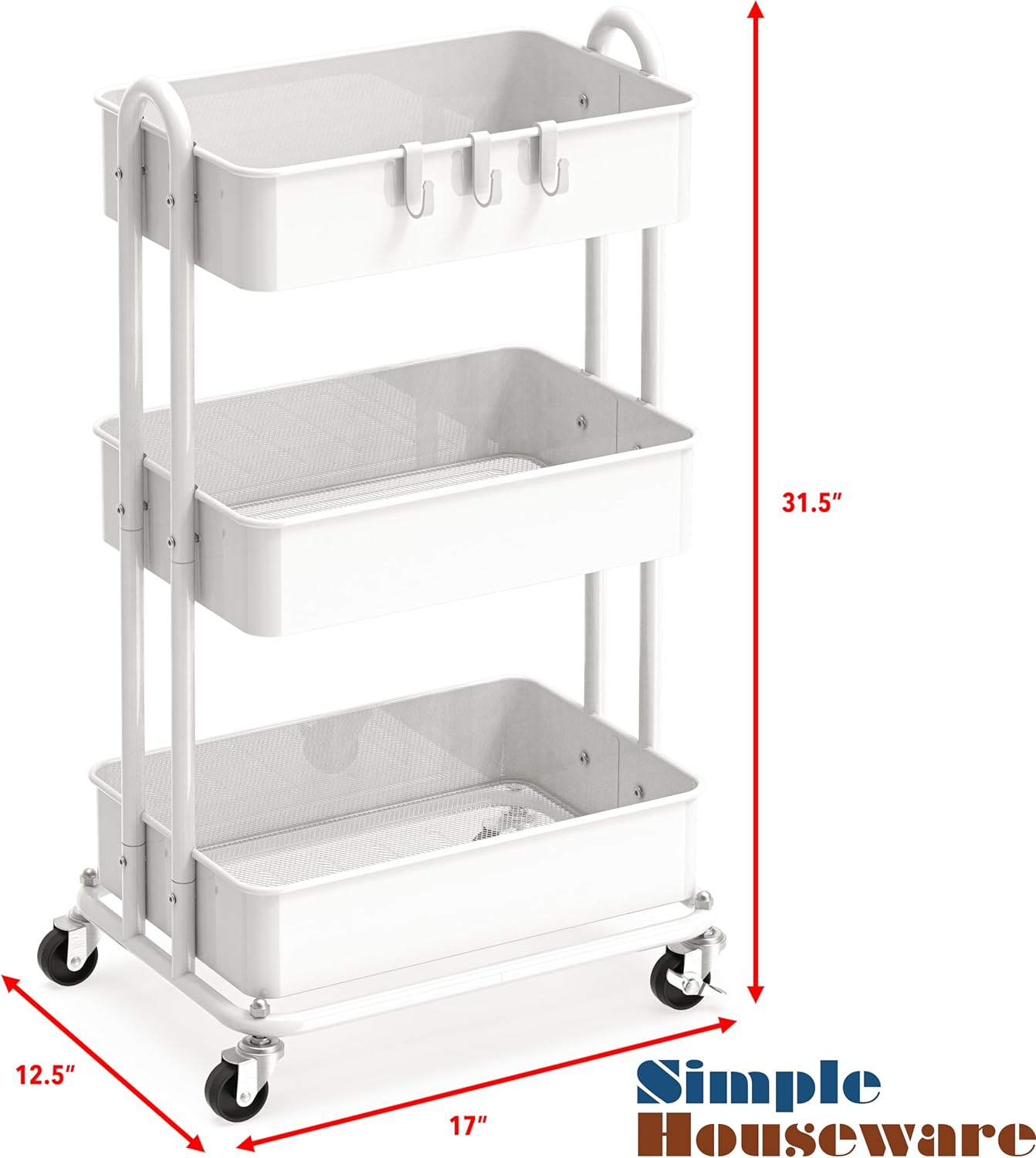
Group 1: Short-term surgical recovery (4–12 weeks). This is the largest group by review volume. Postpartum supply stations, ankle and knee surgery recovery, and post-abdominal surgery mobility all show up repeatedly. Owners in this group report that the Simple Houseware three-tier rolling cart and the Pipishell rolling utility cart earned consistent praise for one specific reason: you can roll the cart directly to wherever you happen to be sitting or lying, rather than making a second trip. Reviewers specifically mention the ability to keep medications, water, snacks, a tablet, a phone charger, and basic wound-care supplies on a single cart that follows them from the bed to the couch to the bathroom doorway. The tradeoff owners name most often: wheel noise on hardwood and LVP (luxury vinyl plank) floors, and handle heights that work well for average-height adults but feel awkward for people under 5’3” or over 6’1”.
Group 2: Chronic home medical management. Owners managing peritoneal dialysis (PD) — a kidney treatment done at home — and home IV infusions represent a smaller but highly specific group who have very different requirements. These reviewers gravitate toward the VEVOR medical trolley and comparable mobile medical trolley designs with lockable drawers, powder-coated steel frames, and silent casters. The pattern in these reviews is consistent: owners report that slow-close drawers matter because they’re often operating with one hand occupied, and silent wheels matter because the cart may move through a bedroom at 6 a.m. Multiple reviewers in this group note that the VEVOR unit “feels as functional as what’s in the clinic” at roughly a quarter of the price of a clinical-grade Medline or Clinton Industries cart — though several also note the drawers don’t seal the same way and wouldn’t be appropriate for sterile supply storage in a regulated setting.
Group 3: Caregiver-purchased for someone else. A notable subset of reviews are written not by patients but by partners, parents, and friends buying for a disabled or mobility-impaired person. One specific example surfaces repeatedly in WORKPRO collapsible cart reviews: a buyer who purchased it for a wheelchair-bound friend living in a studio apartment specifically because it folds flat for storage when not in use and requires no assembly — important when the recipient cannot stand for extended periods to build furniture. This use case drives a completely different set of priorities: fold-flat storage, tool-free setup, and low profile when stowed.
The Tradeoffs Worth Naming Before You Buy
Open-Shelf Wire Carts vs. Drawer-Based Trolleys
The core decision in this category is architecture, not brand. Open-shelf wire carts (the Simple Houseware and Pipishell category) give you immediate visual access to everything on the cart, are easier to wipe down, and typically cost $35–$80. Drawer-based trolleys (the VEVOR category) hide supplies, resist tipping better under heavier loads, and run $120–$250 in the home-grade tier.
By the numbers:
- Open wire cart, 3-tier: typical weight capacity 60–100 lbs total across all shelves; casters 1.5”–2” diameter
- Drawer-based home trolley: typical weight capacity 80–150 lbs; casters 2”–3” diameter; drawer weight rating 15–25 lbs each
- Clinical-grade Medline or Clinton Industries cart: casters 3”–4” diameter; 5-year caster warranty; pricing $400–$900
The honest cost-of-cheap math matters here. A $45 wire cart with 1.5” plastic casters will develop wheel wobble and axle noise within 8–12 months of daily use on hard floors, per patterns documented in long-run owner reviews aggregated by the Wirecutter product review team. If your recovery extends into a chronic caregiving situation — which the review data suggests happens more often than buyers anticipate — the total cost of replacing a $45 cart every year approaches the price of a mid-range trolley that owners report lasting three to five years.
Handle Height: The Underrated Spec
Across every cart in this category, handle height is the complaint that appears most consistently in one-star and two-star reviews, and it’s almost never mentioned in product listings. Most rolling utility carts are built around a handle height of approximately 37”–39”, which works for adults roughly 5’5”–5’10”. Reviewers under 5’3” consistently report that pushing the cart at full-height handle position is awkward enough to cause wrist fatigue. Reviewers over 6’0” describe the same problem in the opposite direction, often reporting lower back discomfort from bending slightly to push.
If the primary user is outside the average-height range, this is worth verifying against the manufacturer spec before purchasing. The VEVOR medical trolley’s spec sheet lists a push bar at approximately 37.4” — functional for most adults but worth checking against your specific user.
Assembly for Someone Who Can’t Stand Long
The WORKPRO collapsible cart’s most-cited advantage in caregiver-purchased reviews is that it arrives nearly fully assembled and requires no tools. For a buyer who is post-surgery or mobility-limited, the difference between “unfold and roll” and “attach 12 caster bolts and three shelf brackets” is not trivial. Several reviewers in this cluster specifically mention that they had to wait for a family member’s next visit to finish assembling a competing cart — a real friction point during recovery.
If assembly ease is the primary purchase driver, the WORKPRO collapsible cart is the recommendation supported most consistently by owner reports. If you need drawer-based storage and can wait for an assist with assembly, the VEVOR trolley reviews note assembly time of approximately 20–30 minutes with a Phillips screwdriver.
The “Cart Outlasts the Recovery” Pattern
One of the most consistent patterns in long-run owner reviews is migration: buyers purchase a cart for a specific recovery period, the recovery ends, and the cart moves permanently into a household role. Kitchen, craft room, and bathroom are the three most common destinations named in follow-up reviews. This is worth factoring into the purchase decision: a cart with steel construction and a neutral finish has a longer post-recovery useful life than a brightly colored plastic unit. Apartment Therapy’s editors, in their 2025 overview of small-space recovery organization, noted the same pattern — that carts purchased for medical use tend to stay in the household because they solve storage problems that predate the recovery.
Frequently Asked Questions
Will the wheels scratch hardwood or LVP floors during daily repositioning?
This depends on caster material, not cart brand. Plastic casters — common on wire utility carts under $60 — are the primary source of both floor scratches and the wheel noise owners complain about. Rubber or polyurethane casters, which appear on the VEVOR and WORKPRO units and on clinical-grade carts, are consistently reported by owners as floor-safe on hardwood and LVP. Healthline’s 2024 overview of post-orthopedic surgery home setup recommends checking caster material specifically if protecting hard flooring is a concern.
How do locking casters actually work — do they hold on carpet as well as hard floors?
Locking casters use a pedal or lever that clamps the wheel to prevent rolling — they do not anchor the cart to the floor. On hard floors, a locked caster holds a cart firmly in place. On low-pile carpet, a locked caster holds almost as well. On thick carpet or area rugs, the cart can still shift slightly because the wheel sits on a compressible surface. For recovery use cases where the cart needs to stay exactly where placed — a dialysis supply station, for example — owners report that hard floors with locked casters are the most reliable setup.
Can a three-tier open wire cart hold IV supply bags and medical equipment without tipping?
The geometry of open wire carts creates a tipping risk if heavy items are placed on the top shelf. Published specs for the Simple Houseware and Pipishell carts rate total capacity at 60–100 lbs, but that load needs to be distributed with the heaviest items on the lower shelf. For IV supply bags specifically, owners managing home infusions report placing the IV pole separately (or using a dedicated IV stand) and using the wire cart for secondary supplies — tubing, alcohol swabs, disposal bags — rather than the primary infusion equipment. Full IV bags on a top wire shelf of a lightweight cart is not a configuration supported by owner reports.
Which carts arrive most assembled for someone who cannot stand for long periods?
Owner reviews are consistent: the WORKPRO collapsible cart requires the least assembly and is reported as usable within minutes of unboxing. The Simple Houseware and Pipishell wire carts require shelf-bracket and caster attachment, typically 15–25 minutes of floor-level work. The VEVOR trolley requires the most assembly of the group — approximately 20–30 minutes — but owners note the result is a substantially sturdier unit. If the buyer cannot perform any floor-level assembly, the WORKPRO collapsible cart is the clearest choice.
Is a drawer-based clinical trolley overkill for a short 6-week recovery versus a chronic daily-use situation?
For a defined 6-week orthopedic recovery with no ongoing medical equipment, a $35–$80 wire utility cart is well-matched to the use case. The NCTRC’s 2024 equipment standards for community-based programs draw a similar line: drawer-based clinical carts are specified for programs where supply security, cleanability to infection-control standards, and long-term daily use all apply simultaneously. None of those conditions typically apply to a 6-week home recovery. The calculus shifts if the recovery is likely to extend, if the user has a chronic condition requiring ongoing supply management, or if the cart will migrate into a long-term caregiving role — in which case the VEVOR trolley’s price-to-durability ratio, as reported by long-run owners, justifies the higher upfront cost.
The Decision Rule
If your recovery is time-bounded (under 12 weeks), you need a cart you can set up alone, and your primary use is bedside supply organization: the Simple Houseware or Pipishell three-tier cart is the right tier. Spend the $35–$65, accept the plastic casters, and plan for the cart to migrate to your kitchen or bathroom after recovery.
If you’re managing a chronic home medical situation — dialysis, home infusions, long-term wound care — or purchasing for a wheelchair user in a small space: step up to the VEVOR trolley for supply security and silent casters, or the WORKPRO collapsible cart if fold-flat storage and no-assembly setup are the overriding priorities. The cost difference is real but the TCO math favors the mid-tier unit within 18 months of daily use.
If your use case extends into institutional or clinical-adjacent territory — a family member in long-term care, an adult day program, or a regulated home health environment — that’s the threshold where clinical-grade carts from Medline or Clinton Industries earn their price premium through caster warranties, infection-control surface ratings, and ADA-compliant handle heights that home-tier products don’t match. The AOTA’s home modification practice guidelines note that for patients with progressive conditions, equipment specified to clinical standards at the outset typically has a lower total cost than sequential upgrades from consumer-grade to clinical-grade over time.
The cart you buy for a six-week recovery may still be in your home six years from now. Buy accordingly.