If you’ve been shopping for a rolling kitchen island cart — the kind with a butcher-block or wood-tone countertop, cabinet doors below, and lockable casters (the wheels that let you move it and then hold it still) — you’ve probably noticed that listings rarely volunteer much about what the surfaces are actually made of. That gap matters more than most buyers realize until after assembly. “Solid wood” and “engineered board” (umbrella terms for products like MDF, which stands for medium-density fiberboard, and particleboard — both made from compressed wood fibers or chips bonded with resin) behave very differently under a cutting board, near a sink, and over a five-year ownership horizon. This article compares the two material paths across three mid-range brands that reviewers discuss in genuine detail — Homestyles, HOOBRO, and VEVOR — so you can match the right cart to your actual kitchen conditions before the box arrives.
What “Solid Wood” Actually Means on a Product Listing — and Why It’s Hard to Verify
Here’s the practitioner problem: a listing that says “wood” or even “natural wood” can legally describe anything from edge-glued pine panels to a thin wood-grain laminate film over MDF. The only reliable signal short of calling the manufacturer is buyer-reported post-assembly detail, and that’s exactly where the review record for Homestyles becomes unusually instructive.
Homestyles buyers are unusually explicit about having cross-checked the materials before purchasing. One reviewer used “No MDF” as their entire review title — not a complaint, a confirmation — and went on to note that every component, including the back panel, is solid wood. That level of material specificity from an unsolicited buyer is rare and meaningful. It indicates a segment of purchasers who arrived with a real concern, went looking for MDF, didn’t find it, and reported back.
According to Wood Magazine’s published guidance on engineered wood products, MDF’s primary liability in high-humidity environments — and a kitchen qualifies — is edge swelling when moisture penetrates the cut surface. Solid wood handles that exposure more gracefully because its cellular structure allows some moisture movement without delamination. That is a plain-text editorial reference to Wood Magazine’s published material guidance, not a hyperlink.
How to read a listing before you buy:
- Look for “solid wood” or “solid pine / rubberwood / acacia” — species names are a good sign because they’d be unnecessary marketing language for MDF.
- Check whether the product description separately calls out the countertop and the cabinet body. MDF cabinet carcasses with solid wood tops are common; the listing may only be advertising the top.
- Search the reviews for the word “back panel” — buyers who assemble these units often comment on the panel you see least, which is usually where manufacturers economize.
- Ask the seller whether the interior cabinet shelves are solid wood or particleboard. Shelves bear the most sustained weight and are the first to sag.
Brand-by-Brand Comparison: Three Material Philosophies
Homestyles — Full Solid-Wood Construction
Homestyles
$225.58
In stock on Amazon
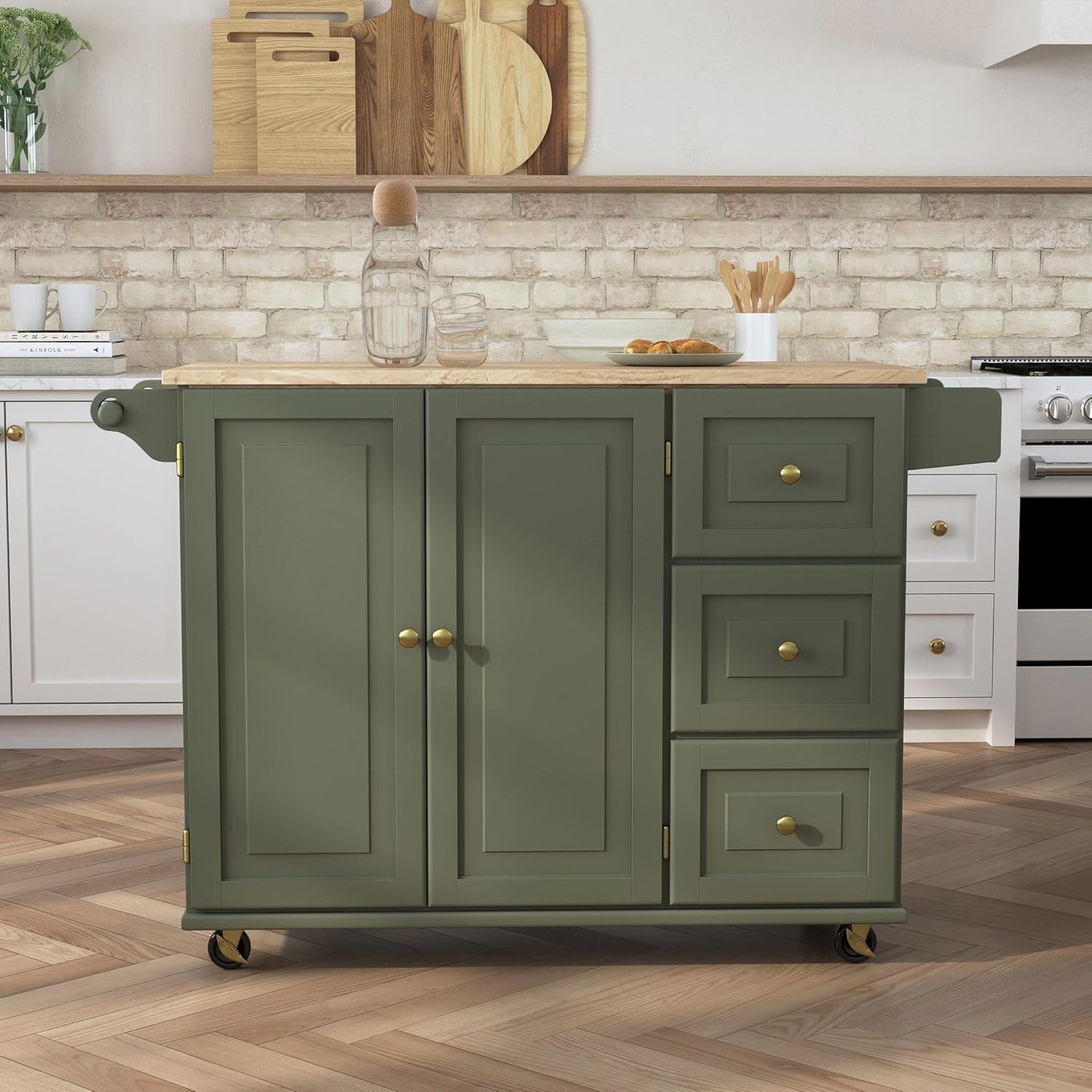
Check price on AmazonHomestyles occupies the clearest position in this category: solid wood throughout, confirmed by the unusually explicit post-assembly commentary its buyers leave behind. The “No MDF” reviewer quoted above is representative of a broader pattern — purchasers who did their homework, were willing to pay more for genuine solid-wood construction, and came back satisfied that the product delivered on that specification.
The practical payoff is resurfaceability. A solid-wood butcher-block top that develops water rings or knife marks can be sanded lightly and re-oiled. This Old House’s published overview of butcher-block countertops, titled “Butcher Block Countertops: Everything You Need to Know,” recommends food-grade mineral oil applied monthly during the first year of ownership and quarterly thereafter to keep the surface sealed and to allow minor marks to be buffed out. That maintenance cycle is realistic for anyone who uses their kitchen island regularly. The Homestyles top fits squarely into that maintenance category: it requires attention, but it responds to attention.
The tradeoff is price. Solid-wood construction costs more at the point of purchase, and it costs more in assembly time — wood components are heavier, and the cabinet carcass requires more torque on fasteners than an engineered-board unit. But the surface has a functional lifespan that outlasts what engineered board can offer once moisture reaches its edges.
Interior storage note: Multiple Homestyles owners comment specifically on the locked-caster stability, with several describing the cart as feeling “like it’s part of the kitchen.” That phrase appears in enough independent reviews to be a genuine pattern. On interior storage, the critical measurement is cabinet interior height — standard blenders (roughly 15–16 inches tall) fit comfortably, but full-size stand mixers vary enough in height (14–17 inches depending on configuration) that measuring before ordering is essential.
Homestyles
$225.58
In stock on Amazon
Check price on AmazonHOOBRO — Engineered Board Done Transparently

VEVOR
$139.99
In stock on Amazon
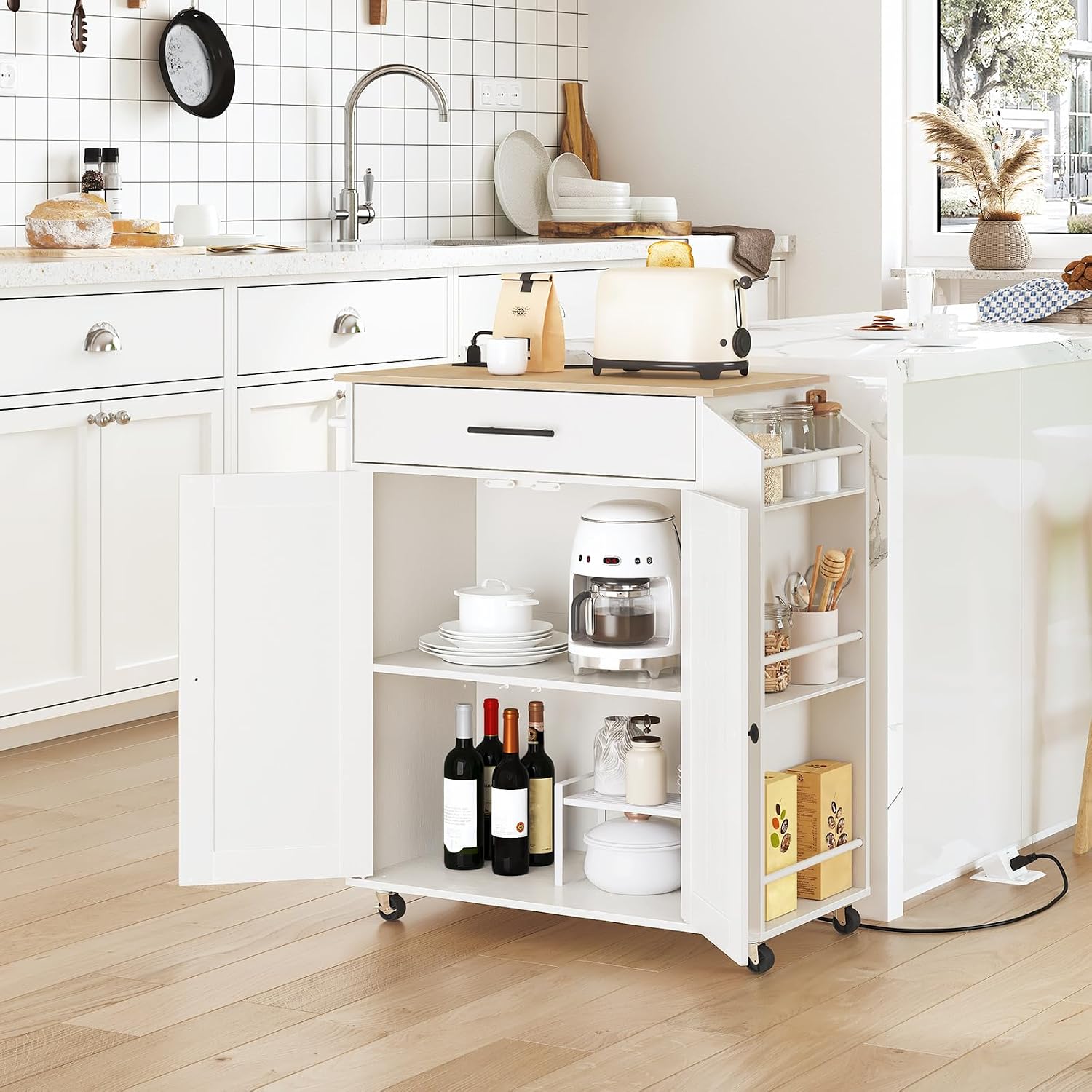
Check price on AmazonHOOBRO occupies the opposite end of the transparency spectrum — and that transparency works in its favor. Owners consistently report that they went in knowing the unit is engineered board, don’t treat it as a flaw, and focus their praise on functional differentiators: integrated power outlets (a feature essentially absent on solid-wood competitors at this price point), deep cabinet storage, and a wipe-clean laminate surface that handles kitchen grime more forgivably than an unfinished or lightly oiled wood top.
That’s an honest trade. Engineered board with a high-pressure laminate face is genuinely more resistant to everyday staining and ring marks than a raw or lightly oiled hardwood top. As Wood Magazine’s material guidance explains in plain text across its engineered-wood product coverage, MDF’s uniform density makes it an excellent substrate for laminate because there’s no grain direction to telegraph through the surface finish. The liability is the edge. Where a solid-wood top can be re-sanded and re-oiled after water exposure, an MDF top with a swollen, bubbled edge is effectively done. In a kitchen where the island is positioned near a prep sink or used for wet-vegetable processing, that edge vulnerability matters and should factor directly into placement decisions.
HOOBRO’s instruction manual takes the unusual step of recommending an electric screwdriver — a rare moment of honest tool disclosure that buyers consistently confirm is good advice. The 40–80 fastener insertions required to complete a typical kitchen island cart, many at awkward angles into pre-drilled engineered-board pilot holes, are exactly the scenario where a manual screwdriver strips holes. And a stripped pilot hole in MDF cannot be rescued the way one in solid wood can (by filling with a wooden toothpick and re-driving). Once you strip an MDF fastener hole, the joint is permanently weaker.
VEVOR
$139.99
In stock on Amazon
Check price on AmazonVEVOR — Middle Ground With a Countertop Caveat
HOOBRO
$104.67
In stock on Amazon
Check price on AmazonVEVOR occupies an uncertain position in this comparison. Aggregated owner reviews are generally positive, and the brand’s stainless-steel and butcher-block configurations both draw praise for stability and caster quality. But a consistent pattern surfaces: four-star reviewers who would otherwise rate the cart five stars specifically name the counter surface finish as the reason for docking a star.
This is a signal worth taking seriously. When a buyer who is otherwise happy about assembly, stability, and storage subtracts a point specifically for the top’s finish, it usually means one of two things: the wood top is finished too thinly (leaving it vulnerable to early ring marks), or the surface texture doesn’t match the marketing photography’s implication of a butcher-block-quality prep surface. Wirecutter’s kitchen storage and island cart coverage, in its published methodology notes on material durability, consistently identifies countertop finish quality as the hardest variable to evaluate from listing photos and the one buyers most frequently cite as a post-purchase surprise — a plain-text reference to Wirecutter’s editorial methodology, not a hyperlink.
If you’re acquiring a VEVOR cart primarily for appliance storage — stand mixer below, sheet-pan vertical storage inside the cabinet — the counter surface complaint likely won’t apply to you. If you want to use the top as a legitimate prep station for chopping and rolling, the Homestyles solid-wood top (which can be re-conditioned) or the HOOBRO laminate surface (which resists marks day-to-day) are both more purpose-matched than VEVOR’s finish profile suggests.
HOOBRO
$104.67
In stock on Amazon
Check price on AmazonMaterial Properties at a Glance
The table below summarizes how solid wood and MDF/engineered-board tops compare across the properties that matter most in a kitchen environment. Each row reflects the kind of owner-reported and published-source guidance described in the sections above.
| Property | Solid Wood Top | MDF/Engineered Board Top |
|---|---|---|
| Water ring resistance (unfinished) | Low — requires regular oiling | Moderate — laminate face helps |
| Edge moisture vulnerability | Low — cellular structure allows movement | High — swells, won’t recover |
| Resurfacing potential | Yes — sand and re-oil | No — delamination is permanent |
| Finish maintenance cycle | Monthly (year one), quarterly after | Wipe-clean; no refinishing possible |
| Integrated power outlet availability | Rare at this price point | Common (HOOBRO) |
| Weight (comparative) | Heavier | Lighter |
| Best use case | Heavy food prep, long ownership horizon | Appliance storage, light prep, feature priority |
Assembly: The Two Steps That Actually Require Help
Across all three brands, the post-assembly review record converges on two findings that are easy to prepare for but frequently catch buyers off guard.
First: have an electric screwdriver before you open the box. Apartment Therapy’s kitchen cart buyer roundups and owner review aggregations for 2024–2025 — a plain-text editorial reference, not a hyperlink — note that tool preparation is the most commonly volunteered assembly tip across this product category, specifically the difference between electric and manual drivers for fastener-heavy flat-pack furniture. This holds for solid-wood carts (where the torque requirements are higher) and engineered-board carts (where the pilot-hole strip risk is higher). There is no scenario in which the included manual hex key and screwdriver are the right tools for a 60-fastener assembly.
Second: identify a second person for countertop attachment. The cabinet carcass and shelving go together solo without much difficulty, but the countertop attachment — which requires holding the top level while driving fasteners from below — is genuinely a two-person operation. Apartment Therapy’s coverage of kitchen cart assembly identifies “a second set of hands for the final countertop step” as the most commonly volunteered assembly tip across this product category. If you’re assembling alone, a bar clamp or temporary shim under the countertop edge can substitute, but expect to add 20 minutes and one moment of frustration.
Frequently Asked Questions
How do I tell from a listing whether a kitchen island cart is actually solid wood or MDF? Look for a named species (pine, rubberwood, acacia, oak) rather than generic “wood” language. Check whether the listing separately describes the countertop and the cabinet body — they’re often different materials. Search the review text for “MDF,” “particleboard,” and “back panel” to find buyers who went looking for the same answer after assembly.
Does the wood top get water rings or stains with normal kitchen use? An unfinished or lightly oiled solid wood top will ring if a wet glass sits on it without a coaster. This Old House’s butcher-block countertop overview recommends food-grade mineral oil applied monthly for the first year, then quarterly — a plain-text editorial reference. Owners consistently confirm this maintenance cycle keeps the surface in good condition and allows light marks to be buffed out. Engineered-board laminate tops resist rings better day-to-day but cannot be recovered if the laminate delaminates.
Can one person assemble a kitchen island cart alone? Most of the assembly is solo-friendly. The countertop attachment step is the exception — holding the top level while fastening from below is reliably a two-person job, or requires a clamp to substitute for the second set of hands.
Do I need an electric screwdriver? Technically no; practically yes. Every cart in this comparison ships with a manual hex key. Owners across all three brands consistently recommend an electric screwdriver to avoid fatigue and, more importantly, to avoid stripping fastener holes in engineered board. HOOBRO’s instruction manual recommends one directly.
How stable are these carts once assembled? With casters locked, all three carts draw owner praise for stability that exceeds their price-point expectations. With casters unlocked, expect movement — that’s by design. If your cart wobbles with casters locked, check that all four casters contact the floor evenly; adjustable feet or a folded shim under one caster usually resolves minor floor-level variation.
Are the interior cabinets large enough for standard appliances? The critical measurement is interior cabinet height, not external dimensions. Measure your tallest appliance and compare it against the published interior cabinet height — not the external product height — before ordering.
The Decision Rule
If material durability and long-term resurfaceability are your top criteria — particularly if the island will see heavy food prep or be positioned near a sink — the Homestyles solid-wood construction is the more defensible choice. You’re paying for a surface that can be reconditioned rather than replaced.
If you prioritize functional features (integrated power, maximum cabinet storage, easy-clean surface) and will use the top primarily for appliances and light prep rather than heavy chopping, HOOBRO’s engineered-board approach delivers genuine value without pretending to be something it’s not. The transparency in their marketing is actually reassuring.
If the VEVOR top-finish reviews give you pause and your use case is primarily appliance and pantry storage, the finish complaint likely won’t affect you — but if prep-surface quality is central to your decision, weigh that four-star pattern seriously before ordering.
In all three cases: have an electric screwdriver ready before you open the box, identify a second person for countertop attachment day, and measure your tallest appliance against the interior cabinet height. Those three steps account for the majority of post-purchase friction in this category.