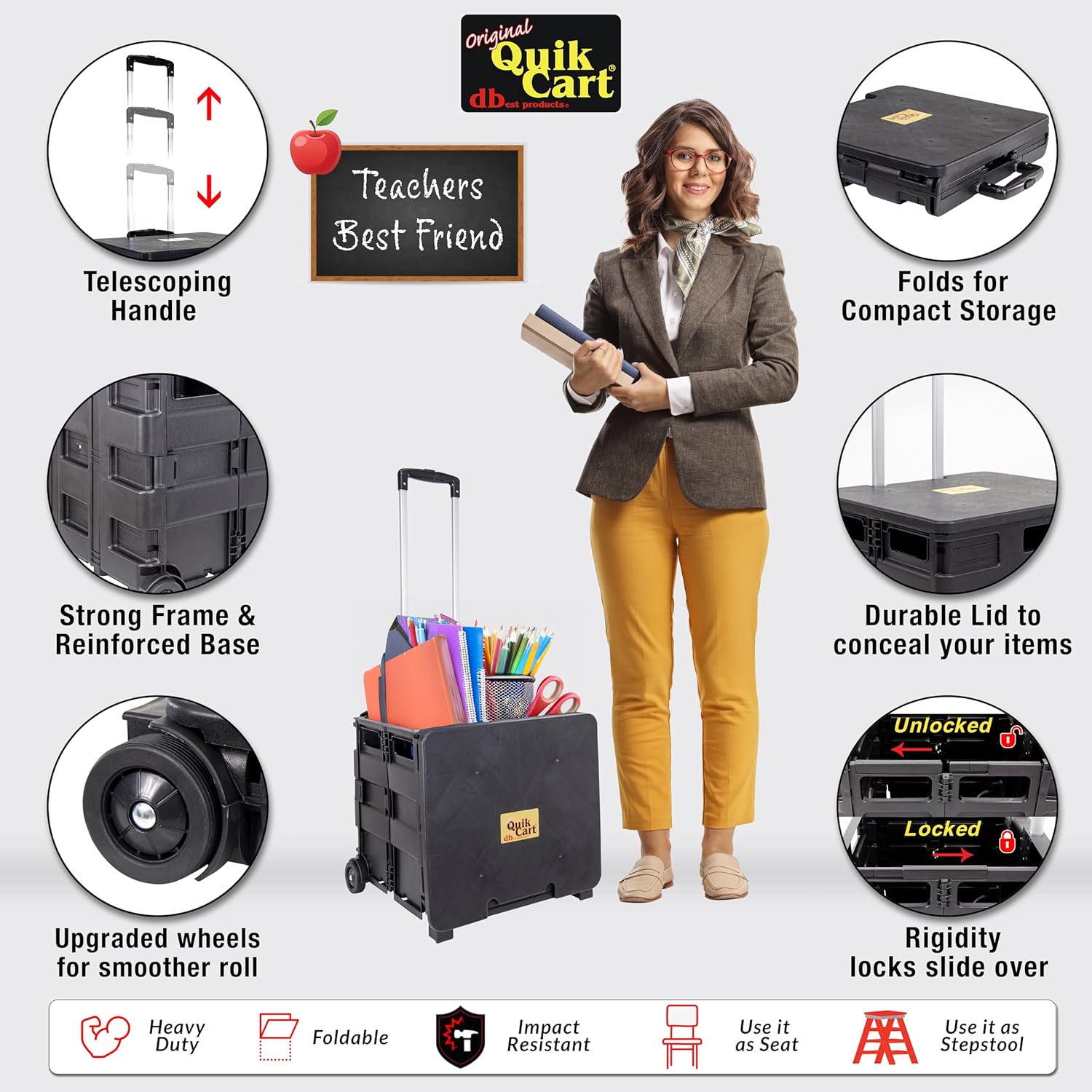
If you’ve ever watched a teacher navigate a hallway with one hand on a cart and the other on a canvas bag that’s slowly separating at the seam, you already know what this article is about. A rolling cart — meaning any wheeled storage unit small enough to maneuver through a standard 36-inch doorway — is one of those purchases that sounds simple until you’ve bought the wrong one twice. The difference between a cart that earns its spot in your room and one that becomes a garage-sale fixture comes down to a handful of specs most product pages bury: caster (wheel) diameter, weight capacity, shelf clearance, and how the thing behaves on floor transitions like tile-to-carpet. This guide walks through the honest tradeoffs at each price tier, names specific models worth considering, and ends with a clear decision rule so you can stop second-guessing and place the order.
Why “Any Cart Will Do” Is the Most Expensive Assumption You Can Make
Let’s start with the math that doesn’t appear on the product listing.
By the numbers — the real cost of a budget cart:
- Average price of an entry-level $45–$60 plastic cart: $52
- Estimated replacement cycle when used daily in a classroom: 14–18 months (based on aggregated owner reviews across major retail platforms)
- Average price of a mid-range metal utility cart ($120–$160) with a 3-year caster warranty: $138
- Replacement cycle cited by owners in long-run reviews: 5–7 years
Over a seven-year window, two budget carts plus freight on the second one runs you roughly $120–$130. One mid-range cart costs $138 once. The total cost of ownership (TCO — what you actually spend across the life of the purchase, not just the sticker price) favors the better cart by year two.
The failure point on cheap classroom carts is almost always the casters — the swiveling wheel assemblies at the base. On plastic-body carts under $60, casters are typically rated for static loads (meaning weight sitting still), not dynamic loads (meaning weight shifting as you push the cart around a corner or over a threshold). Once a caster fails, the cart lists to one side, drawers bind, and the whole unit becomes a trip hazard. This isn’t speculation: Wirecutter’s 2025 review desk noted that caster failure is the leading complaint across budget utility cart categories, appearing in a disproportionate share of one- and two-star owner reviews.
The Three-Tier Framework: Matching Cart to Workflow
Tier 1: The Floating Teacher and the Sub-Cart Problem ($40–$90)
If you’re a specials teacher — art, music, PE — or a resource room teacher who travels between classrooms, you face a different problem than a homeroom teacher. Your cart isn’t parked; it’s moving. That changes everything about what you should prioritize.
At this price point, the Origami folding utility cart (the three-shelf steel wire version) is the model most consistently recommended in the teacher-buying community, and for a specific reason: it folds flat to about 4 inches when empty, which means it fits in a closet, a car trunk, or a shared storage room without claiming permanent real estate. Spec sheets put the load rating at 150 lbs per shelf for the steel version. Owners in long-run reviews note that the wire shelving works against them for small items — paint bottles, glue sticks, and manipulatives (small hands-on learning tools like cubes or tiles) fall through the grid unless you add a shelf liner, which runs another $8–$12 and is worth every cent.
The Flash Furniture three-shelf mobile utility cart in the $55–$75 range is the other name that appears consistently at this tier. Published specs show a 110-lb total load rating and 3-inch casters. Three-inch casters are the minimum functional diameter for classroom use — anything smaller struggles on the seam between tile and carpet. Flash Furniture’s caster warranty at this tier is 1 year, which tracks with what owners report: casters are the first thing to show wear around the 12–18 month mark under daily use.
Decision rule for Tier 1: If you move between rooms more than twice a day, the Origami’s fold-flat design justifies the slight premium over the Flash Furniture. If you park in one room and pull supplies occasionally, either works — go with whichever is in stock, and budget $10 for a shelf liner.
Tier 2: The Dedicated Classroom Cart ($90–$180)
This is the most contested tier, because it’s where budget and mid-range genuinely overlap and the differences aren’t always obvious from spec sheets alone.
The Offex three-tier rolling storage cart and the Flash Furniture commercial-grade series both land in the $120–$160 range with meaningfully better caster specs than their entry-level siblings. At this price, look for:
- 4-inch casters (standard 4-inch diameter handles tile-to-low-pile carpet transitions without catching)
- Caster warranty of at least 2 years — 3 years is better
- Total load rating of 200 lbs or more — this matters if you’re carrying reams of paper, project boards, or a document camera
- Locking casters on at least two wheels — so the cart stays put when you’re working from it
The Apartment Therapy buying team’s 2024 roundup of rolling carts for shared spaces flagged one underappreciated spec: shelf-to-floor clearance on the bottom shelf. A cart where the lowest shelf sits less than 4 inches off the ground is nearly impossible to clean under, and in a classroom with 25 students and craft supplies, that gap collects debris fast. Look for at least 6 inches of clearance under the bottom shelf.
One honest tradeoff at this tier: most carts in the $120–$160 range arrive via freight or oversized shipping, which can add $20–$45 to the effective purchase price if you’re buying through a consumer channel. Institutional buyers going through a school district purchasing agreement or a cooperative purchasing contract (a pre-negotiated group discount arrangement for public entities) often avoid this surcharge — worth checking before you order personally.
Tier 3: The Cart as Infrastructure ($180–$400 and the case for going institutional)
Most classroom teachers won’t spend $300 on a cart. But if you’re a makerspace coordinator, a library media specialist, or a teacher who received a DonorsChoose grant — the crowdfunding platform that funds public school classroom projects — the math changes.
At $200–$350, you’re crossing into carts built to commercial-grade standards: welded steel frames rather than bolt-together assemblies, 5-inch polyurethane casters (polyurethane wheels are quieter on hard floors and don’t leave black scuff marks), and load ratings of 400–600 lbs. Brands like Medline and the lower end of the Diversified Woodcrafts catalog enter the picture here, though their primary market is clinical and therapeutic recreation settings rather than classrooms.
For a makerspace specifically, the relevant spec is drawer or bin organization rather than open shelving — because loose fasteners, electronic components, and craft tools need containment. At this tier, look for carts with at least two locking drawers and a pegboard or tool-rail panel option.
The ADA Standards for Accessible Design (U.S. General Services Administration, Section 4.2) specify that a compliant work surface reaches no higher than 34 inches from the floor and that an unobstructed forward approach requires at least 30 inches of clear floor space. If your cart will serve as a shared work surface for students of varying abilities or in an inclusion classroom, these numbers matter for how you spec the top shelf height.
The Tote Bag Half of the Equation
A rolling cart handles the room-to-room haul, but most teachers also carry a daily bag — the thing that goes from car to building to classroom and back. This is where the decision framework is simpler, but the failure mode is even more common.
The core spec problem: most teacher tote bags on the market are sized for a 13-inch laptop and a few folders, but teachers routinely carry a 15-inch laptop or a tablet plus a charging brick, grade books, and a full water bottle. A bag sized for 13 inches that’s being asked to carry 15 inches distorts at the zipper and fails at the strap attachment point within a year.
Look for:
- Reinforced shoulder strap attachment (bar-tack stitching) — this is the single most important durability indicator
- Laptop compartment rated for 15.6 inches — the common standard for school-issued devices
- Padded spine panel — reduces fatigue on the 10–15 minutes of daily carry most teachers log
Owners in long-run reviews consistently report that bags with padded trolley sleeves (a panel on the back that slides over a rolling luggage handle) are meaningfully better for teachers who park a rolling suitcase or cart at the building entrance and carry the bag the rest of the way. It sounds like a minor feature; owners report it changes the ergonomics of their entire morning.
If X, Then Y: Your Decision Rules
| Your situation | The call |
|---|---|
| You travel between rooms 2+ times daily | Origami folding cart + a 15.6-inch tote with trolley sleeve |
| You’re a homeroom teacher, one classroom, shared storage | Flash Furniture or Offex at $120–$160, prioritize 4-inch casters and 2-year warranty |
| You have a DonorsChoose grant of $250+ | Go commercial-grade (welded frame, 5-inch casters, locking drawers) — the TCO math is clear |
| Your classroom includes students with mobility considerations | Check ADA surface height (34-inch max) before ordering any cart that doubles as a work surface |
| You’re buying for a makerspace or maker cart program | Prioritize drawer containment and load rating over shelf count |
The through-line: the cart that earns its place is the one you spec for your actual workflow, not the one that looks good in the product photo. Start with how many times it moves per day, then size the casters, then check the warranty, then look at the price. In that order, the right choice usually becomes obvious — and it’s rarely the cheapest option on page one of the search results.