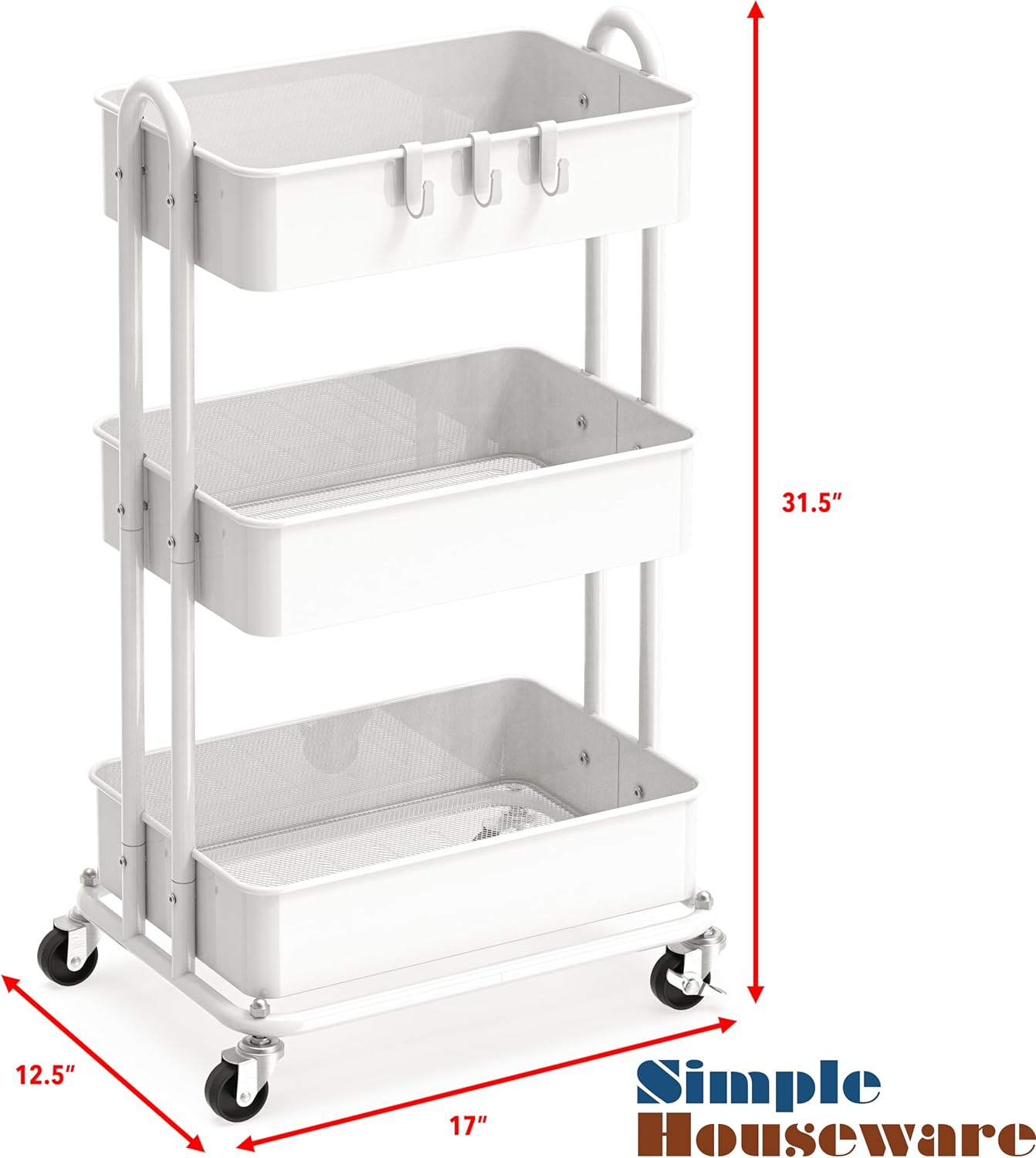
A three-tier rolling cart — a freestanding metal shelving unit on wheels, typically with three basket-style shelves stacked vertically — has become a staple in classrooms, craft rooms, kitchens, and clinics alike. The appeal is obvious: you get vertical storage that moves. In the $20–$45 price band, dozens of nearly identical-looking carts compete on color and shelf count while hiding meaningful differences in how long they’ll actually hold up. If you’re buying one cart for your home studio, the stakes are manageable. If you’re sourcing six to ten units for an art room rotation, a makerspace, or a senior activity program, the hidden trade-offs start adding up fast. This guide breaks down what separates a cart that lasts two years from one that lasts six months — and gives you a clear decision framework before you commit.
| EDITOR'S PICK[Simple Houseware 3-Tier Heavy D…](https://www.amazon.com/dp/B07V49ZP66?tag=greenflower20-20) | Mid-tier[Amazon Basics 3-Tier Rolling Ut…](https://www.amazon.com/dp/B07TY1RFH5?tag=greenflower20-20) | Budget pick[Pipishell 3 Tier Rolling Cart](https://www.amazon.com/dp/B08GS9T78W?tag=greenflower20-20) | |
|---|---|---|---|
| Lockable wheels | — | ✓ | — |
| Handle | — | — | ✓ |
| Material | Metal | — | Metal |
| Use cases | — | Multifunctional | Nursery, living room, painting, office, kitchen |
| Price | $37.97 | $34.77 | $26.99 |
| See on Amazon → | See on Amazon → | See on Amazon → |
The Spec Sheet Is Doing More Work Than You Think
At first glance, most budget rolling carts in this range share a profile: powder-coated (baked-on paint over bare steel) tubular steel frame, three mesh or flat wire shelves, and four swivel casters (the rolling wheels at the base — two of which typically lock). The frame diameter and the steel gauge (the thickness of the metal, where a lower number means thicker, stronger steel) are the two specs that determine almost everything about longevity and wobble resistance.
Most carts in this price range are built from 0.7 mm to 1.2 mm steel tubing. That half-millimeter difference is small on paper and significant in use. Apartment Therapy’s rolling cart roundup noted that carts with thinner frames — generally the sub-$25 options — show visible flex under loads of 20 lbs or more per shelf, which matters when you’re stacking paint bottles, binders, or craft supplies. The manufacturer-rated per-shelf capacity on budget carts typically ranges from 15 to 22 lbs, but that number reflects static load (something sitting still), not dynamic load (someone pulling the cart by one shelf corner, or rolling it over a door threshold).
By the numbers — typical budget rolling cart specs in 2026:
| Price tier | Frame steel gauge | Rated capacity (per shelf) | Caster diameter | Caster warranty |
|---|---|---|---|---|
| $20–$28 | 0.7–0.8 mm | 15–18 lbs | 1.5–2 in | None stated |
| $29–$36 | 0.9–1.0 mm | 18–20 lbs | 2 in | 30–90 days |
| $37–$45 | 1.0–1.2 mm | 20–22 lbs | 2–2.5 in | 90 days–1 year |
Those caster diameter numbers matter more than most buyers realize. A 1.5-inch caster rolls smoothly on polished concrete or sealed tile. On textured vinyl flooring, carpet runners, or the lip of a mat, it stutters — and that’s where frames take the most abuse from users pushing harder to get the cart moving.
Where the Money Actually Goes (and Doesn’t)
The biggest variable in this price band isn’t the shelves — it’s the casters and the connection hardware.
Casters. Wirecutter’s utility cart buying guide identifies caster failure as the primary reason budget carts get replaced within 12–18 months of regular use. Swivel casters in the sub-$30 range typically use a plain-bearing (unlubricated metal-on-metal) swivel ring. These work fine under light loads but develop wobble and drag as the ring wears. Carts in the $37–$45 range increasingly use ball-bearing swivel rings — a small roller bearing inside the swivel mechanism — which rotate more smoothly under load and hold up longer. If the product listing doesn’t specify ball-bearing casters, assume plain-bearing.
Frame connection method. Budget carts assemble via one of two systems: snap-lock connectors (plastic clips that press into pre-drilled holes) or screw-and-nut connectors (a metal bolt that passes through the frame and tightens with a wing nut or Allen bolt). Snap-lock assemblies go together in under ten minutes with no tools, which is genuinely useful when you’re setting up 10 units on a Friday afternoon. But owners consistently report that snap-lock connectors on the lowest-cost carts loosen after several months of regular rolling and loading, especially at the shelf-to-upright joints. Screw-and-nut assembly adds five minutes per cart but produces a noticeably more rigid frame.
Powder coat vs. bare steel risk. Consumer Reports’ small storage product guidance notes that powder coating quality varies significantly even within similar price tiers — the critical variable is whether the steel was properly cleaned (phosphate-washed) before coating, which you can’t assess from a photo. Chips and scratches in a low-quality powder coat on steel shelving will rust, particularly in humid classrooms, activity rooms, or kitchens. If your environment has any moisture exposure, look for carts described as using a “rust-resistant” or “galvanized” steel base before the powder coat is applied. This information is sometimes buried in the Q&A sections of product listings rather than the main description.
The Real Comparison: Five Decision Scenarios
Let’s be direct about where each price tier actually fits, because the honest answer is that the right cart depends on your use case, not on getting the “best” cart.
Scenario 1: You’re buying one cart for a home craft room with light, irregular use. The $20–$28 tier is likely fine. You’re probably not rolling it more than a few times a week, and you control the load. The wobble and caster wear that matter in institutional settings are largely irrelevant at this volume. Our read of aggregated owner reviews shows that buyers who use these carts in low-traffic home settings report satisfaction rates that hold up through at least 18–24 months.
Scenario 2: You’re buying two to four carts for a classroom activity rotation that moves daily. Jump to the $37–$45 range and look specifically for ball-bearing casters and screw-and-nut assembly. The delta in upfront cost is $50–$80 across four units. Based on the caster failure patterns documented in Wirecutter’s utility cart guide, the lower-tier units in daily classroom use typically require replacement or repair within 12–18 months — which erases the upfront savings and creates a procurement headache mid-year.
Scenario 3: You’re outfitting a makerspace or art room with five to ten carts on a DonorsChoose or school budget grant. This is where the TCO (total cost of ownership — the real price including replacements, not just sticker price) math is most punishing. Five carts at $24 each = $120. Five carts at $42 each = $210. If the $24 carts need replacement at 14 months and the $42 carts run 36 months in similar conditions, the $42 carts cost $70 per year of service vs. $102 per year for the budget tier — at identical function. For grant-funded purchases specifically, budget this way: grants cover the purchase, but your labor time (and your program’s credibility) absorbs the replacement friction.
Scenario 4: You need carts in a clinical or memory-care setting. Stop here. The $20–$45 tier is not appropriate for clinical activity programming, dementia care stations, or any setting with infection-control requirements. The open wire shelves trap particulates and are not sanitizable to clinical standards. The frame materials are not rated for chemical disinfectant exposure. Carts for those environments start around $400 (Clinton Industries, Hausmann, Medline) and are covered separately in our clinical cart guides. This section exists specifically to save you from a purchasing mistake that several activity directors have made when a budget constraint pushed them toward retail carts in a clinical context.
Scenario 5: You’re a design-conscious buyer who wants the cart to look good in a visible space. This tier delivers reasonably well on aesthetics — the color range from most major budget brands has expanded significantly since 2023, with matte black, blush pink, sage green, and white all readily available. This Old House’s workshop cart feature notes that for visible workshop or studio storage, the main aesthetic failure mode isn’t the color — it’s shelf sag from overloading, which makes even a new-looking cart look cheap within months. Load each shelf to no more than 70% of its rated capacity if appearance matters.
Five Questions to Ask Before You Click “Add to Cart”
Because product listings at this price tier are inconsistently detailed, here’s a pre-purchase checklist calibrated to the specs that actually predict performance:
- Are the casters ball-bearing or plain-bearing? If the listing doesn’t say, assume plain-bearing.
- What is the frame tubing diameter and gauge? Look for 1.0 mm or thicker. Anything described only as “sturdy” without a number is a flag.
- What is the assembly method — snap-lock or screw hardware? If the listing says “tool-free assembly,” it’s snap-lock.
- Is there any warranty, and what does it cover? At minimum, a 90-day parts warranty suggests the manufacturer has some confidence in the casters and connectors.
- What is the weight rating per shelf, and does the listing distinguish static vs. dynamic load? Most listings only give static ratings; treat them as a ceiling, not a working target.
The Decision Rule
If the framing above has been useful, here’s the compressed version:
If you’re buying one or two carts for low-frequency home or personal studio use: the $20–$28 tier is defensible — buy based on color and shelf spacing, not specs.
If you’re buying three or more carts for daily classroom, makerspace, or activity-room use: the $37–$45 tier with ball-bearing casters and screw assembly is the minimum threshold. The math on replacement frequency makes the upgrade cost-neutral within 18 months and ahead after that.
If you’re buying for any clinical, memory-care, or infection-controlled setting: this entire price band is the wrong category. Redirect the budget conversation toward clinical-grade carts and document why — your facility’s infection-control policy likely makes this non-discretionary anyway.
The $20–$45 rolling cart is a genuinely useful tool in the right context. The frustration most buyers feel after six months comes not from the category failing them, but from applying a light-duty product to a medium-duty problem. Match the tier to the use case, check the five questions above, and the cart you buy will earn its space.